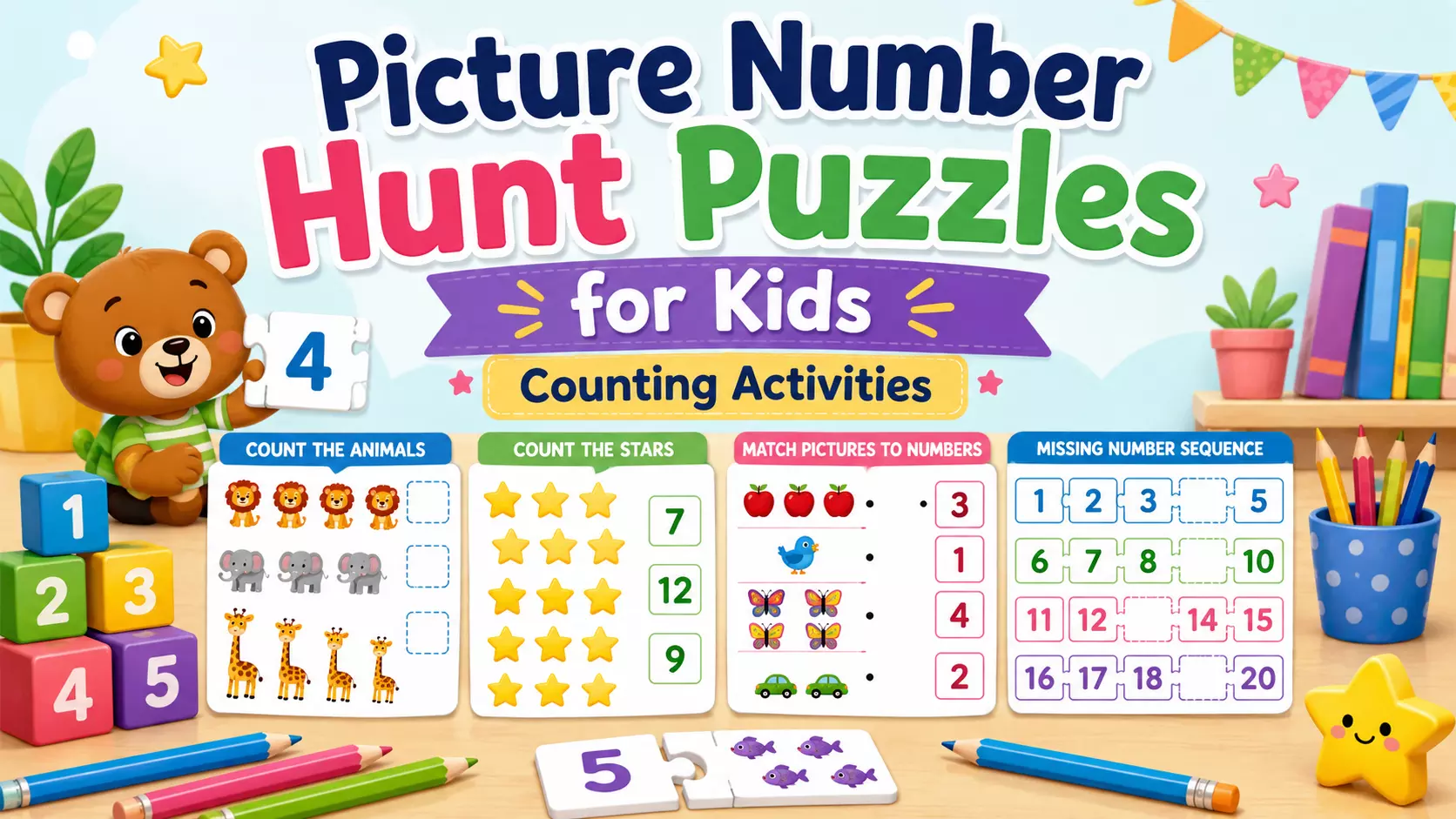
Picture Number Hunt Puzzles for Kids | Counting Activities
Learning numbers does not always have to begin with memorising a page of digits. For many young learners, counting becomes easier to understand when numbers are connected to familiar pictures, colourful objects, animals, food, or playful scenes.
This is where Number Hunt Puzzles for Kids can be useful. These visual activities invite children to count objects, recognise numbers, complete simple sequences, and match pictures with the correct answer. Instead of treating mathematics as a repetitive lesson, they turn early number practice into an activity children can explore at their own pace.
Picture-based puzzles can be used at home, in preschool, during classroom warm-ups, or as a short break between longer learning sessions. They are simple to begin, but they still encourage children to observe carefully before choosing an answer.
What Are Picture Number Hunt Puzzles?
Picture number hunts are visual challenges built around numbers and illustrated objects. A puzzle might show a group of animals and ask the child to count them. Another activity may include a number sequence with one value missing. Some puzzles ask children to connect a group of pictures with the correct number.
Common activities include:
- Counting animals, cookies, stars, balloons, or other objects
- Finding the missing number in a sequence
- Matching pictures with number choices
- Comparing two groups of objects
- Recognising numbers in colourful scenes
- Counting objects arranged in rows or mixed patterns
The pictures make each task feel approachable, while the number question gives the activity a clear learning purpose.
Children and parents looking for a varied collection can explore these Number Hunt Puzzles for Kids, which include visual counting cards, animal worksheets, number-matching activities, missing-number challenges, and themed picture puzzles.
Why Visual Counting Activities Appeal to Children
Young children often respond well to activities that give them something interesting to look at. A plain row of numbers may feel abstract, while a group of turtles, stars, cookies, or farm animals gives the child a clear object to count.
The image creates a simple connection between the number and its quantity. For example, the number six is no longer only a written symbol. It becomes six horses, six stars, or six gingerbread cookies.
This approach can make counting games for kids feel less like formal practice and more like a small challenge. The child is not only asked to remember a number. They need to look, count, compare, and decide.
The changing themes can also keep the activity fresh. One card may use a forest scene, while the next presents a space background or a farm setting. The counting skill remains the same, but the visual context changes.
Skills Children Can Practise Through Number Hunts
Number hunt activities can support several early-learning skills when they are used at an appropriate difficulty level.
Number Recognition
Children become familiar with the appearance and order of numbers. Seeing the same number in different cards and layouts can help them recognise it outside a fixed worksheet format.
One-to-One Counting
When children point to or mentally track each object, they practise counting every item once. This is especially useful when pictures are arranged in uneven groups rather than simple rows.
Visual Attention
Some picture number puzzles place objects near the edge of the card or inside a busy scene. Children need to scan the full image instead of focusing only on the centre.
Number Order
Missing-number activities encourage learners to follow a sequence and identify where a gap appears. Beginners may work with numbers from 1 to 10, while more confident children can move to longer sequences.
Comparison
When two groups look similar, children must compare them carefully. One extra object can change the answer, so guessing from the overall shape of the group may not work.
Explaining an Answer
A puzzle becomes more valuable when children explain how they solved it. A parent or teacher can ask, “How did you count them?” or “What number comes before the empty space?” This helps reveal whether the answer came from careful reasoning or a quick guess.
How to Use a Number Puzzle Worksheet for Kids
A Number Puzzle Worksheet for Kids should match the learner’s current ability. An activity that is too easy may not hold attention, while one that is too difficult can create unnecessary frustration.
Start with puzzles that contain fewer objects and clearly separated pictures. Once the child becomes comfortable, introduce cards with more objects, mixed arrangements, or slightly busier backgrounds.
A simple activity routine can follow these steps:
- Let the child look at the complete picture.
- Ask what they think the task is asking.
- Encourage them to count slowly.
- Suggest pointing to each object when necessary.
- Ask them to check the answer a second time.
- Let them explain how they reached the result.
Avoid immediately correcting every mistake. First, invite the child to look again. A prompt such as “Can you check the objects near the corner?” is often more helpful than giving the answer directly.
Easy Ways to Make Number Hunt Games More Engaging
The same puzzle can be used in several ways, depending on the child’s age and attention span.
Turn It Into a Friendly Challenge
Ask the child to solve one card carefully rather than racing through many cards. Accuracy should remain more important than speed.
Count Out Loud
Speaking each number can help children maintain the correct sequence. It also allows an adult to notice where the counting process becomes unclear.
Use Real Objects Afterwards
After solving a cookie-counting card, place a few blocks, pencils, or coins on a table and ask the child to count them. This connects the picture activity with objects in the real world.
Ask Follow-Up Questions
Once the child has found the answer, ask a related question:
- What would the total be if we added one more?
- Which group has fewer objects?
- What number comes next?
- Can you arrange the objects into two equal groups?
These questions extend the activity without requiring another worksheet.
Allow a Second Attempt
Children may miss an object or count one twice. A second attempt teaches them that checking their work is a normal part of problem-solving.
Common Mistakes Children Make
Most mistakes in number hunt games are not caused by a lack of ability. They usually happen because the child answers too quickly or loses track while counting.
One common issue is counting the same object twice. This often happens when pictures are scattered around the card. Pointing to each object or counting row by row can help.
Another mistake is overlooking smaller pictures near the corners. Encourage children to scan from left to right or from top to bottom before deciding.
Missing-number puzzles create a different challenge. A child might recognise the numbers but read the sequence in the wrong direction. Asking them to say the full sequence aloud can make the missing value easier to identify.
Children may also choose an answer because it “looks right.” Remind them that the correct response should come from counting or following the number pattern, not from the size or shape of the picture group.
Read: Best ABC Phonics Apps for Kids: Sounds & Practice
Choosing the Right Puzzle Difficulty
There is no single level that suits every child. Age can provide a general guide, but confidence and previous experience matter too.
Beginners can start with:
- Numbers from 1 to 5
- Large and clearly separated objects
- Two or three answer choices
- Straightforward matching activities
Developing learners may be ready for:
- Numbers from 1 to 10 or 1 to 20
- Missing-number sequences
- Objects placed in mixed arrangements
- Simple comparison questions
More confident children can try:
- Busy visual scenes
- Larger object groups
- Cards with similar answer options
- Puzzles that combine counting and matching
The goal is to provide a manageable challenge. A good puzzle should make the child pause and think without making the task feel impossible.
Using Counting Games at Home or in the Classroom
Parents can use counting games for kids during short learning sessions, after school, or as a quiet weekend activity. Even five or ten focused minutes can be enough for a few puzzles and a short discussion.
Teachers can use picture activities as:
- Morning warm-ups
- Small-group maths practice
- Early-finisher activities
- Visual learning stations
- Informal number-recognition checks
- Home-practice suggestions
These puzzles should complement broader learning rather than replace hands-on activities. Children also benefit from counting toys, sorting household objects, using building blocks, and noticing numbers in everyday surroundings.
Conclusion
Number Hunt Puzzles for Kids offer a simple way to connect early mathematics with colourful and familiar pictures. A child might count animals on one card, complete a missing sequence on another, and match objects to a number on the next.
The variety keeps the activity interesting, but the most important part is how the puzzles are used. Children should be encouraged to slow down, count carefully, check their answers, and explain their thinking.
When picture activities are combined with real objects, conversation, and age-appropriate support, number practice can become an enjoyable part of everyday learning rather than another task to complete.
Frequently Asked Questions
Are picture number puzzles suitable for preschool children?
Many picture number activities are suitable for preschoolers when they use small quantities, clear images, and simple answer choices. The difficulty should be adjusted to the child’s current counting ability.
How long should a number puzzle session last?
A short session is usually more effective than completing too many puzzles at once. Stop when the child begins losing focus and return to the activity later.
Should children solve the puzzles independently?
Children can try independently, but adults should be available to provide gentle prompts. Asking guiding questions is often more useful than immediately revealing the correct answer.
Can these puzzles be used as printable worksheets?
Many visual counting formats work well as printable activities. Make sure the images and numbers remain clear when printed, especially if the worksheet contains small objects.
Are number hunts only about counting?
No. Depending on the activity, children may also practise number recognition, sequence order, comparison, matching, attention, and basic reasoning.