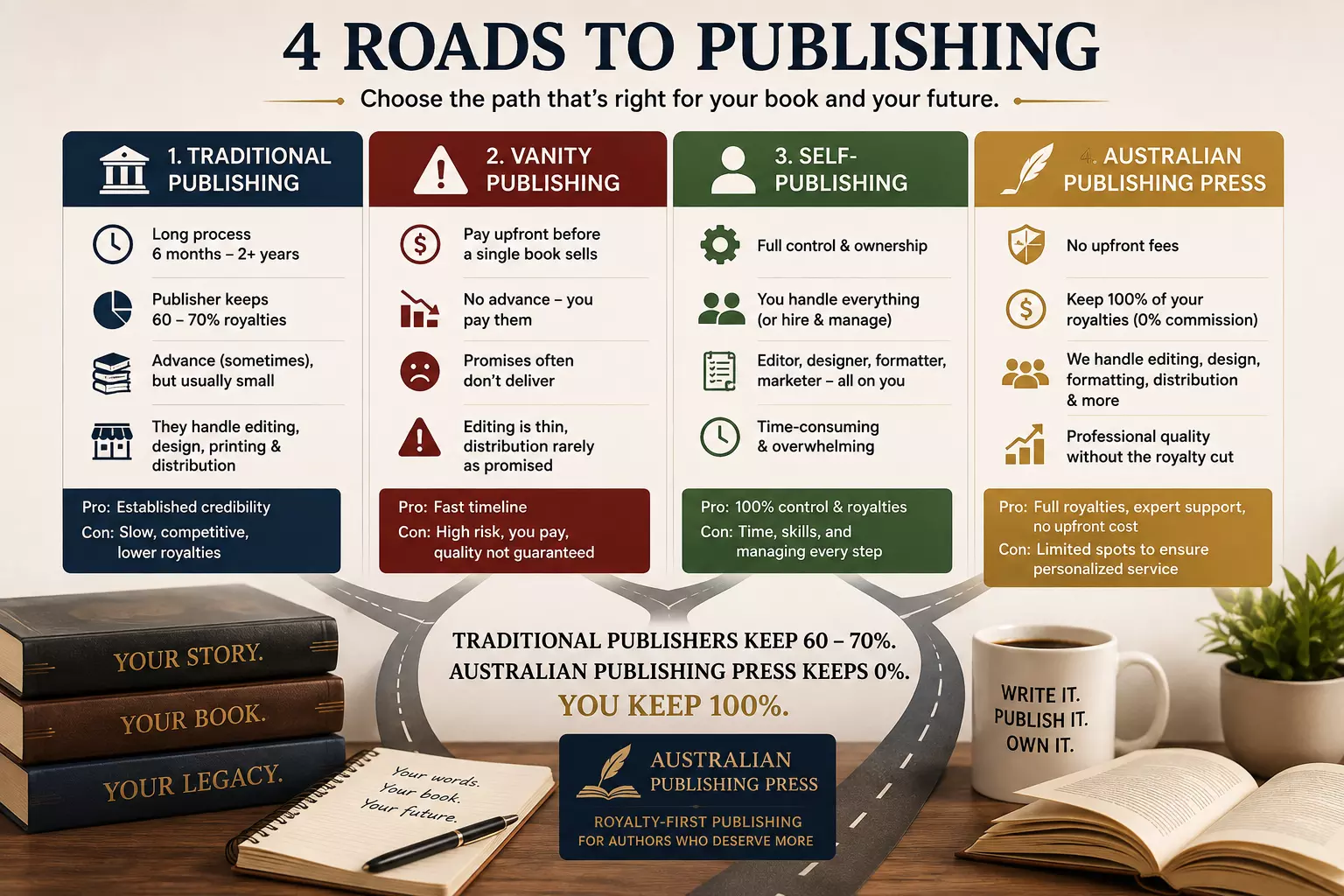
Picking a Publisher in Australia: Traditional vs Vanity vs Self-Publishing
You finish the manuscript. Weeks of work, sometimes years. Then nobody tells you what comes next, and that's the part that trips most first-time authors up. Publishing isn't one thing.
It's three very different roads, and picking the wrong one can cost you money, time, or both.
Going the Traditional Route
This is the one everyone assumes is "real" publishing. You submit to a publishing house, they say yes or no, and if it's yes, they take the manuscript off your hands, handling editing, cover design, printing, and getting it into stores.
Sounds great until you look at the timeline. Six months to a year just to hear back. Then another year or so before the book's actually out. Some authors wait longer than they spent writing the thing.
The money doesn't work in your favour either. Publishers usually keep somewhere around 60 to 70 percent of what the book brings in. You wrote every word of it, and you're still the minority shareholder in your own book.
There's an advance sometimes, sure, but for most authors that doesn't come close to covering what a traditional deal costs them in the long run.
Vanity Publishing: Read This Twice Before You Sign Anything
Here's the pitch. Skip the long submission process, pay us, and we'll get your book out fast. Sounds tempting once you've already been rejected a few times.
But think about what's actually happening. You're paying before a single copy sells. No advance from them to you, it works the opposite way.
Once that invoice clears, a lot of these outfits go quiet. Editing is thin. Distribution promises rarely hold up. You've paid for the appearance of being published, not the substance of it.
If a publisher wants your money before your book has earned a cent, that's the warning sign right there.
Self-Publishing, or Doing It All Yourself
Full control. Nobody telling you what your cover should look like or rewriting your ending. Sounds ideal.
Except now you're the editor, the designer, the formatter, and the marketer, or you're hiring four different freelancers and managing all of them yourself while also trying to write your next book. It's doable.
Plenty of authors pull it off well. But it's a second job stacked on top of the writing, and most people underestimate how much coordination it takes until they're three months in and still haven't found a formatter.
Read: Top 9 Queensland Firms Helping Authors Publish
Where Something Like Australian Publishing Press Comes In
There's a fourth option that doesn't get talked about as much, and it's worth pausing on.
Australian Publishing Press isn't a vanity publisher. That needs to be said plainly, because the two get confused constantly.
There's no upfront fee designed to profit off you before your book sells anything, and no royalty cut sitting between you and your earnings the way a traditional deal works.
The number that actually says it best is this. Traditional publishers keep 60 to 70 percent. Australian Publishing Press keeps 0 percent. Authors publishing through them get their full royalties, meaning every dollar the book earns goes to the person who wrote it.
It also takes the self-publishing headache off the table. You're not hunting down a cover designer on one freelance site and a proofreader on another.
That's already handled, without the royalty cut a traditional publisher expects and without a vanity publisher's invoice landing in your inbox first.
So Which One Do You Pick?
It depends what you're after. Want the name recognition of a big publishing house and don't mind waiting years and giving up most of your royalties? Traditional still has a case. Want to run every part of the process yourself and don't mind the extra workload? Self-publishing works for plenty of people.
But if what you actually want is a properly produced book, without handing over most of your earnings and without paying someone upfront only to find out later they weren't worth it, a royalty-first publisher like Australian Publishing Press is the option most authors don't hear about until it's too late to matter.
Ask any publisher these questions before signing.
Do they charge you first. What percentage do you actually keep. Who owns the rights once the book's out. The answers tell you more than their website ever will.