Photonic Integrated Circuit Market Analysis, Key Players, and Forecast 2025-2033
Market Overview:
The global photonic integrated circuit market is experiencing rapid growth, driven by rising demand for high-speed data transmission, advancements in miniaturization and integration, and growing applications in emerging technologies. According to IMARC Group's latest research publication,
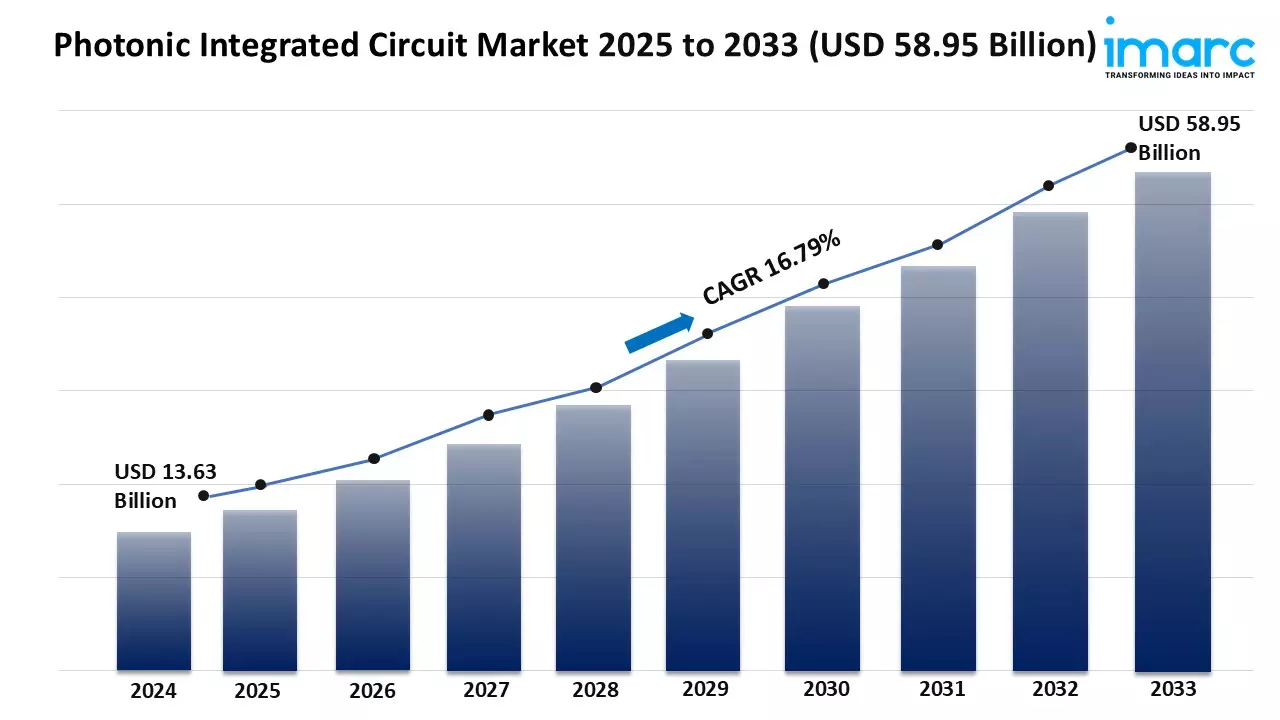
"Photonic Integrated Circuit Market Size, Share, Trends and Forecast by Component, Raw Material, Integration, Application, and Region, 2025-2033", the global photonic integrated circuit market size was valued at USD 13.63 Billion in 2024. Looking forward, IMARC Group estimates the market to reach USD 58.95 Billion by 2033, exhibiting a CAGR of 16.79% from 2025-2033.
This detailed analysis primarily encompasses industry size, business trends, market share, key growth factors, and regional forecasts. The report offers a comprehensive overview and integrates research findings, market assessments, and data from different sources.
It also includes pivotal market dynamics like drivers and challenges, while also highlighting growth opportunities, financial insights, technological improvements, emerging trends, and innovations. Besides this, the report provides regional market evaluation, along with a competitive landscape analysis.
Download a sample PDF of this report: https://www.imarcgroup.com/photonic-integrated-circuit-market/requestsample
Our report includes:
- Market Dynamics
- Market Trends and Market Outlook
- Competitive Analysis
- Industry Segmentation
- Strategic Recommendations
Growth Factors in the Photonic Integrated Circuit Market
Rising Demand for High-Speed Data Transmission
The increasing need for high-speed data transmission is a significant growth factor for the Photonic Integrated Circuit (PIC) market. With the proliferation of cloud computing, streaming services, and 5G networks, data centers require faster and more efficient communication systems. PICs, which integrate multiple photonic components like lasers, modulators, and detectors onto a single chip, enable high-bandwidth data transfer with minimal latency.
For instance, companies like Intel have developed silicon photonics-based transceivers that support 400Gbps data rates, meeting the demands of hyperscale data centers. This trend is further fueled by the global surge in internet traffic, necessitating scalable and energy-efficient solutions.
Advancements in Miniaturization and Integration
Technological advancements in miniaturization and integration are driving the PIC market forward. By combining multiple optical functions into compact chips, PICs reduce size, cost, and power consumption compared to traditional discrete optical systems.
This is particularly impactful in telecommunications and consumer electronics, where space and efficiency are critical. For example, Infinera’s PIC-based optical engines have revolutionized coherent optical transmission, enabling compact solutions for long-haul networks.
Ongoing research in materials like indium phosphide and silicon photonics further enhances integration capabilities, making PICs viable for applications beyond telecom, such as medical diagnostics and autonomous vehicles, thus expanding market potential.
Growing Applications in Emerging Technologies
The expansion of PIC applications in emerging technologies like quantum computing and LiDAR is a key growth driver. PICs provide precise control over light, essential for quantum communication systems and high-resolution sensing in autonomous vehicles.
For instance, companies like Lumentum are developing PIC-based LiDAR systems for automotive applications, offering compact and cost-effective solutions for 3D mapping. Similarly, quantum computing startups leverage PICs for photon-based qubits, enabling scalable quantum systems. As industries increasingly adopt these technologies, the demand for specialized PICs grows, fostering innovation and creating new market opportunities across diverse sectors.
Key Trends in the Photonic Integrated Circuit Market
Adoption of Silicon Photonics
Silicon photonics is a prominent trend reshaping the PIC market, leveraging existing semiconductor manufacturing infrastructure to produce cost-effective, scalable photonic devices. By integrating optical components with silicon-based electronics, silicon photonics enables high-performance solutions for data centers and telecommunications.
For example, Cisco’s acquisition of Acacia Communications highlights the industry’s focus on silicon photonics for high-speed transceivers. This trend reduces production costs and accelerates deployment, making PICs more accessible for applications like AI-driven data processing and high-performance computing, driving widespread adoption across industries.
Integration with Artificial Intelligence
The integration of PICs with artificial intelligence (AI) systems is an emerging trend, enhancing data processing capabilities for AI-driven applications. PICs enable ultra-fast optical interconnects, critical for handling the massive data throughput required by AI algorithms in data centers and edge computing.
For instance, companies like Ayar Labs are developing optical I/O solutions using PICs to accelerate AI workloads, reducing latency and power consumption compared to traditional electrical interconnects. As AI adoption grows in sectors like healthcare, finance, and autonomous systems, PICs are becoming essential for supporting next-generation computing architectures.
Expansion into Biomedical and Sensing Applications
The PIC market is witnessing a trend toward biomedical and sensing applications, driven by the technology’s ability to manipulate light for precise measurements. PICs are increasingly used in medical diagnostics, such as lab-on-chip devices for blood analysis, and in environmental sensing for detecting pollutants.
For example, Genalyte’s PIC-based diagnostic platform uses photonic chips to perform rapid blood tests, improving healthcare accessibility. This trend is supported by advancements in biocompatible materials and compact designs, enabling PICs to address niche markets like wearable health monitors and environmental sensors, further diversifying their applications.
Our report provides a deep dive into the photonic integrated circuit market analysis, outlining the current trends, underlying market demand, and growth trajectories.
Leading Companies Operating in the Global Photonic Integrated Circuit Industry:

- Broadcom Inc.
- ColorChip Ltd.
- Hamamatsu Photonics K.K.
- II-VI Incorporated
- Infinera Corporation
- Intel Corporation
- LioniX International
- POET Technologies
- VLC Photonics S.L. (Hitachi Ltd.).
Photonic Integrated Circuit Market Report Segmentation:
By Component:
- Lasers
- MUX/DEMUX
- Optical Amplifiers
- Modulators
- Attenuators
- Detectors
Lasers dominate due to their critical role in high-speed data transmission, LiDAR, medical diagnostics, and quantum computing.
By Raw Material:
- Indium Phosphide (InP)
- Gallium Arsenide (GaAs)
- Lithium Niobate (LiNbO3)
- Silicon
- Silica-on-Silicon
Indium Phosphide (InP) leads for its superior optical properties, enabling efficient PICs for 5G, data centers, and quantum applications.
By Integration:
- Monolithic Integration
- Hybrid Integration
- Module Integration
Monolithic Integration is preferred for its compact design, high performance, and cost-effectiveness in telecom and data center applications.
By Application:

- Optical Fiber Communication
- Optical Fiber Sensor
- Biomedical
- Quantum Computing
Optical Fiber Communication drives demand, fueled by 5G expansion and the need for high-speed, low-latency networks.
Regional Insights:
- North America (United States, Canada)
- Asia Pacific (China, Japan, India, South Korea, Australia, Indonesia, Others)
- Europe (Germany, France, United Kingdom, Italy, Spain, Russia, Others)
- Latin America (Brazil, Mexico, Others)
- Middle East and Africa
North America leads with strong R&D, tech adoption, and infrastructure investments in data centers, telecom, and quantum technologies.
Research Methodology:
The report employs a comprehensive research methodology, combining primary and secondary data sources to validate findings. It includes market assessments, surveys, expert opinions, and data triangulation techniques to ensure accuracy and reliability.
Note: If you require specific details, data, or insights that are not currently included in the scope of this report, we are happy to accommodate your request. As part of our customization service, we will gather and provide the additional information you need, tailored to your specific requirements. Please let us know your exact needs, and we will ensure the report is updated accordingly to meet your expectations.
About Us:
IMARC Group is a global management consulting firm that helps the world’s most ambitious changemakers to create a lasting impact. The company provide a comprehensive suite of market entry and expansion services. IMARC offerings include thorough market assessment, feasibility studies, company incorporation assistance, factory setup support, regulatory approvals and licensing navigation, branding, marketing and sales strategies, competitive landscape and benchmarking analyses, pricing and cost research, and procurement research.
Contact Us:
IMARC Group
134 N 4th St. Brooklyn, NY 11249, USA
Email: [email protected]
Tel No:(D) +91 120 433 0800
United States: +1-631-791-1145