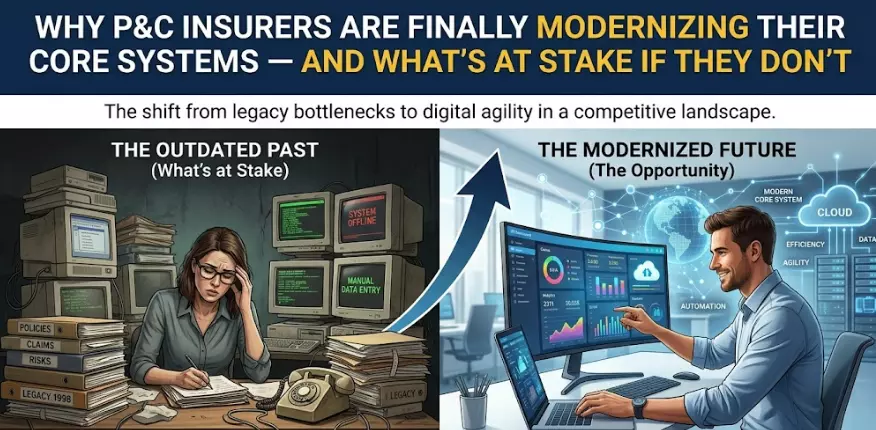
Why P&C Insurers Are Finally Modernizing Their Core Systems — And What's at Stake If They Don't
Property and casualty insurance is one of the most operationally demanding segments in the entire financial services industry.
Between managing policy lifecycles, processing high-volume claims, handling complex billing structures, and staying current with ever-shifting regulatory requirements, P&C carriers are running a constant operational balancing act.
For decades, many carriers managed this complexity with legacy systems held together by institutional knowledge, manual workarounds, and a general reluctance to touch anything that was technically still working.
That approach is becoming harder to sustain. Competitive pressure from digital-native insurtech entrants, rising customer expectations, and the growing cost of maintaining outdated infrastructure are forcing
P&C insurers to confront a question they've been deferring for years: when does the cost of not modernizing exceed the cost of change?
For a growing number of carriers, that tipping point has already arrived.
The Three Core Systems Every P&C Carrier Depends On
To understand where modernization is happening — and why — it helps to look at the three operational pillars that underpin every P&C insurance business.
Policy Administration
Policy administration is where the insurance relationship begins. It covers everything from new business submission and underwriting through policy issuance, endorsements, renewals, and cancellations.
When a policy administration system is working well, it's invisible — workflows move smoothly, data is consistent, and changes to coverage terms or rates can be implemented without heroic IT effort.
When it's not working well, the problems cascade quickly. Rate changes that take months to implement create competitive disadvantages.
Coverage data that isn't consistent across systems leads to billing errors and claims disputes. Underwriters relying on manual processes work slower and make more errors than those supported by modern automation.
Modern p&c policy admin systems address these pain points by centralizing policy data, automating routine workflow steps, and giving underwriters and product managers the flexibility to configure products and rates without depending entirely on IT development cycles.
The operational impact shows up in faster time-to-market for new products, fewer policy processing errors, and a significantly reduced administrative cost per policy.
Billing
Billing in P&C insurance is more complex than it appears from the outside. Carriers manage multiple payment plans, installment structures, agency bill versus direct bill arrangements,
premium financing relationships, and state-specific fee and tax requirements — often simultaneously, across large books of business.
Legacy billing systems struggle with this complexity. They were typically built for a specific set of products and payment structures and become increasingly difficult to maintain as the business grows and diversifies.
The result is a billing operation that generates a disproportionate share of customer complaints, collections problems, and reconciliation headaches.
Purpose-built billing software for p&c insurers handles this complexity natively.
Flexible payment plan configuration, automated installment billing, integrated collections workflows, and real-time account reconciliation all reduce the manual burden on billing teams and improve the accuracy of financial reporting.
For carriers managing high policy volumes, the efficiency gains at scale are substantial — and so is the reduction in billing-related customer churn.
It's worth noting that p&c insurance billing systems that integrate directly with the policy administration and claims layers eliminate a major source of data inconsistency.
When billing, coverage, and claims data are synchronized in real time, disputes get resolved faster and financial reporting becomes significantly more reliable.
Claims Management
Claims is where the P&C insurance promise is either kept or broken. A policyholder who experiences a smooth, fair, and timely claims process is likely to renew and recommend.
One who experiences delays, confusion, or inconsistent communication is unlikely to do either.
The operational challenge in claims management is significant. High-volume lines like personal auto and homeowners involve enormous claim counts with tight cycle time expectations.
Complex commercial lines involve lengthy investigations, coverage disputes, and coordination across multiple parties. Third-party administrator (TPA) arrangements add another layer of coordination complexity.
A dedicated P&C claims management TPA platform handles the full claims lifecycle — first notice of loss, assignment, investigation, reserving, settlement, and payment — while supporting both in-house adjusting teams and third-party administrators through configurable access controls and workflow routing.
Automation handles the high-frequency, low-complexity claims that don't require adjuster judgment, freeing experienced staff to focus on the claims that genuinely need their attention.
The measurable outcomes of modern claims platforms include shorter average cycle times, lower loss adjustment expense ratios, more consistent reserve adequacy, and higher policyholder satisfaction scores.
Each of these has a direct financial impact on the carrier's combined ratio.
Read: The Value of Smart P&C Insurance Solutions
The Integration Problem That Derails Most Modernization Efforts
One of the most common failure modes in P&C technology modernization is treating each system as an independent upgrade project.
A carrier implements a new policy admin system without considering how it will connect to billing. Or modernizes claims without updating the data feeds that reporting and analytics depend on.
The result is a newer version of the same fragmentation problem — modern systems that don't talk to each other effectively, creating the same manual reconciliation work and data inconsistency that the modernization was meant to eliminate.
The carriers that get the most out of their technology investments think about their core systems as an integrated platform rather than a collection of point solutions.
A unified p&c insurance software environment — where policy, billing, and claims data share a consistent data model and communicate through well-defined integration points — eliminates the fragmentation problem at the source.
This doesn't mean every carrier needs to replace all three systems simultaneously, which is rarely practical.
It does mean that modernization decisions should be made with integration architecture in mind from the start, not treated as something to figure out after each system is live.
What to Prioritize When Evaluating P&C Technology
For carriers evaluating modernization options, a few evaluation criteria consistently separate platforms that deliver long-term value from those that solve the immediate problem but create new constraints:
- Configurability without customization. The best platforms allow product managers and operations teams to configure products, rates, and workflows through the system itself — without requiring custom code for every change. This distinction matters enormously for the total cost of ownership over a five- to ten-year horizon.
- API-first integration architecture. Systems that expose and consume data through well-documented APIs are significantly easier to integrate with existing tools, third-party data sources, and future technology investments. Platforms that require proprietary integration methods create long-term dependency and migration complexity.
- Regulatory compliance support. P&C insurance is regulated at the state level in the US, with significant variation in form filing requirements, rate approval processes, and mandatory coverage rules. Platforms built for the P&C market should have compliance management capabilities built in — not bolted on as an afterthought.
- Scalability under volume. Claims surges after major weather events, high-volume renewal cycles, and seasonal business patterns all stress insurance systems in ways that controlled demos don't reveal. Understanding how a platform performs under peak load conditions is an essential part of any serious evaluation.
The Cost of Waiting
There is a version of this decision that carriers have been making for years: the cost of the new system feels large and visible, while the cost of the existing system feels manageable and diffuse.
What's harder to see in that comparison is the accumulating cost of the status quo — the developer time spent maintaining aging code, the manual effort that modern
automation would eliminate, the products not launched because the system can't support them, and the customers lost to competitors with better digital experiences.
These costs don't show up as a line item. They show up as a combined ratio that's persistently higher than it should be,
a technology team spending most of its capacity on maintenance rather than innovation, and a business that's slower to respond to market opportunities than leadership wants it to be.
The carriers making the strongest technology investments right now are not necessarily the largest ones. They're the ones that have done the honest accounting of what staying put actually costs — and decided that the math no longer works in favor of waiting.