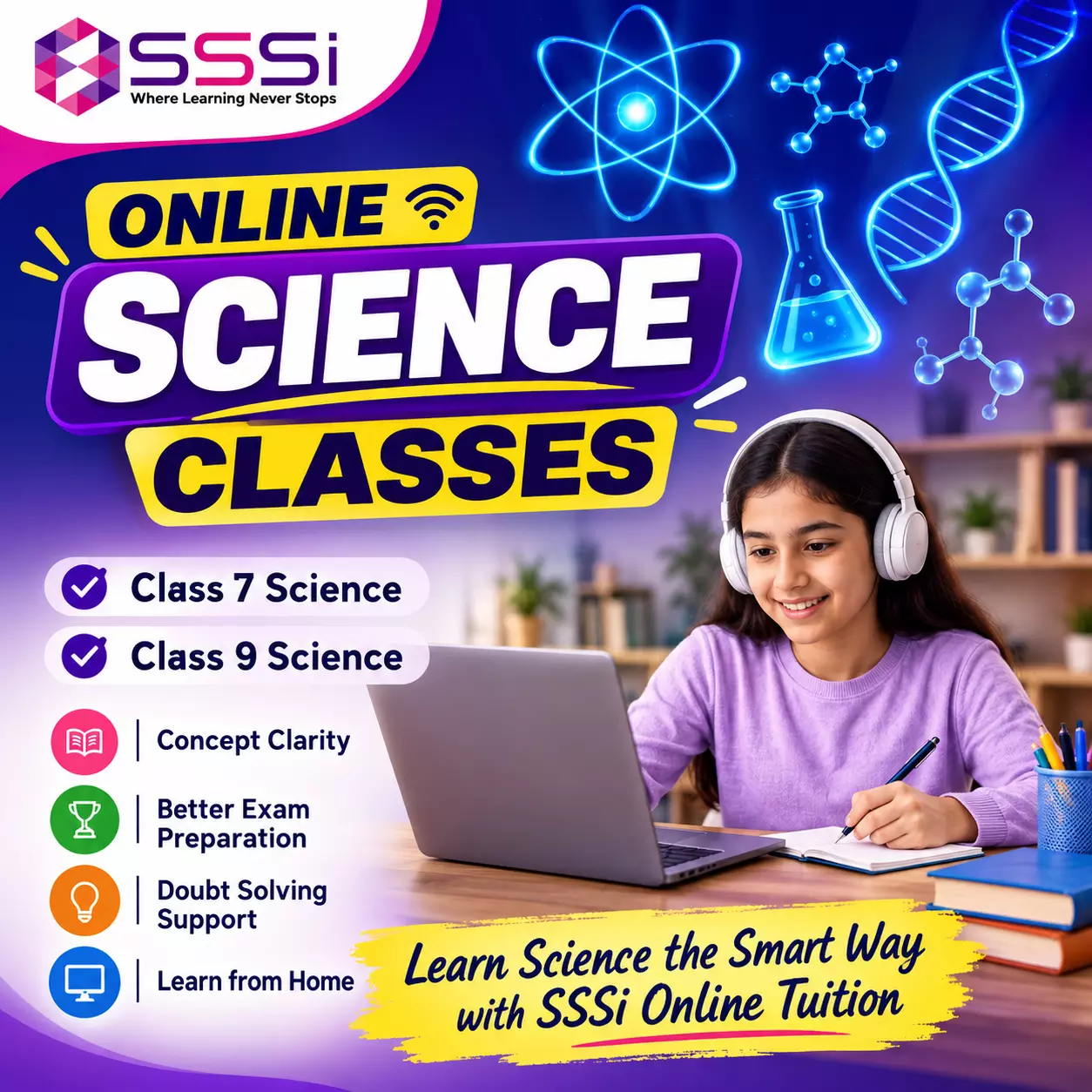
Online Science Classes: Learn Through Discovery, Observation, and Experiments
Why does metal feel colder than wood? How do plants prepare their food? What makes an object move or change its direction? Science helps students explore questions like these and understand the principles behind everyday experiences.
However, learning science effectively requires more than memorising definitions. Students need to observe, ask questions, interpret information, and apply concepts to different situations.
Online Science Classes can support this process through structured lessons, visual explanations, interactive discussions, and regular practice.
For students in Classes 7 and 9, the right learning approach can make scientific concepts easier to understand while building the reasoning skills needed for future academic progress.
How Online Science Classes Make Concepts Easier to Understand
Science includes abstract ideas, technical vocabulary, diagrams, processes, and numerical problems. Students may find certain topics difficult when they cannot connect textbook explanations with practical examples.
Online learning can help bridge this gap through a combination of teaching methods:
- Visual explanations: Diagrams, animations, and presentations help students understand structures and scientific processes.
- Real-world examples: Connecting lessons with everyday observations makes scientific ideas more meaningful.
- Interactive discussions: Students can ask questions, explain their reasoning, and clarify doubts.
- Topic-based practice: Worksheets and exercises help learners apply what they have studied.
- Regular revision: Reviewing concepts helps students retain information and identify areas that need additional attention.
Students looking for structured subject guidance can explore Online Science Classes at SSSi.
Building Curiosity and Scientific Thinking in Class 7
Class 7 is an important stage for developing a broader understanding of the natural world. Depending on the curriculum, students may study topics related to nutrition, heat, acids and bases, physical and chemical changes, motion, electricity, plants, animals, and the environment.
At this stage, students benefit from learning how scientific principles relate to familiar situations. For example, studying physical and chemical changes can help them distinguish between melting ice and rusting iron.
Learning about heat can encourage them to investigate how different materials respond to temperature.
Online science lessons can help Class 7 students:
- Understand scientific terms and explain them in their own words.
- Recognise patterns and relationships between concepts.
- Interpret and label scientific diagrams.
- Compare materials, processes, and natural phenomena.
- Develop observation and reasoning skills.
- Write structured answers using appropriate scientific vocabulary.
Students should also be encouraged to ask questions instead of accepting every explanation without understanding it. This habit makes science more engaging and supports deeper learning.
For additional grade-specific guidance, explore science classes for class 7.
Developing Deeper Scientific Understanding in Class 9
Class 9 science introduces more detailed concepts across Physics, Chemistry, and Biology. Students begin to work with scientific relationships, numerical calculations, specialised terminology, and explanations that require greater analytical thinking.
Depending on the syllabus, Physics may cover motion, force, and gravitation. Chemistry introduces concepts related to matter, atoms, and molecules, while Biology explores cells, tissues, and life processes.
At this stage, students need to understand not only what happens but also why it happens and how scientific principles explain the result.
Online Science Classes can help Class 9 students:
- Understand concepts before memorising definitions and formulas.
- Apply relevant formulas to numerical problems.
- Interpret scientific diagrams and describe biological structures.
- Compare related concepts and identify important differences.
- Connect theoretical principles with practical examples.
- Improve the accuracy and organisation of written answers.
For example, when studying motion, students can learn how distance, displacement, speed, and velocity differ. In Chemistry, understanding the particle-based explanation of matter can make changes of state easier to interpret.
Consistent practice and guided explanations can help students identify gaps in their understanding before they affect more advanced topics. Students seeking class-specific support can visit science classes for class 9.
Read: Top-Rated Data Science Course in Delhi with Certification
Making Science More Engaging Through Practical Connections
Science becomes more memorable when students connect concepts with observations from daily life. Online lessons can introduce these connections through demonstrations, illustrations, guided questions, and safe activities.
Explore the Science Behind Everyday Objects
Students can investigate why some materials conduct heat more effectively than others, how shadows change throughout the day, or why certain objects float in water. These questions encourage learners to apply scientific principles to familiar situations.
Use Diagrams to Understand Complex Processes
Diagrams can make structures and processes easier to visualise. Students can practise labelling parts, identifying relationships, and explaining what a diagram represents instead of simply memorising its appearance.
Learn by Asking Questions
A question-led approach encourages students to predict what might happen, explain their reasoning, and compare their ideas with scientific evidence. This supports critical thinking and helps tutors identify misunderstandings.
Connect Theory with Application
Practice questions can help learners apply concepts to new examples. This is especially useful when students understand a definition but struggle to use it in an unfamiliar situation.
Any hands-on experiment should be appropriate for the student's age and performed with suitable safety precautions and adult supervision where necessary.
Study Strategies That Help Students Improve in Science
Attending lessons is only one part of effective learning. Students also need time to revise, practise, and reflect on what they have understood.
- Review notes after each lesson: Summarise the key concepts while the topic is still fresh.
- Maintain a science glossary: Record unfamiliar terms with simple explanations and examples.
- Practise drawing diagrams: Repeated practice improves familiarity with scientific structures and processes.
- Explain concepts aloud: Try teaching a topic to a friend or family member to check understanding.
- Solve questions regularly: Use textbook exercises and additional practice to test knowledge.
- Keep a list of doubts: Note confusing points and ask for clarification during the next lesson.
- Revise earlier chapters: Revisit previous topics to strengthen connections between concepts.
Students should adapt their routine to their school timetable and syllabus, giving extra attention to topics they find difficult.
Choosing Suitable Online Science Classes
A useful science learning programme should help students understand concepts, practise applying them, and track their progress. Before choosing a programme, families can consider the following factors.
- Clear teaching methods: Explanations should be easy to follow and appropriate for the student's grade.
- Syllabus alignment: Lessons should correspond to the relevant school curriculum and academic requirements.
- Interactive learning: Students should have opportunities to participate and clarify doubts.
- Practice and feedback: Exercises and assessments can help learners understand their strengths and areas for improvement.
- Regular revision: Revisiting earlier concepts helps students retain knowledge and prepare for assessments.
The goal is to build independent learners who can understand scientific ideas and apply them confidently, rather than depend entirely on memorised answers.
Frequently Asked Questions
What are Online Science Classes?
Online Science Classes are lessons delivered through digital platforms. They may include live teaching, visual explanations, interactive discussions, practice questions, and revision activities to help students understand science concepts.
Are Online Science Classes suitable for Class 7 students?
Yes. They can help Class 7 students understand foundational scientific concepts, interpret diagrams, connect lessons with everyday experiences, and develop observation and reasoning skills.
How can online science lessons help Class 9 students?
Class 9 students study more detailed concepts across Physics, Chemistry, and Biology. Guided lessons can help them understand difficult topics, practise numerical questions, interpret diagrams, and prepare for school assessments.
Can students understand science experiments through online classes?
Online lessons can explain experiments through demonstrations, diagrams, and videos. Students can learn about the procedure, observations, and scientific principles involved. Any practical activity should follow appropriate safety precautions.
How can students remember scientific definitions and concepts?
Students can use short summaries, labelled diagrams, flashcards, regular revision, and active recall. Explaining a concept in their own words is also a useful way to check whether they understand it.
How often should students revise science?
Short revision sessions after lessons, followed by a weekly review, can help students retain concepts. The frequency can be adjusted according to the syllabus, upcoming assessments, and individual learning needs.
Conclusion
Science encourages students to explore their surroundings, ask meaningful questions, and understand the principles that explain natural phenomena.
Online Science Classes can make this process more structured through clear teaching, visual learning, guided practice, and regular revision.
For students in Classes 7 and 9, developing strong concepts and consistent study habits can support better academic understanding and prepare them for more advanced scientific learning.