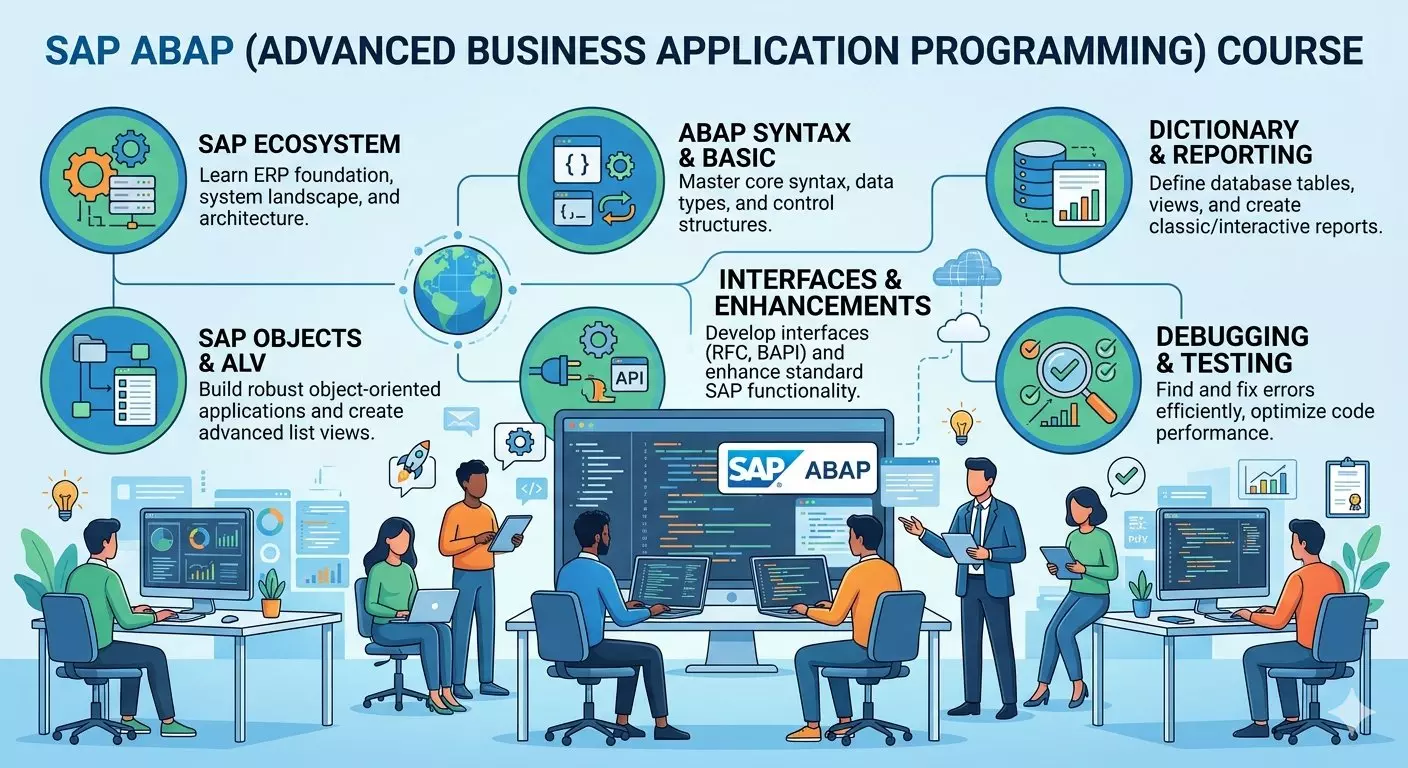
What Is an SAP ABAP Course and How Can It Build Your SAP Career?
An SAP ABAP course teaches you ABAP (Advanced Business Application Programming), the language used to customize and extend SAP systems.
You learn to build reports, interfaces, forms, enhancements, and modern cloud-ready applications. An online SAP ABAP course lets you do this remotely, usually with hands-on practice in a live SAP system.
Search Intent: What Are You Really Looking For?
If you searched this topic, you probably want to know:
- What ABAP is and what a course actually teaches
- Whether it leads to real jobs
- How an online SAP ABAP course compares with classroom training
- Where SAP HR course classes fit in
This guide answers each, without assuming prior SAP knowledge.
What Is ABAP?
ABAP is SAP's programming language. Businesses run finance, sales, procurement, manufacturing, and HR processes on SAP software, and no two companies work exactly alike. ABAP developers adapt the standard system to fit those differences.
A typical task might be: "Our finance team needs a report of overdue invoices grouped by region, with an approval flag." An ABAP developer writes that report, tests it, and moves it into production.
ABAP has evolved well beyond its older report-writing image. Today it includes:
- ABAP on SAP HANA, which pushes data-heavy logic to the database
- Core Data Services (CDS) views for data modeling
- ABAP RESTful Application Programming Model (RAP) for building apps and APIs
- ABAP Cloud, SAP's approach to cloud-ready, upgrade-safe development
What Does an SAP ABAP Course Cover?
Course content varies by provider, but a solid program usually moves from basics to advanced topics.
Stage
Topics You Should Expect
Foundation
SAP architecture, ABAP Dictionary (tables, data elements, domains), basic syntax, internal tables
Core development
Reports (classical and interactive), selection screens, modularization, Open SQL
Presentation
Smart Forms or Adobe Forms, ALV reports
Enhancements
User exits, BAdIs, enhancement framework
Integration
IDocs, BAPIs, RFCs, OData basics
Modern ABAP
ABAP Development Tools in Eclipse, CDS views, RAP, ABAP Cloud
Quality
Debugging, ABAP Unit testing, performance tuning
Check that the syllabus includes modern topics. A course that stops at classical reports leaves you underprepared for current projects.
Read: High Salary Courses After 12th for a Bright Future
A Simple Practical Example
Suppose a retail company wants a daily list of products below minimum stock.
- You read stock data from the relevant tables using Open SQL.
- You filter items under the threshold in an internal table.
- You display results in an ALV grid with sorting and export.
- You schedule it as a background job and add an authorization check.
This one small task uses four core skills: data access, logic, presentation, and system administration. Good courses build practice around exercises like this rather than theory alone.
Where Do SAP HR Course Classes Fit In?
SAP HR (officially SAP Human Capital Management, or HCM) covers payroll, time management, personnel administration, and organizational management. There are two common paths:
- Functional HR/HCM consultants configure the system and advise on processes.
- HR ABAP developers write custom reports, infotype logic, and payroll extensions.
If you choose the technical route, SAP HR course classes that include ABAP are valuable. You learn HR-specific concepts such as infotypes, logical databases, and payroll schemas and rules, then apply ABAP to them.
One honest caution: SAP's strategic direction for HR is cloud-based SuccessFactors.
Many organizations still run on-premise SAP HCM, but you should check SAP's current maintenance and roadmap statements before committing to an HR-only path. Pairing HR knowledge with strong ABAP skills keeps your options open.
Online SAP ABAP Course vs. Classroom Training
Factor
Online Course
Classroom
Flexibility
Learn around work or study
Fixed schedule
Location
Anywhere with internet
Must travel
Practice access
Depends on provider (remote system access)
Often lab-based
Instructor interaction
Live sessions or recordings
Face to face
Cost
Often lower, varies widely
Often higher
Neither format is automatically better. What matters is the quality of instruction and the amount of hands-on practice.
How to Choose a Good Online SAP ABAP Course
Before enrolling, check these points:
- Hands-on system access. You cannot learn ABAP by watching. Confirm you will get a practice environment.
- Current syllabus. Look for CDS, RAP, and ABAP Cloud, not only legacy topics.
- Instructor background. Ask whether trainers have real project experience.
- Live doubt-clearing. Questions come up constantly, especially while debugging.
- Project or case work. You need something concrete to discuss in interviews.
- Certification guidance. SAP offers developer certifications; verify current exam details on SAP's official learning site.
- Transparent claims. Be cautious of guaranteed job promises or unverifiable placement numbers.
How an ABAP Course Builds Your SAP Career
A course alone does not make a career, but it builds the foundation for these roles:
- ABAP Developer
- SAP Technical Consultant
- ABAP on HANA / RAP Developer
- SAP Integration Developer
- HR ABAP Developer (with HCM knowledge)
A realistic progression looks like this:
- Learn the fundamentals and practice daily.
- Build two or three small projects (a report, a form, a simple enhancement).
- Learn debugging and performance basics, which interviewers value.
- Add modern skills such as CDS and RAP.
- Consider certification to validate your knowledge.
- Apply for junior roles, internships, or support positions to gain project exposure.
Many people also add functional knowledge in finance, logistics, or HR. Developers who understand the business process behind the code usually communicate better with consultants and clients.
Who Should Take This Course?
- Computer science and IT graduates
- Programmers from Java, .NET, or Python backgrounds
- SAP functional consultants who want technical depth
- HR professionals moving into HR technology
- Career changers with logic and problem-solving strength
You do not need prior SAP experience, though basic programming concepts help.
Common Mistakes to Avoid
- Memorizing syntax without writing code
- Skipping the ABAP Dictionary and data model basics
- Ignoring debugging until late
- Choosing a course purely on price
- Learning only legacy ABAP and neglecting modern development
Conclusion
An SAP ABAP course gives you a practical, in-demand technical skill: customizing the systems that run large parts of global business.
The best results come from a course with hands-on practice, a current syllabus, and experienced trainers. If you lean toward HR, combine SAP HR course classes with ABAP so you are not tied to a single module.
Start with the fundamentals, practice consistently, build small projects, and keep your skills current as SAP's technology evolves.
Frequently Asked Questions
1. What is an SAP ABAP course?
It is training in ABAP, the programming language for building and customizing SAP applications, including reports, forms, interfaces, and enhancements.
2. Is an online SAP ABAP course worth it?
It can be, if it offers hands-on system access, live support, and a current syllabus. Passive video-only courses are less effective.
3. Do I need programming experience before starting?
Not strictly. Prior programming helps, but many courses start from the basics and build up.
4. How long does it take to learn ABAP?
It depends on your background and study time. Many programs run for several weeks to a few months, but real proficiency comes from continued practice.
5. What is the difference between SAP HR and ABAP?
SAP HR (HCM) is a functional module for people-related processes. ABAP is the programming language used to customize it and every other SAP module.
6. Are SAP HR course classes still relevant?
Many companies still run SAP HCM, while others are moving to SuccessFactors. Check SAP's current roadmap and consider building skills in both areas.
7. Is ABAP still in demand?
SAP systems remain widely used, and ABAP continues to evolve through ABAP Cloud and RAP. Demand varies by region and experience level, so review current job listings in your market.
8. Which modern ABAP topics should I learn?
CDS views, RAP, ABAP Development Tools in Eclipse, and ABAP Cloud development principles.
9. Is SAP certification necessary?
It is not mandatory, but it can validate your skills. Confirm current certification options on SAP's official learning portal.
10. Can a non-IT person learn ABAP?
Yes, with consistent effort. Logical thinking matters more than a specific degree.