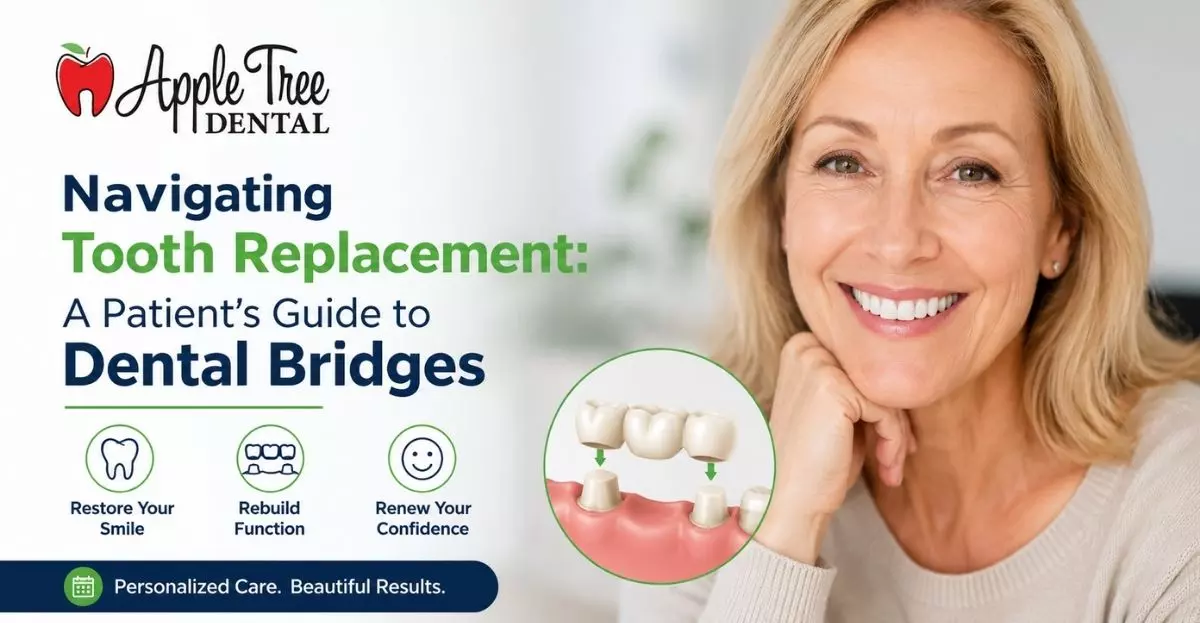
Navigating Tooth Replacement: A Patient’s Guide to Dental Bridges
Losing a natural tooth is a surprisingly emotional experience. Beyond the immediate physical changes to your bite, it often brings a wave of self-consciousness. Whether the loss is due to an unexpected sports injury, progressive decay, or an extraction, that empty space in your smile can change the way you speak, chew, and interact with the world.
If you are currently dealing with a missing tooth, you’ve likely spent hours researching solutions online. You’ve probably seen terms like "implants," "partials," and "bridges" thrown around. While the sheer volume of dental terminology can be overwhelming, the path forward doesn't have to be.
For decades, the dental bridge has been one of the most reliable, time-tested solutions in restorative dentistry. In this comprehensive guide, we will break down exactly what a dental bridge is, what the procedure involves, and how to determine if it is the right step for restoring your smile and your confidence.
What Exactly is a Dental Bridge?
In straightforward terms, a dental bridge literally "bridges" the gap created by one or more missing teeth.
Rather than surgically implanting a metal post into your jawbone (which is how a dental implant works), a bridge relies on the healthy teeth on either side of the gap for support. These supporting teeth are called abutments. The false tooth that fills the gap is called a pontic.
Modern bridges are highly sophisticated. They are custom-milled and shade-matched to blend flawlessly with your natural enamel. When a well-crafted bridge is placed by an experienced professional, it is virtually indistinguishable from the teeth you were born with.
The Hidden Risks of Ignoring a Missing Tooth
A common question patients ask is, "Can I just leave the gap alone if it’s in the back of my mouth where no one can see it?"
From a purely cosmetic standpoint, perhaps. But from a structural standpoint, leaving a gap untreated can lead to a cascade of oral health issues:
- Shifting Teeth: Your teeth naturally support one another. When one is removed, the adjacent teeth will slowly drift into the empty space, misaligning your bite.
- Bone Loss: Without the stimulation of a tooth root (or an implant), the jawbone in the empty space begins to resorb or shrink over time.
- TMJ and Chewing Issues: A misaligned bite forces your jaw muscles to work harder, often leading to temporomandibular joint (TMJ) pain, chronic headaches, and difficulty chewing certain foods.
This is why exploring tooth replacement options promptly is about much more than just aesthetics; it is a critical step in preserving your overall facial structure and digestive health.
Understanding Your Bridge Options
Not all gaps are the same, and therefore, not all bridges are built the same way. Depending on the location of the missing tooth and the health of your surrounding teeth, your dentist will recommend one of several designs.
1. Traditional Dental Bridges
This is the most common type. It involves creating a crown for the tooth on either side of the gap, with a pontic suspended in between. Traditional bridges are incredibly strong and are typically made of ceramics, porcelain fused to metal, or modern zirconia.
2. Cantilever Bridges
What happens when you only have a healthy tooth on one side of the missing gap? A cantilever bridge might be the solution. The pontic is supported by a dental crown on just one adjacent tooth. While less common today—especially in the back of the mouth where chewing forces are heavy—they are still a viable option for specific front-tooth restorations.
3. Maryland Dental Bridges
Often used to replace missing front teeth, a Maryland bridge uses two natural abutment teeth, but instead of using full crowns, it relies on a framework of metal or porcelain wings bonded to the backs of the adjacent teeth. This is a more conservative approach because it requires removing less enamel from the supporting teeth.
The Procedure: What to Expect in the Chair
Fear of the unknown keeps many patients away from the dentist. Understanding the step-by-step process can significantly reduce pre-appointment anxiety. If you are a patient looking to restore your smile with dental bridges London, here is exactly what your journey will look like.
Phase 1: Assessment and Preparation
During your first visit, your dentist will take comprehensive X-rays to assess the roots of the neighboring teeth and the surrounding bone. If the adjacent teeth are healthy enough to serve as anchors, the preparation begins.
The dentist will apply a local anesthetic so you remain completely comfortable. Then, they will carefully recontour the abutment teeth by removing a small portion of enamel to make room for the crowns that will hold the bridge in place.
Phase 2: Impressions and the Temporary Bridge
Once the teeth are prepared, highly accurate impressions (often using a digital 3D scanner rather than the messy putty of the past) are taken. These scans are sent to a specialized dental laboratory where your final bridge will be fabricated.
Because creating custom porcelain bridges is an intricate process that takes a couple of weeks, your dentist will fit you with a temporary plastic bridge to protect your exposed teeth and gums in the meantime.
Phase 3: The Final Placement
When your permanent bridge arrives from the lab, you will return to the office. The temporary bridge is gently removed, and the new, permanent bridge is tried in. Your dentist will check the color match, the fit, and most importantly, your bite. Minor adjustments will be made on the spot. Once everything is perfect, the bridge is permanently cemented into place.
Read: The Ultimate Guide to Getting a Tooth Implant in London, Ontario
Life After the Procedure: Maintenance and Longevity
"How long will my bridge last?" is the most frequently asked question in the restorative dentistry chair.
On average, a high-quality dental bridge lasts between 5 and 15 years, though many last well over a decade with impeccable care. Your bridge won't succumb to tooth decay, but the natural teeth underneath the crowns absolutely can. If an anchor tooth decays, the entire bridge can fail.
Best Practices for Bridge Care:
- Specialized Flossing: You cannot floss normally around a bridge because the false tooth sits flush against the gums. You will need to use a floss threader or a water flosser to clean underneath the pontic to remove trapped food and plaque.
- Dietary Adjustments: While modern materials like zirconia are incredibly tough, they aren't invincible. Avoid chewing on ice, hard candies, or using your teeth to open packaging, as this can chip the porcelain.
- Consistent Cleanings: Professional dental cleanings every six months are non-negotiable. Your hygienist has the tools to clean areas around the bridge that your toothbrush simply cannot reach.
Is a Dental Bridge the Right Choice for You?
While bridges are an excellent solution, they aren't the only solution. In recent years, dental implants have become the gold standard because they replace the tooth root and don't require altering the adjacent healthy teeth.
However, implants require a sufficient amount of jawbone density, involve minor oral surgery, and have a healing timeline that can span several months.
Bridges, on the other hand, are less invasive, require no surgery, and can fully restore your smile in just a few weeks. Furthermore, bridges are often covered at a higher percentage by standard dental insurance plans compared to implants.
The right choice ultimately depends on your specific clinical needs, your budget, and your timeline. A transparent conversation with a trusted dental professional is the only way to map out the best treatment plan for your mouth.
Reclaiming Your Confidence
A missing tooth doesn't have to be a permanent fixture in your life. Modern dentistry offers comfortable, incredibly natural-looking solutions that restore not just the function of your bite, but the ease of your smile. If you have been hiding your teeth in photos or struggling to eat your favorite foods, taking the first step toward a restoration can be life-changing.
About the Author: Apple Tree Dental
Apple Tree Dental is a premier dental practice dedicated to providing compassionate, comprehensive, and technologically advanced oral care. With a focus on patient education and comfort, the clinical team at Apple Tree Dental specializes in family dentistry, cosmetic enhancements, and complex restorative procedures.
Their commitment to E-E-A-T (Experience, Expertise, Authoritativeness, and Trustworthiness) ensures that every patient receives personalized, evidence-based treatment plans designed for long-term oral health.