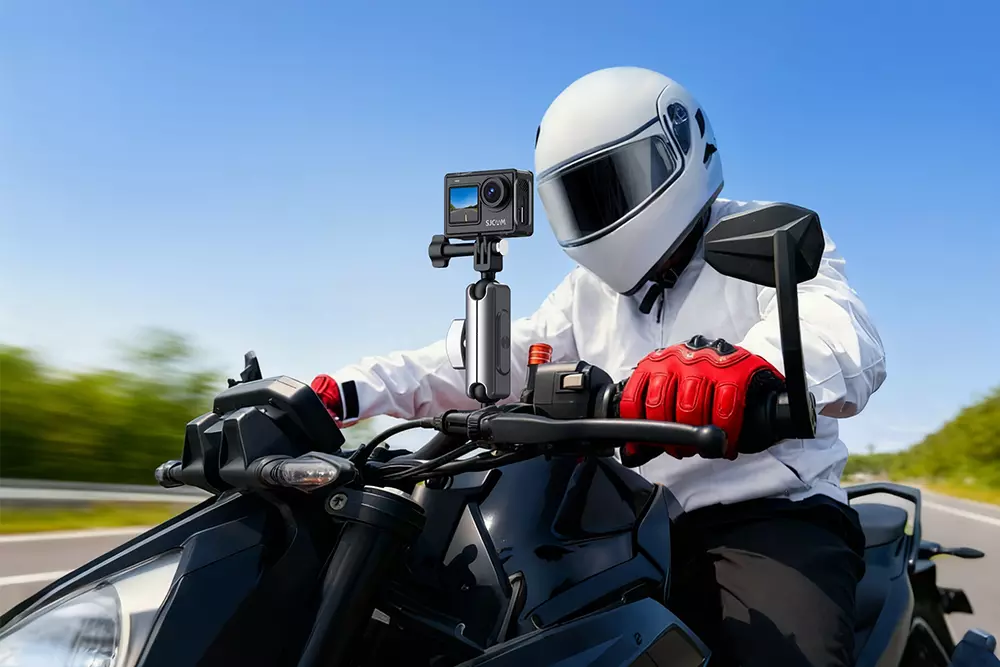
Motorcycle Action Camera vs Dash Cam: What’s Better for Riders
Riders today have more options than ever for recording their journeys. Two of the most popular choices are the motorcycle action camera and the traditional dash cam.
Both devices capture video while you ride, yet they serve different primary purposes and deliver very different results. Understanding the strengths and limitations of each helps you choose the right tool for your needs — or decide whether using both makes sense.
This comprehensive comparison examines motorcycle action cameras and dash cams across key factors that matter to riders: image quality and perspective, stabilization, mounting flexibility, durability, battery performance, ease of use, legal and safety value, and overall versatility.
By the end, you will have a clear picture of which option is better for your riding style and goals.
Understanding the Two Categories
A motorcycle action camera is a compact, versatile device originally designed for sports and outdoor activities. Modern models are highly adaptable to motorcycle use.
They typically feature wide-angle lenses, advanced electronic image stabilization, multiple mounting options (helmet, handlebar, chest, etc.), and the ability to record high-resolution video suitable for both documentation and content creation.
A dash cam (or motorcycle-specific dash cam) is primarily designed as a continuous recording device focused on safety and evidence.
These cameras usually mount in a fixed position on the bike — often near the handlebars, mirrors, or fairing — and emphasize loop recording, automatic power-on with the ignition, parking mode, and reliable all-day operation. Video quality and creative flexibility are usually secondary to consistent forward-facing coverage.
Perspective and Field of View
One of the biggest differences lies in the viewing angle and immersion.
Motorcycle action cameras excel at delivering authentic first-person perspective. When mounted on a helmet, they show exactly what the rider sees, including leans, head movements, and the full road environment.
Chest or handlebar mounts still provide dynamic, engaging footage that feels alive. The wide field of view (often 140–170 degrees) captures more of the surroundings, making the video more interesting for personal archives or social media.
Dash cams, by contrast, typically offer a fixed forward-facing view optimized for the road ahead.
This perspective is excellent for documenting traffic, road conditions, and potential incidents, but it lacks the immersive quality of a rider’s-eye camera. Footage tends to feel more static and utilitarian.
Winner for engagement and storytelling: Motorcycle action camera.
Read: Best Cheap Action Camera with 4K Video – Affordable &
Stabilization and Footage Quality on the Move
Motorcycles generate significant vibration from the engine and road surface. Stabilization performance is therefore critical.
High-quality motorcycle action cameras use multi-axis gyroscopic electronic image stabilization, often combined with horizon-corection features.
These systems actively counteract shake and help keep the horizon level during leans and turns. The result is relatively smooth, watchable footage even on imperfect roads.
Many dedicated motorcycle dash cams also include basic stabilization, but their primary design goal is continuous reliable recording rather than cinematic smoothness. Some models perform adequately, while others still produce noticeable vibration, especially at higher speeds or on rough surfaces.
Winner for smooth, usable riding footage: Motorcycle action camera (particularly models with advanced stabilization and horizon lock).
Mounting Flexibility and Versatility
This is where the motorcycle action camera clearly pulls ahead for most riders.
Action cameras support a wide range of mounts: helmet (top, side, or chin), chest harness, handlebar, mirror, fairing, and even temporary adhesive mounts. Riders can easily switch angles or run multiple cameras. The same device can be used off the bike for hiking, travel, or other activities.
Dash cams are generally designed for one or two fixed mounting positions. While some motorcycle-specific kits offer limited flexibility, they are far less adaptable. Once installed, they tend to stay in place for continuous recording.
Winner for versatility: Motorcycle action camera.
Battery Life and Power Management
Dash cams usually have a clear advantage here. Many are hardwired to the motorcycle’s electrical system and turn on automatically with the ignition. They support loop recording and can run for the entire duration of a ride (and sometimes longer in parking mode) without battery anxiety.
Motorcycle action cameras typically rely on internal batteries. Recording times of 60–150 minutes are common depending on resolution and settings.
Removable batteries and external power banks or power handles help, but they still require more management than a hardwired dash cam.
For riders who want set-and-forget continuous coverage, a dash cam is more convenient. For those who record selectively or in shorter sessions, an action camera is perfectly adequate.
Winner for continuous all-day recording: Dash cam.
Winner for flexible, selective recording: Motorcycle action camera.
Durability and Weather Resistance
Both categories offer weather-resistant options. Many motorcycle action cameras come with waterproof housings rated to 30 meters or more and are built to handle rain, dust, and temperature changes. Some models are waterproof without a case for light rain and splashes.
Dedicated motorcycle dash cams are also designed for outdoor exposure and often feature robust housings. However, because they remain mounted permanently, long-term UV exposure and constant vibration become more relevant considerations.
Overall durability is comparable when quality products are chosen, though action cameras generally offer more replaceable protective cases.
Audio Performance
Wind noise is a major challenge at motorcycle speeds. Motorcycle action cameras increasingly include detachable wind guards, better internal microphones, and support for external wireless mics. Results vary, but higher-end models can produce usable audio with proper accessories.
Dash cams usually prioritize video over audio. Many produce acceptable but not impressive sound, and external mic options are less common.
Winner for better audio potential: Motorcycle action camera.
Safety and Legal Value
Both devices provide useful evidence in the event of an accident. A fixed forward-facing dash cam offers consistent coverage of the road ahead and is often preferred by insurance companies for its predictable viewpoint.
A motorcycle action camera can also serve this purpose, especially when handlebar- or fairing-mounted. Helmet-mounted footage adds the rider’s exact perspective, which can be valuable in certain disputes, though some insurers may prefer a fixed bike-mounted view.
Many riders ultimately choose to run both: a dash cam for continuous safety coverage and an action camera for immersive or multi-angle footage.
Cost and Overall Value
Entry-level dash cams can be inexpensive, but quality motorcycle-specific models with good video and reliable hardwiring add up.
Motorcycle action cameras range from budget to premium, with mid-range options often delivering excellent value because of their versatility beyond the bike.
When you factor in the ability to use an action camera for other activities (travel, sports, vlogging), the overall value frequently favors the motorcycle action camera for riders who want more than pure documentation.
Which Should You Choose?
Choose a motorcycle action camera if you want:
- Immersive POV footage
- Flexibility to change mounting positions
- Higher-quality stabilized video for content or personal enjoyment
- A device you can also use off the bike
- Better creative control and audio options
Choose a dash cam if you want:
- Continuous, set-and-forget recording
- Automatic power with the bike
- Primary focus on safety and evidence
- Minimal daily management
Many experienced riders eventually use both systems together for maximum coverage and flexibility.
Recommended Motorcycle Action Camera: SJCAM SJ6 Ultra
For riders seeking a capable and versatile motorcycle action camera, the SJCAM SJ6 Ultra is an excellent choice. It combines practical features that address the specific demands of motorcycle use.
The SJ6 Ultra features SteadyMotion 2.0 stabilization with real-time 45° horizon correction, helping keep footage smooth and level during leans, turns, and imperfect road surfaces — a critical advantage for motorcycle video.
Its dual screens (2.0-inch rear touchscreen and 1.3-inch front display) make framing easier, while the lightweight 77g body is comfortable for helmet mounting. The 166° wide-angle lens captures a broad view of the road and scenery, and the included waterproof case provides protection up to 30 meters.
Additional benefits include true 4K video, voice control, Wi-Fi connectivity, and a removable battery. Whether mounted on a helmet for immersive POV, on the handlebars for a stable road view, or used off the bike for other adventures, the SJ6 Ultra delivers reliable performance and strong value.
Final Thoughts
The debate between a motorcycle action camera and a dash cam is not about which device is universally superior — it is about matching the tool to your priorities.
If your main goal is continuous safety documentation with minimal effort, a dedicated dash cam is hard to beat.
If you value immersive footage, mounting flexibility, creative potential, and a device that works beyond the motorcycle, a quality motorcycle action camera is the better overall choice for most riders.
In many cases, the ideal setup combines both. Start with a strong motorcycle action camera such as the SJCAM SJ6 Ultra to capture the full experience of riding, and add a dash cam later if continuous recording becomes a priority. Either way, having reliable video of your rides enhances safety, skill development, and the lasting enjoyment of every journey.
Ride safe, choose the right tools for your needs, and capture the road ahead.