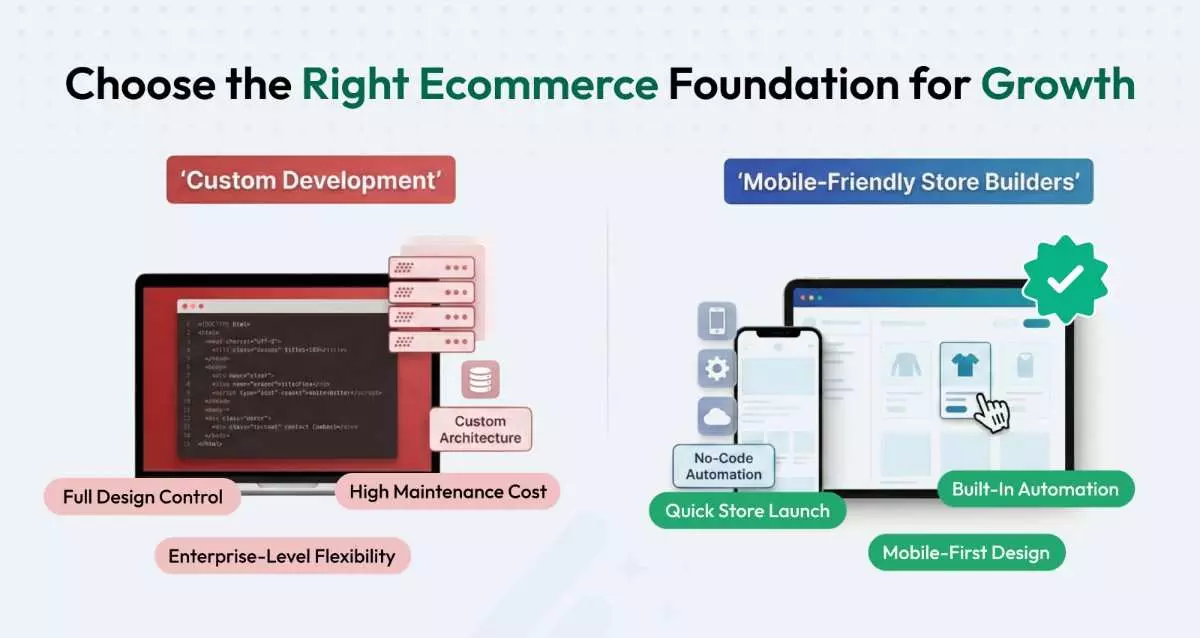
Mobile-Friendly eCommerce Store Builders vs Custom Development: Which Is Better for You?
The way people shop has changed dramatically over the last decade. Mobile phones have become the primary gateway to the internet for millions of Indians, and ecommerce is no exception. The rise of mobile-first shopping behavior has pushed brands—big and small—to rethink how they design and build their online stores.
While earlier, businesses debated between websites and apps, today a new question dominates early-stage ecommerce planning: should you choose a mobile-friendly store builder, or is a custom-built solution a better long-term investment?
For first-time entrepreneurs, MSMEs, and emerging D2C brands, this decision carries significant weight. The right choice can simplify operations, improve customer experience, and accelerate growth. The wrong choice can lead to high costs, operational inefficiencies, and frequent rebuilds. As more Indian businesses adopt Ecommerce Software in India, understanding the difference between mobile-friendly builders and custom builds becomes essential.
This guide takes a deep, narrative look at both paths—how they function, what they offer, and which business types benefit the most. Instead of treating the discussion as a technical comparison, it focuses on real-world needs, customer behaviors, and the operational challenges that growing businesses face daily.
The Rise of Mobile-First Ecommerce in India
India is a mobile-first nation. From metros to smaller towns, mobile phones dominate browsing, discovery, and purchasing. More than 70% of ecommerce traffic comes from mobile devices, and this share continues to grow as data becomes cheaper and mobile networks expand.
This shift has transformed what businesses expect from ecommerce platforms. Mobile responsiveness is no longer optional—it is foundational. A platform that does not automatically adapt to mobile screens immediately loses buyers. Even the design principles have evolved: minimal layouts, fast loading, thumb-friendly navigation, and simplified checkout flows are must-haves.
Because of this, many businesses gravitate toward Ecommerce Platform with Mobile App Builder solutions to ensure they meet customer expectations without needing separate web and app development teams.
But does this replace the need for custom development? Or does custom development still offer unmatched flexibility? The answer depends greatly on the stage and structure of the business.
Understanding Mobile-Friendly Store Builders
Mobile-friendly store builders are SaaS-based ecommerce solutions that allow businesses to create online stores without coding. These platforms prioritize responsive design, ensuring that stores automatically adapt to mobile screens. Many modern builders also offer built-in mobile app creators, allowing businesses to launch an app alongside their website.
Why Are Mobile Store Builders So Popular in India?
For MSMEs and emerging brands, these builders reduce complexity. They eliminate the need to hire developers, manage hosting, or create designs from scratch. Business owners can focus on inventory, shipping, marketing, and customer experience rather than technical upkeep.
A mobile-first builder ensures:
- Responsive storefront design
- Fast loading on mobile devices
- Simplified checkout paths
- Integrated mobile app options
- Easier updates and scalability
Most importantly, these platforms are built for non-technical users. They allow entrepreneurs to manage their online store confidently without learning code or depending heavily on external developers.
The Case for Custom-Built Ecommerce Solutions
While mobile-friendly store builders prioritize simplicity and speed, custom-built ecommerce solutions focus on flexibility. With a custom build, businesses can create unique shopping experiences, advanced functionalities, and tailor-made interfaces that reflect their brand identity.
Custom development is typically preferred by larger enterprises or brands with very specific requirements—structured customization, deep integrations, unique UI functionality, or complex workflow automation.
However, custom builds come with challenges: high development cost, long timelines, ongoing maintenance, and reliance on technical teams for even minor changes. For businesses with dynamic product lines or frequent updates, this can create operational bottlenecks.
Inventory, Shipping & Taxes: Where the Difference Really Shows
Although both mobile-friendly builders and custom solutions can offer feature-rich storefronts, the real difference emerges behind the scenes—in the operational backbone of the business.
Inventory Management
A SaaS-based store builder provides integrated inventory tracking across locations, channels, and order sources. Custom builds require integrations, modules, or additional development.
Shipping Workflows
Mobile-friendly builders usually include built-in courier integrations, label generation, tracking updates, and return workflows. Custom builds need third-party integrations that can increase long-term maintenance.
Tax Compliance
Indian GST rules are extensive. A custom solution typically requires frequent updates to reflect compliance changes. SaaS builders update automatically, reducing the risk of outdated tax structures.
For small and growing businesses, these systems become critical. Complexity grows as order volume increases, and SaaS builders reduce manual effort significantly.
When a Mobile-Friendly Store Builder Makes More Sense
For most MSMEs, startups, and D2C brands, mobile-friendly store builders address real-world challenges with ease. They eliminate development overhead, support mobile commerce trends, and streamline everyday operations. Businesses can focus on products, marketing, customer experience, and growth rather than maintaining technology.
This approach suits companies that:
- Operate in fast-moving categories
- Frequently update their catalogue
- want to launch quickly
- Rely heavily on mobile customers
- Need reliable automation
- Want predictable monthly costs
Mobile-friendly builders also avoid the risk of platform abandonment—something small brands face when developers move on, leave the project, or lose interest.
When a Custom Build Is the Right Choice
Custom ecommerce development fits businesses that require specialized workflows. This includes large enterprise systems, unique product customizers, unusual checkout logic, or deeply integrated B2B processes.
It is best suited for businesses that:
- Have complex business models
- Require unique user experiences
- Have in-house development teams
- Need full control of the backend
- Are prepared for high maintenance costs
For such companies, the investment offers long-term differentiation.
The Hybrid Mindset: Scalability Without Overcomplication
Many Indian businesses assume they must choose between convenience and customization. But today’s SaaS platforms blend both worlds—offering strong mobile-first design, integrated apps, and scalable backend systems while still allowing customization.
This hybrid mindset is useful for brands that want an agile foundation without giving up flexibility. Instead of building everything from scratch, businesses start with a reliable base and customize only where needed.
Read: Simplified MSME Identification Beyond Udyog Aadhaar
At this stage, even MSMEs realize that rebuilding platforms every two years is unsustainable. A scalable foundation saves both cost and effort.
Cost, Time, and Long-Term Practicality
Custom builds often come with unpredictable costs. Patchwork development, plugin conflicts, hosting issues, and security patches collectively increase expenses. On the other hand, mobile-friendly builders offer predictable pricing, automatic updates, and built-in support.
A business evaluating long-term practicality should consider:
- How fast they want to launch
- How often changes are needed
- How important mobile is to their audience
- How much they want to depend on developers
- How much operational automation they need
Choosing the right ecosystem reduces friction in scaling.
Why the Indian Market Leans Toward Mobile-Friendly Solutions
Indian ecommerce grows rapidly, but it also evolves constantly. Payment preferences shift, logistics models improve, and GST rules get updated periodically. Mobile-friendly builders adapt quickly to these changes, allowing businesses to keep up without development overhauls.
Moreover, mobile commerce drives a large portion of the revenue. A platform optimized for mobile traffic naturally aligns with the purchasing behavior of Indian shoppers.
While enterprises may still choose custom builds for differentiation, most ecommerce sellers prefer systems that combine functionality, convenience, and reliability.
And for businesses seeking long-term scalability with minimal complexity, SaaS platforms that support mobile-first experiences continue to be the preferred choice.
Conclusion: Choosing What Aligns With Your Business Reality
Both mobile-friendly store builders and custom-built ecommerce solutions have merit. The right choice depends on your business stage, goals, operational capacity, and long-term vision. For entrepreneurs and MSMEs who want an agile, mobile-optimized, easy-to-manage foundation, mobile-friendly builders offer unmatched practicality. For businesses with niche requirements or enterprise-level customization needs, custom builds offer control and uniqueness.
In a market where customer expectations rise continuously and mobile commerce dominates online traffic, choosing a platform that supports reliability, automation, and simplicity becomes essential. Whether you’re exploring SaaS options or full custom development, the goal remains the same: building an ecosystem that supports growth without unnecessary friction.