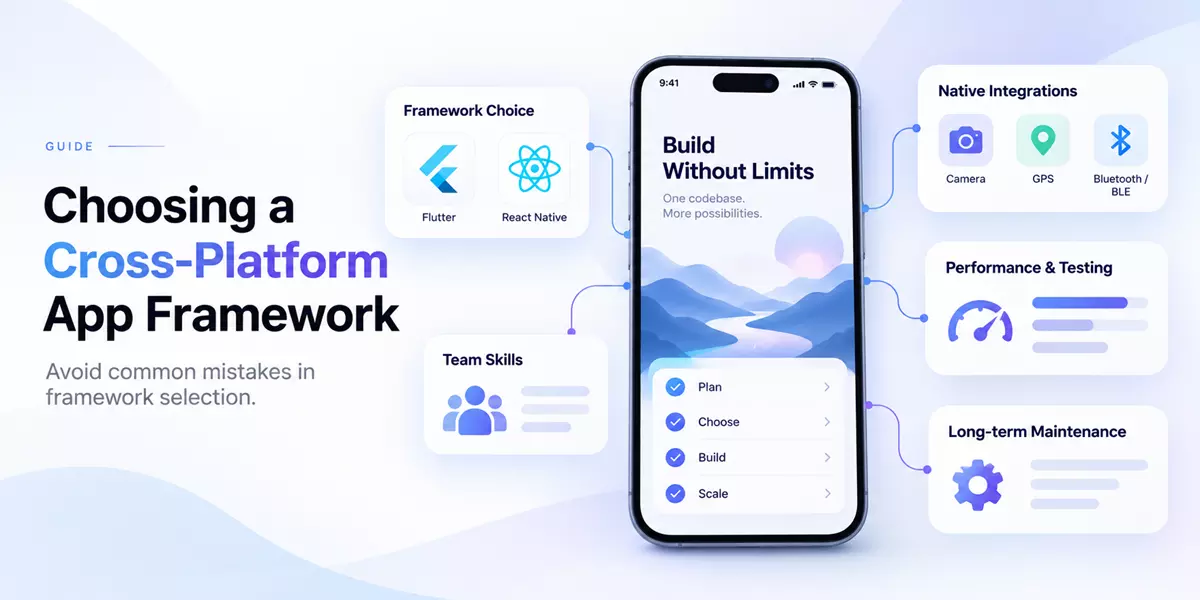
5 Mistakes to Avoid When Choosing a Cross-Platform App Framework
Choosing the wrong mobile app framework can create problems later with integrations, maintenance, performance, and team productivity.
Cross-platform development can reduce some duplicated work across iOS and Android, but the framework still needs to match the product requirements, technical constraints, and the team that will maintain the app.
Flutter and React Native are both common options, but neither is automatically the right choice for every project.
Here are five mistakes to avoid before choosing a cross-platform mobile framework.
1. Choosing a Framework Only Because It Is Popular
A popular framework is not automatically the best fit for your app.
Start by defining what the product actually needs.
Consider:
- iOS and Android support
- user authentication
- payments
- offline functionality
- backend APIs
- third-party integrations
- native device features
The framework should support these requirements instead of forcing the product to fit the technology.
2. Ignoring the Skills of Your Development Team
Team experience can directly affect how easy the app is to build and maintain.
If your developers already use React, JavaScript, or TypeScript, React Native may feel more familiar.
If the team has experience with Flutter and Dart, Flutter may be more practical.
This does not make one framework better than the other. The important question is whether the team can build, test, update, and support the app over time.
3. Not Testing Native Integrations Early
Some mobile apps depend heavily on device-specific features.
Examples include:
- camera access
- GPS
- Bluetooth and BLE
- biometric authentication
- sensors
- background services
- vendor-specific SDKs
Both Flutter and React Native can support native functionality, but some requirements may need plugins or platform-specific code.
For example, if an app depends on BLE hardware or a specialized vendor SDK, it is better to test that integration before selecting the final framework.
A small proof of concept can reveal compatibility issues early.
4. Comparing Performance Without Real Testing
It is easy to find general claims that one framework is faster than another.
In practice, mobile app performance depends on much more than the framework.
It can be affected by:
- UI complexity
- API response time
- backend performance
- database queries
- native integrations
- device capabilities
- network conditions
- implementation quality
Instead of relying only on generic benchmarks, test the most important workflows on representative devices.
If you are comparing both frameworks in detail, this Flutter vs React Native comparison covers UI, performance, MVP development, cost, backend integration, native features, and long-term maintenance.
Read: What technologies are used in mobile app development services
5. Forgetting Long-Term Maintenance
Launching the app is only the beginning.
Mobile applications also need ongoing work for:
- framework updates
- dependency upgrades
- operating-system changes
- security improvements
- bug fixes
- new features
Before choosing a framework, check whether important libraries are actively maintained and whether your team can support the technology in the long term.
For businesses planning a complete product, reviewing the Mobile App Development Services process can also help connect framework selection with UI/UX, backend development, testing, and release planning.
How to Make a Better Framework Decision
Before making the final choice:
- Define the app requirements.
- Identify critical native features.
- Review the team's technical skills.
- Test difficult integrations early.
- Check backend and API requirements.
- Plan for long-term maintenance.
The goal is not to choose the most popular framework. It is to choose the one that fits the product and can be supported over time.
Final Thoughts
Cross-platform development can be a practical approach for building apps for both iOS and Android, but framework selection should be based on real product needs.
Focus on requirements, integrations, team capability, testing, and maintenance before making the final decision.
A good framework is the one that helps your team build and maintain the app without unnecessary complexity.