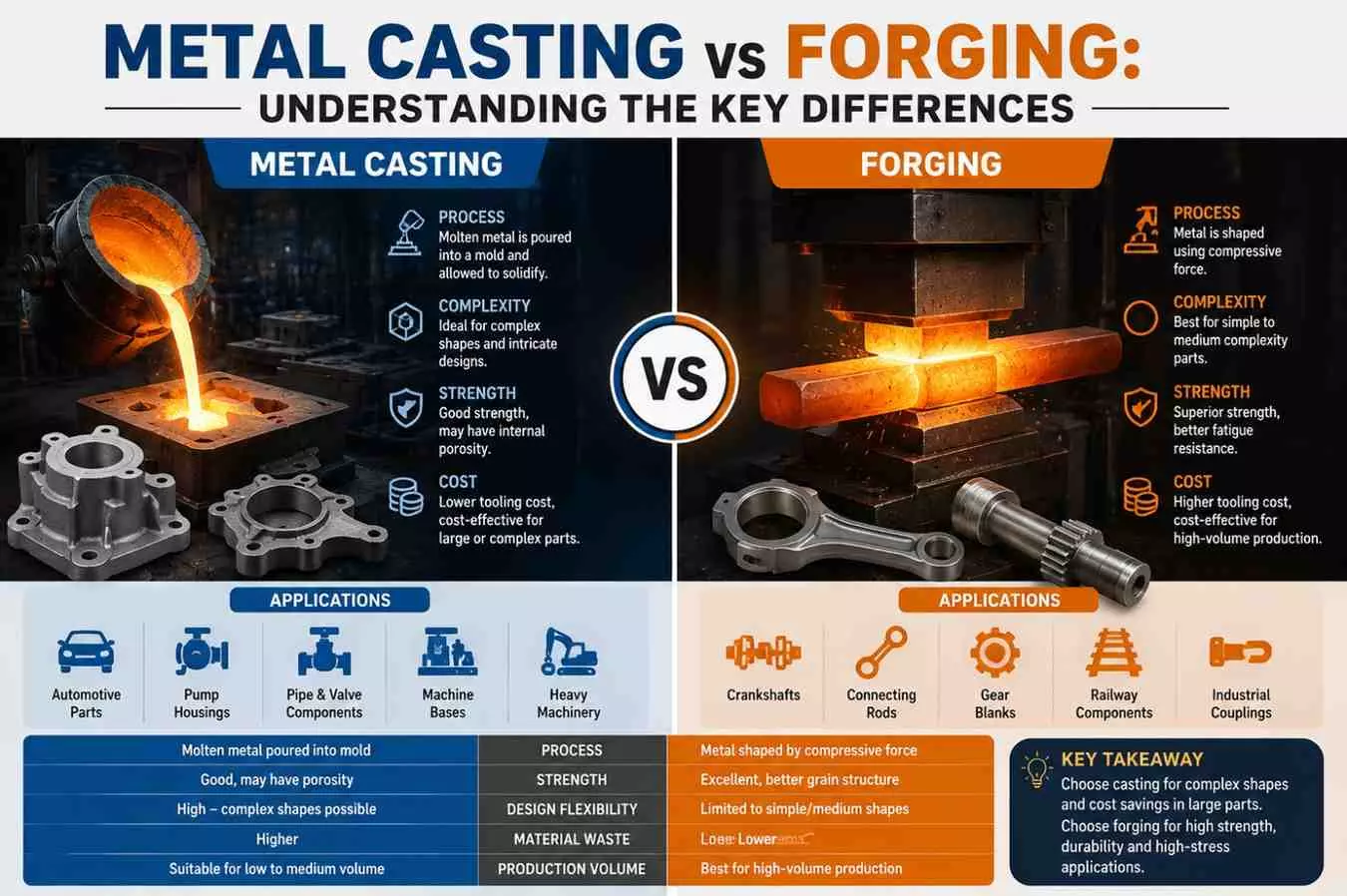
Metal Casting vs Forging: Understanding the Key Differences
Metal casting and forging are two widely used manufacturing processes for producing industrial metal components.
Both methods are important in industries such as automotive, railway, aerospace, construction, agriculture, oil & gas, and heavy engineering.
However, metal casting and forging differ in terms of manufacturing methods, material properties, strength, cost, and applications.
Understanding the differences between metal casting and Forging Services helps manufacturers select the most suitable process based on component design, performance requirements, and production volume.
Key Takeaways
- Metal casting and forging are both important industrial manufacturing processes.
- Casting is suitable for complex and large components.
- Forging provides superior strength and durability.
- Casting is often more cost-effective for intricate designs.
- Forging is ideal for high-stress industrial applications.
What is Metal Casting?
Metal Casting is a manufacturing process where molten metal is poured into a mold cavity and allowed to solidify into the desired shape.
Common Casting Materials
- Cast iron
- Aluminum
- Stainless steel
- Carbon steel
- Bronze
Advantages of Metal Casting
- Suitable for complex shapes
- Cost-effective for large parts
- Wide material flexibility
- Ideal for detailed designs
What is Forging?
Forging is a metal shaping process that uses compressive force to form metal into a desired shape.
Common Forging Materials
- Carbon steel
- Alloy steel
- Stainless steel
- Titanium
- Aluminum
Advantages of Forging
- Higher mechanical strength
- Better grain structure
- Improved fatigue resistance
- Stronger impact resistance
Key Differences Between Metal Casting and Forging
1. Manufacturing Process
Metal Casting:
- Molten metal is poured into molds.
- Suitable for intricate and complex shapes.
Forging:
- Metal is shaped using pressure and force.
- Produces stronger and denser components.
2. Strength and Durability
Metal Casting:
- Good strength for many industrial applications.
- May contain internal porosity in some cases.
Forging:
- Superior mechanical strength.
- Better resistance to stress and fatigue.
3. Component Complexity
Metal Casting:
- Best for complex geometries and detailed designs.
Forging:
- Better for simple and medium-complexity components.
4. Production Cost
Metal Casting:
- Lower tooling costs for complex components.
- Cost-effective for large and heavy parts.
Forging:
- Higher tooling investment.
- Economical for high-volume production.
5. Surface Finish and Accuracy
Metal Casting:
- Good surface quality depending on casting method used by Casting Manufacturer.
Forging:
- Often requires additional machining for precise dimensions.
Read: Advanced Shot Blasting Machine Manufacturing for the
Applications of Metal Casting
Common Industries
- Automotive
- Construction
- Pump manufacturing
- Valve manufacturing
- Heavy machinery
Common Products
- Engine blocks
- Pump housings
- Pipe fittings
- Industrial machine bases
Applications of Forging
Common Industries
- Aerospace
- Railway
- Automotive
- Oil & Gas
- Agriculture
Common Products
- Crankshafts
- Connecting rods
- Gear blanks
- Railway components
Which Process is Better?
The choice between metal casting and forging depends on the product application, strength requirements, design complexity, and production volume.
Metal Casting is Preferred When:
- Complex designs are required
- Large components are needed
- Lower production cost is important
Forging is Preferred When:
- High strength is required
- Components face heavy stress
- Better fatigue resistance is necessary
FAQs
1. What is the main difference between casting and forging?
Casting uses molten metal poured into molds, while forging shapes metal using compressive force.
2. Which process produces stronger components?
Forging generally produces stronger and more durable components because of improved grain structure.
3. Is metal casting cheaper than forging?
Casting can be more cost-effective for complex or large components, while forging is economical for high-volume production.
4. Which industries use forged components?
Automotive, aerospace, railway, agriculture, and oil & gas industries widely use forged components.
5. When should metal casting be preferred?
Metal casting is preferred for components with complex shapes, detailed designs, and larger dimensions.