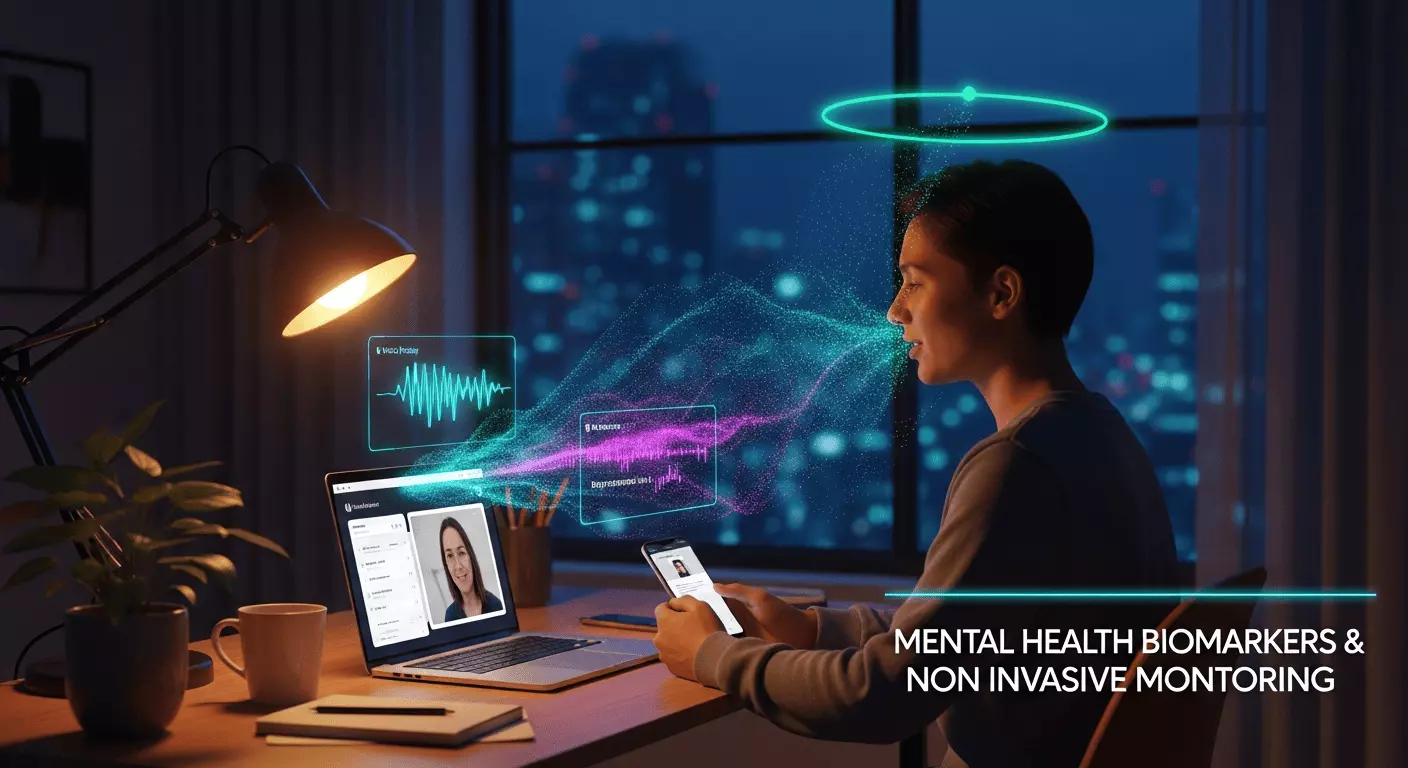
Mental Health Biomarkers and Non Invasive Monitoring
The landscape of mental health diagnostics is undergoing a fundamental shift in 2026. For decades, clinicians relied on retrospective self-reporting—a method vulnerable to memory bias and the "white coat effect."
Today, the integration of passive digital biomarkers into mobile ecosystems is moving the needle from reactive treatment to proactive maintenance.
This guide explores how the 2026 updates to Apple’s HealthKit and Google’s Health Connect have unlocked non-invasive monitoring.
We specifically examine the use of typing dynamics and vocal analysis to identify mental health trends before a crisis occurs.
This analysis is intended for healthcare providers, developers, and privacy advocates seeking to understand the current technical and ethical state of behavioral informatics.
The Current State of Passive Health Monitoring in 2026
By early 2026, the "Quantified Self" movement has matured into "Continuous Clinical Insights." The primary friction point—user burden—has been largely eliminated by shifting from active data entry to passive background sensing.
Apple and Google have standardizing the way "Mental Wellbeing" data is categorized. In previous years, these platforms focused on heart rate and sleep.
Now, they provide secure, on-device hooks for behavioral patterns. We are seeing a move away from sporadic mood logging toward high-frequency, low-friction data streams that capture the reality of a user’s daily life without requiring them to open a specific app.
The Core Framework: Typing Patterns and Voice Tone
The technical foundation of 2026 mental health monitoring rests on two primary digital biomarkers: keystroke dynamics and vocal prosody.
These are processed locally on the device to maintain the "Privacy Wall" while providing actionable insights to authorized clinical apps.
Keystroke Dynamics: The Pulse of Cognition
Typing is a complex neuromotor task. Changes in mental state often manifest as subtle variations in how we interact with our keyboards. Advanced APIs now allow for the analysis of several key metrics:
- Flight Time: The duration between releasing one key and pressing the next. Significant increases in flight time can correlate with cognitive fatigue or depressive episodes.
- Dwell Time: How long a finger stays on a specific key. Erratic dwell times may signal anxiety or psychomotor agitation.
- Correction Rate: The frequency of backspacing and auto-correct reliance, which often spikes during periods of high stress or decreased focus.
Vocal Prosody: Identifying Sub-Audible Shifts
While typing measures motor and cognitive speed, voice tone captures emotional state through prosody—the rhythm, stress, and intonation of speech.
In 2026, HealthKit and Health Connect allow apps to request "Vocal Health Metrics" derived from short snippets of speech during phone calls or virtual assistant interactions.
This does not involve recording the content of what is said, but rather the acoustic metadata:
- Pitch Variability: A "flattening" of vocal range is a documented biomarker for clinical depression.
- Speech Rate: Rapid, pressured speech may indicate a manic or hypomanic state.
- Spectral Jitter: Micro-tremors in the voice that are often imperceptible to the human ear but detectable by on-device ML, signaling high physiological stress.
Real-World Application and Implementation
Integrating these biomarkers requires a sophisticated understanding of both medical ethics and mobile architecture.
Organizations focusing on mobile app development in Maryland and other tech hubs are increasingly building "Wrapper Apps" that act as a bridge between these low-level biomarkers and the patient’s care team.
For instance, a modern 2026 implementation for a patient with Bipolar Disorder involves the app monitoring for "Velocity Shifts." If the typing flight time decreases significantly while speech rate increases over a 48-hour period, the system can trigger a "Soft Alert."
This prompts the user to complete a quick validated survey or suggests a check-in with their therapist, preventing a full manic episode through early intervention.
AI Tools and Resources
To implement these biomarkers effectively in 2026, developers and clinicians utilize a specific stack of specialized tools:
- Core Motion & HealthKit Frameworks (2026 Edition): Apple’s native tools for accessing high-frequency sensor data. They are essential for any iOS-based health monitoring and now include specific classes for "Mental Wellbeing" metrics.
- TensorFlow Lite for Microcontrollers: Used for on-device processing of vocal jitter and shimmer. This ensures that raw audio never leaves the device, satisfying HIPAA and GDPR requirements.
- Sema (Psychological Signal Processor): A lesser-known but powerful tool that translates raw keystroke data into standardized psychological "scores" based on the latest clinical research.
- Google Health Connect API: The central hub for Android developers to sync behavioural data across multiple health apps, ensuring a unified view of the user’s mental health biomarkers.
Practical Application: The 2026 Workflow
If you are developing or implementing a monitoring system today, the workflow follows a strict logic to ensure data integrity and user trust:
- Permission Layer: Requesting specific access to "Keystroke Timing" and "Voice Metadata" via the OS-level health dashboard.
- Baseline Establishment: The system requires a 14-day "Quiet Period" to establish the user's unique baseline. This accounts for individual differences in typing speed and natural vocal tone.
- Trend Detection: Rather than flagging single instances of "slow typing," the system looks for 3-standard-deviation shifts from the established baseline over a rolling 72-hour window.
- Clinical Integration: Data is encrypted and sent to a provider dashboard where it is visualized as a "Behavioral Stability Score."
Read: Digital Health Startups vs. Big Tech: Who Will Shape the Future
Risks, Trade-offs, and Limitations
Despite the technical leaps of 2026, these systems are not infallible. The primary risk is the Contextual False Positive.
- The Failure Scenario: A user spends a weekend at a loud music festival. The ambient noise affects the vocal analysis (jitter), and physical exhaustion leads to slower typing (flight time). The system flags this as a "Depressive Trend."
- Warning Signs: Systems that lack "Activity Context" (e.g., not checking if the user’s GPS shows they are at a concert or if their heart rate is elevated from exercise) are prone to these errors.
- The Solution: Biomarkers must always be interpreted in the context of other health data, such as sleep, movement, and location, to ensure the "Mental Health Score" isn't just a "Hangover Score."
Key Takeaways
- Passive is Priority: In 2026, the most valuable mental health data is collected without user effort, focusing on the "how" of interaction rather than the "what."
- On-Device is Non-Negotiable: Privacy standards now dictate that raw behavioral data (audio/keystrokes) must be processed locally; only the calculated biomarker should be uploaded.
- Keystrokes = Cognition: Typing flight time and correction rates are now recognized as valid indicators of cognitive load and emotional stability.
- Prosody > Content: Voice monitoring in 2026 focuses on the acoustic signature of speech, providing a window into the autonomic nervous system without compromising the privacy of conversation content.
As we move further into 2026, the goal of these technologies remains clear: to provide a safety net that catches the subtle, sub-clinical changes in behavior that precede a mental health crisis. By leveraging the tools already in our pockets, we are creating a more responsive and empathetic healthcare system.