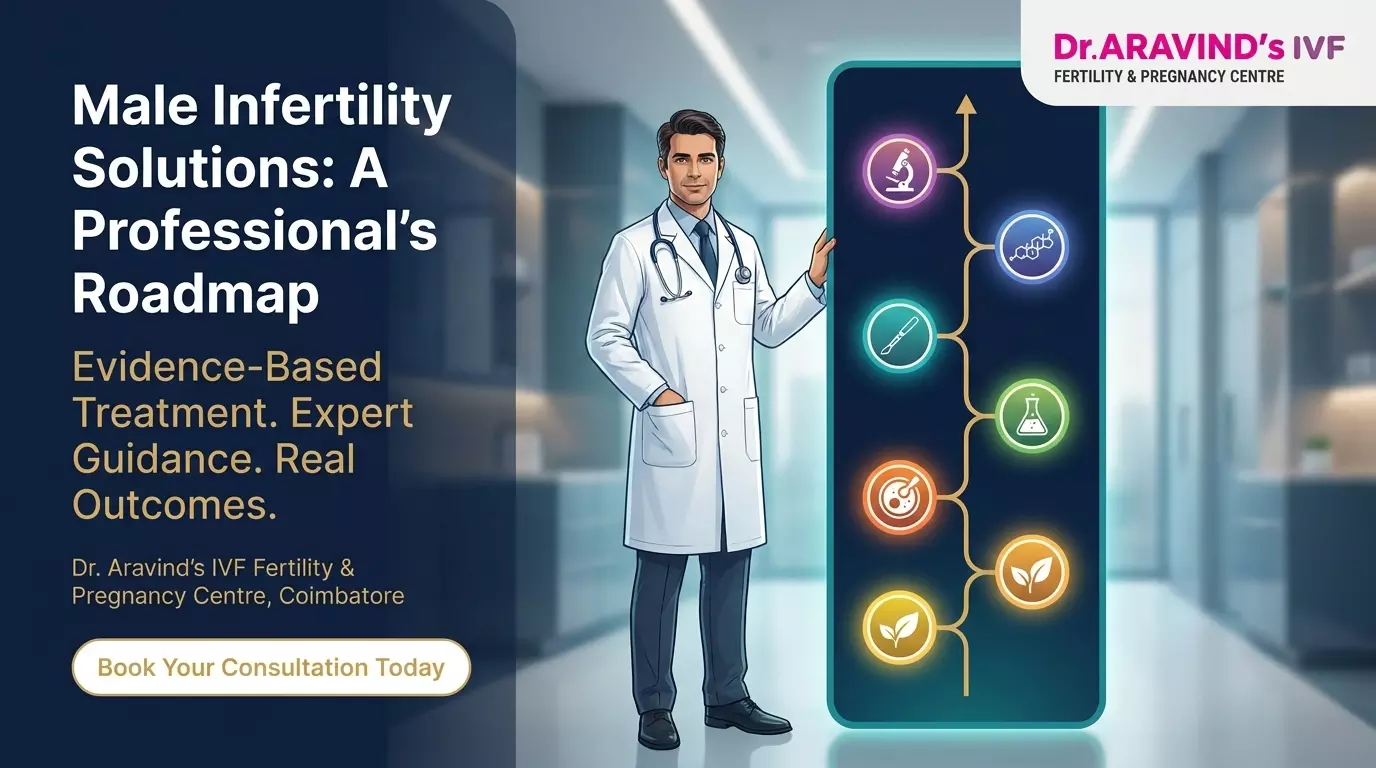
Male Infertility Solutions: A Professional's Roadmap to Effective Treatment Modalities
Effective male infertility treatment does not follow a single path.
It follows a sequence — diagnosis first, treatment matched to findings, and ongoing monitoring to track outcomes. Men who understand this sequence make better decisions at every stage.
Working with the best fertility specialist in Coimbatore means having a clinician who reads your specific results and builds a roadmap around your actual diagnosis rather than applying a generic protocol to a complex, individual problem.
Step 1: Clinical Diagnosis Before Any Treatment Decision
No treatment decision is valid without a complete clinical picture.
A proper male fertility evaluation includes:
- Semen analysis — measuring sperm count, motility, morphology, and volume
- Hormonal panel — testosterone, FSH, LH, prolactin, and thyroid function
- Scrotal ultrasound with Doppler — identifying varicocele, obstruction, or testicular abnormalities
- Genetic testing — karyotyping and Y-chromosome microdeletion analysis for severe cases
- Post-ejaculatory urinalysis — ruling out retrograde ejaculation where indicated
Each of these tests answers a different clinical question. Together, they form the foundation on which every treatment plan must be built. Skipping any layer risks treating the wrong cause entirely. Connecting with the best male fertility doctor in Coimbatore ensures this diagnostic process is thorough, accurate, and properly interpreted before any treatment begins.
Step 2: Hormonal Therapy for Endocrine-Based Infertility
Hormonal imbalance is a correctable cause of male infertility in a significant proportion of men.
When FSH, LH, or testosterone levels fall outside the clinical range, sperm production is directly affected. Targeted hormonal therapy uses medications to restore the endocrine environment that sperm development requires.
Common therapeutic approaches include:
- Clomiphene citrate — stimulates FSH and LH release to drive sperm production
- Gonadotropin therapy — used in hypogonadotropic hypogonadism where the pituitary fails to signal adequately
- Prolactin management — elevated prolactin suppresses testosterone and responds to targeted medication
- Thyroid correction — unmanaged thyroid disorders affect reproductive hormone balance significantly
Hormonal treatment is assessed over three to six months, aligned with the sperm regeneration cycle of approximately 72 days.
Step 3: Surgical Interventions That Restore Fertility
Two surgical conditions account for a large proportion of correctable male infertility cases.
Varicocele repair:
Microsurgical varicocelectomy is the gold standard treatment for varicocele — enlarged scrotal veins that raise testicular temperature and suppress sperm quality.
Clinical evidence shows sperm count improvement in 60 to 70 percent of treated men. Natural conception rates of 30 to 50 percent are documented within two years of surgery.
Obstruction correction:
Vasovasostomy and vasoepididymostomy are microsurgical procedures that restore sperm flow in men with obstructive azoospermia caused by prior vasectomy, infection, or injury. Success rates depend on the location and duration of obstruction and the experience of the operating surgeon.
Both procedures are most effective when performed by specialists with dedicated training in reproductive microsurgery.
Step 4: Assisted Reproductive Techniques for Male Factor Cases
When natural conception or surgical repair alone is insufficient, assisted reproductive techniques offer proven clinical solutions.
IUI (Intrauterine Insemination):
Appropriate for mild to moderate male factor cases. Processed sperm is placed directly into the uterus at the time of ovulation, reducing the distance and barriers sperm must navigate.
IVF (In Vitro Fertilisation):
Used when sperm parameters require laboratory-controlled fertilisation. Eggs and sperm are combined in a controlled environment, and the resulting embryos are transferred to the uterus.
ICSI (Intracytoplasmic Sperm Injection):
The most precise intervention for severe male factor infertility. A single healthy sperm is injected directly into a mature egg, bypassing the need for sperm to penetrate the egg independently. ICSI has transformed outcomes for men with very low count, poor motility, or high sperm DNA fragmentation.
Men considering these pathways should speak with a specialist at a dedicated infertility centre in Coimbatore to understand which technique is appropriate for their specific semen profile and their partner's reproductive health.
Read: How to Find the Best IVF Doctor in Delhi for a Successful Fertility
Step 5: Sperm Retrieval for Azoospermia
Azoospermia — the complete absence of sperm in ejaculate — is not an absolute barrier to biological fatherhood.
Surgical sperm retrieval techniques make IVF with ICSI possible even in these cases:
- TESA (Testicular Sperm Aspiration) — sperm aspirated directly from testicular tissue using a fine needle
- TESE (Testicular Sperm Extraction) — small testicular tissue biopsy from which sperm are extracted
- Micro-TESE — microsurgical technique that identifies and retrieves sperm from specific tubules in men with non-obstructive azoospermia
Retrieved sperm is used immediately for ICSI or cryopreserved for future cycles. The success of retrieval depends on the underlying cause of azoospermia — obstructive causes yield significantly higher retrieval rates than non-obstructive causes.
Step 6: Lifestyle Optimisation as an Active Treatment Layer
Lifestyle is not a soft add-on to clinical treatment.
It is an active treatment layer that affects how well every other intervention works. Key optimisation areas:
- Nutrition — antioxidant-rich diet supporting sperm DNA integrity and motility
- Supplementation — CoQ10, zinc, selenium, and vitamin D under specialist guidance
- Sleep — seven to eight hours of quality sleep to maintain hormonal balance
- Stress management — cortisol suppresses testosterone; active management is clinically relevant
- Eliminating harmful habits — smoking, alcohol, anabolic steroids, and heat exposure all measurably compromise sperm health
Sperm takes 72 days to develop. Lifestyle changes sustained consistently over three months are reflected meaningfully in follow-up semen analysis results.
Why the Best Fertility Specialist in Coimbatore Builds the Right Roadmap
Every man's infertility profile is different.
The same semen analysis result can have five different underlying causes requiring five completely different treatment approaches. A roadmap that works requires a specialist who reads the full clinical picture — not one who applies standard protocols to non-standard cases.
At Dr. Aravind's IVF Fertility & Pregnancy Centre in Coimbatore, the fertility specialist in Coimbatore integrates diagnostic precision, evidence-based treatment sequencing, and ongoing clinical monitoring into a single coordinated care pathway.
From basic semen analysis to advanced microsurgical and assisted reproduction procedures, every treatment decision is made around your specific numbers and your realistic outcomes.
Male infertility is a clinical problem with real, structured solutions. At Dr. Aravind's IVF Fertility & Pregnancy Centre in Coimbatore, the best fertility specialist in Coimbatore ensures every man receives a treatment roadmap built around his diagnosis, not a protocol built around convenience.
Whether you are at the beginning of your investigation or already considering advanced treatment, the right clinical guidance changes everything.