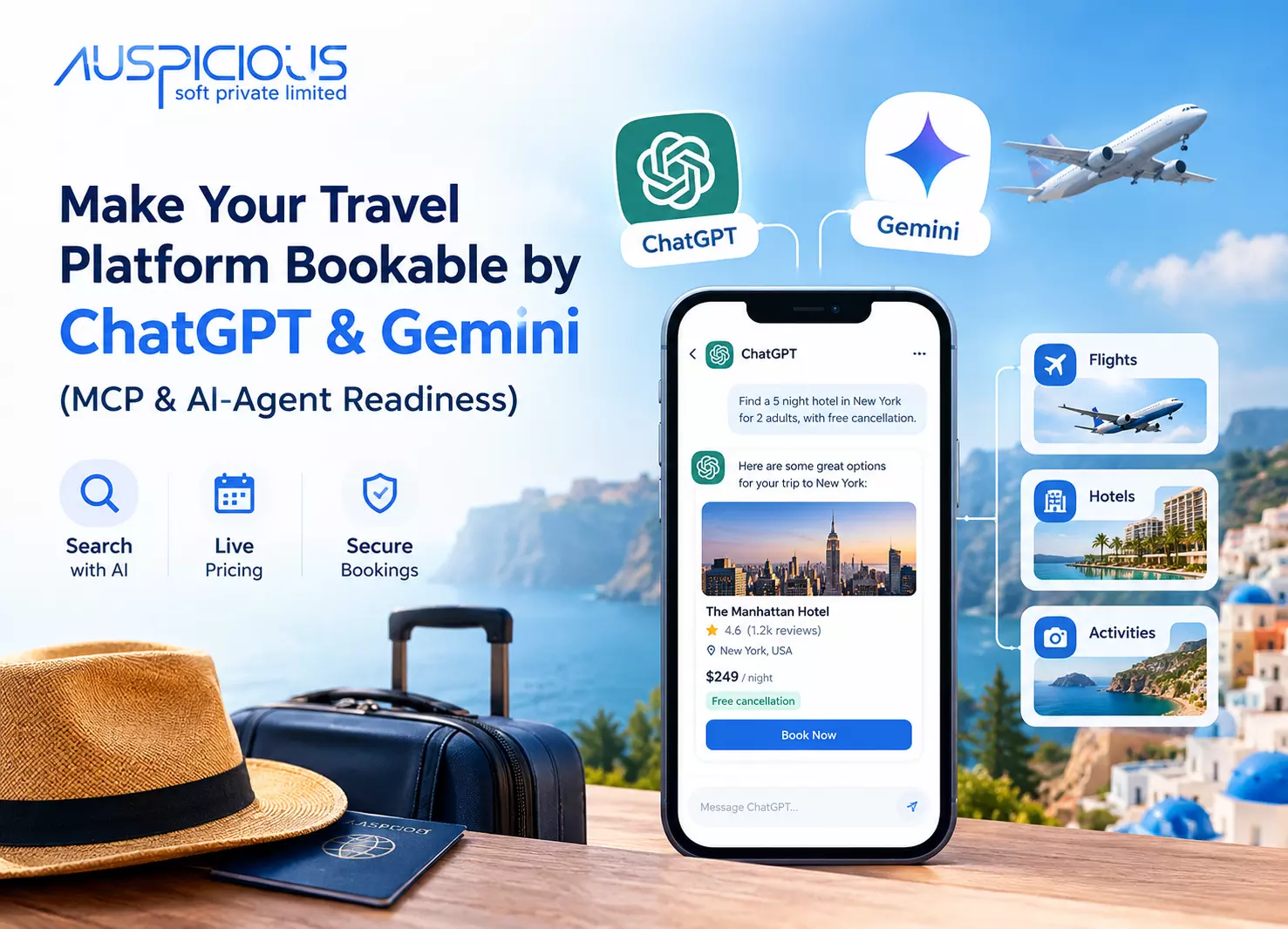
Make Your Travel Platform Bookable by ChatGPT & Gemini: MCP & AI-Agent Readiness Guide
Travelers are changing how they discover and book trips. Instead of opening multiple websites, comparing dozens of hotels, and checking flight options manually, they increasingly expect AI assistants to help them find relevant options and complete tasks with less effort.
For travel businesses, this shift creates a new opportunity: making their platforms accessible to AI assistants such as ChatGPT and Google Gemini. But appearing in an AI-generated recommendation is only the first step.
The bigger opportunity is enabling travelers to move from a simple conversation to a real booking without unnecessary redirects, repeated data entry, or confusing checkout processes.
This is where Travel Software Development and a modern Software Development Service approach can help travel companies prepare their platforms for AI-assisted discovery, real-time availability checks, and booking workflows.
In this guide, we explain how Model Context Protocol (MCP), AI agents, APIs, and secure transaction workflows work together to make travel platforms ready for the next generation of digital bookings.
What Does It Mean to Make a Travel Platform AI-Bookable?
An AI-ready travel platform allows compatible AI assistants and authorized applications to interact with its travel inventory through clearly defined, secure interfaces. Depending on the integration and the capabilities supported by the AI product, travelers may be able to:
- Search for flights based on their budget, destination, and preferred dates.
- Compare hotels using location, amenities, cancellation policies, and guest preferences.
- Discover activities that fit a planned itinerary.
- Check live availability and current pricing.
- Review booking conditions before making a purchase.
- Proceed through a supported booking or payment flow.
Consider a traveler asking ChatGPT to find a family-friendly hotel in Orlando for a five-night stay. An AI assistant could use an appropriate integration to retrieve hotel options, compare supported attributes, and present relevant choices.
If the platform supports transactional actions, the traveler may also be able to continue toward a reservation through an authorized workflow. The exact experience depends on the assistant, its available tools, the travel platform's integration, and the permissions granted to the user.
The key distinction: AI visibility helps travelers discover your business. AI-bookability connects that discovery to a functional, trustworthy reservation process.
Why MCP Matters for Travel Businesses
Model Context Protocol, commonly known as MCP, is an open protocol designed to connect AI applications with external tools and data sources.
For travel companies, MCP can provide a standardized way for compatible AI clients to discover and invoke supported capabilities without requiring a completely different custom integration for every individual workflow.
Rather than building an entirely new booking system for AI, a travel company can expose selected capabilities from its existing platform through a carefully designed integration layer.
For example, an MCP-enabled travel service might expose tools such as:
search_hotels— Find properties matching a destination and travel dates.check_availability— Verify whether a selected room or activity can be booked.get_offer_details— Retrieve the latest price, inclusions, and restrictions.create_booking— Initiate a reservation after the required validations.get_booking_status— Retrieve the status of an existing reservation, subject to authorization.
These are illustrative tool names, not a prescribed MCP standard. Each platform must define its own tool schemas, validation rules, permissions, and business logic.
MCP does not automatically make a website bookable, nor does it guarantee that ChatGPT or Gemini will discover or use an integration. It provides a way to connect compatible AI applications with capabilities that your business deliberately makes available.
MCP vs. Traditional Travel APIs
Traditional APIs remain essential for exchanging data between booking engines, suppliers, payment providers, and travel management systems. MCP can build on those existing capabilities by presenting selected tools in a format compatible with supported AI clients.
The two technologies serve complementary purposes. Traditional APIs handle the underlying operations. MCP can make selected operations accessible to compatible AI applications.
For example, your existing hotel API might return room availability, pricing, and cancellation conditions. An MCP server could expose a validated search tool that invokes this API and returns a structured response an AI assistant can interpret.
This approach allows travel companies to preserve their existing booking infrastructure while adding a new interaction channel.
How ChatGPT and Gemini Fit Into AI-Assisted Travel Booking
ChatGPT and Gemini are not interchangeable booking channels. Each product has its own integration mechanisms, supported capabilities, access requirements, and user experience.
Travel businesses should therefore separate their underlying AI-ready architecture from the specific integration requirements of each assistant.
Making A Travel Platform Accessible Through ChatGPT
Depending on the applicable product and integration pathway, a travel company may be able to connect its services through supported apps, tools, or other approved integrations.
A practical implementation may involve:
- Identifying the supported ChatGPT integration pathway for the intended use case.
- Defining the travel searches and transactional actions the integration should support.
- Connecting those capabilities to the platform's backend services.
- Implementing authentication, authorization, and transaction safeguards.
- Testing the complete journey from a travel query to a confirmed booking.
An MCP server may be suitable when the target ChatGPT environment supports the required MCP integration.
However, MCP compatibility alone does not guarantee that a particular integration can be published, discovered, or used for every transaction. Travel businesses should verify current platform requirements before selecting an implementation strategy.
Preparing for Google Gemini
Google Gemini also supports tool-based and application integrations, but its available capabilities depend on the specific Gemini product and integration environment.
A travel platform may need to connect through supported APIs, function-calling mechanisms, or other compatible integration options. The underlying travel services can often be designed for reuse, even when the assistant-facing integration differs.
For example, both integration pathways might rely on the same hotel search service, pricing engine, and booking validation system.
The connector layer can then adapt those capabilities to the requirements of each supported environment. This avoids maintaining two separate booking engines simply because travelers use different AI assistants.
The Architecture of an AI-Ready Travel Booking Platform
A reliable implementation needs more than an AI chatbot connected to a database. It needs a structured architecture that connects AI requests to real travel inventory, validates every transaction, and protects sensitive information. A typical architecture includes six layers.
1. AI Assistant and Interaction Layer
This is where travelers describe what they want in natural language.
Examples include:
- Find a hotel in New York near public transportation.
- Compare refundable hotel rooms under $250 per night.
- Find a flight that arrives before noon.
- Show me family-friendly activities near my hotel.
The assistant interprets the request and determines which supported tools, if any, are appropriate to call.
Your platform should not depend on the AI assistant to enforce business rules. Those rules belong in your own backend.
2. MCP Server or Integration Adapter
This layer exposes approved platform capabilities through the appropriate interface. It defines the available tools, input parameters, expected outputs, and error responses.
It also determines which actions require authentication or explicit user approval. A well-designed adapter should validate incoming requests rather than blindly forwarding arbitrary instructions to internal services.
For travel companies supporting multiple AI environments, separate adapters can connect to shared backend services.
3. Travel API and Service Layer
The service layer connects AI requests to the systems that power your business.
Depending on the platform, these may include:
- Flight search and booking APIs.
- Hotel inventory and reservation systems.
- Tour and activity providers.
- Car rental services.
- Customer profiles and loyalty programs.
- Payment and invoicing systems.
- Existing property management or global distribution systems.
A robust Software Development Service implementation focuses on making these integrations reliable, maintainable, and consistent across different channels.
4. Inventory, Pricing, and Availability Engine
Travel inventory changes constantly. A room displayed as available a few minutes ago may no longer be available when the traveler attempts to book it.
Your platform should retrieve fresh information from the appropriate source and distinguish between an indicative search result and a confirmed, bookable offer.
Before a reservation is finalized, the system should revalidate the relevant details, including:
- Travel dates and occupancy.
- Final price, taxes, and applicable fees.
- Room, fare, or activity availability.
- Cancellation and refund conditions.
- Supplier restrictions and booking deadlines.
AI-generated summaries must not replace authoritative pricing and availability data.
5. Booking and Payment Layer
Once a traveler selects an offer, the platform must handle the transaction through a controlled workflow.
A typical process includes validating the selected offer, confirming the final amount, collecting any required traveler details, obtaining authorization, submitting the booking, and processing the response from the supplier.
The system should support duplicate-request protection, transaction reconciliation, and clear handling of timeouts or partial failures.
Payment information must be processed through appropriately secured payment infrastructure. An AI assistant should not receive unrestricted access to payment credentials or internal financial systems.
6. Security, Monitoring, and Audit Layer
Every tool invocation should be subject to appropriate access controls, validation, logging, and monitoring.
The platform should record relevant events such as search requests, offer selections, booking attempts, supplier responses, and confirmed reservations without unnecessarily storing sensitive personal information.
This layer helps teams investigate failed transactions, detect suspicious behavior, and demonstrate how important booking decisions were processed.
Step-by-Step: How to Make Your Travel Platform AI-Ready
A phased implementation is usually more practical than attempting to automate the entire booking journey at once.
Step 1: Audit Your Existing Travel Platform
Start by understanding what your current platform can already do. Review your booking engine, supplier integrations, availability services, pricing logic, customer accounts, payment processing, and cancellation workflows.
Identify which functions are available through APIs and which depend on manual operations or tightly coupled application code.
For example, a hotel booking platform may already support hotel search and reservations through REST APIs but lack a reliable endpoint for rechecking a selected room's price before checkout. That gap should be addressed before exposing the booking workflow to an AI assistant.
Deliverable: An inventory of existing capabilities, integration gaps, technical dependencies, and transaction risks.
Step 2: Select The First AI Booking Use Case
Avoid launching with every possible travel transaction. Choose a use case that offers customer value while keeping implementation risk manageable.
Good starting points include:
- Hotel discovery and comparison.
- Destination-based activity search.
- Flight search with clear filtering criteria.
- Availability checks for selected inventory.
- Booking-status retrieval for authenticated customers.
For many businesses, search and comparison are a sensible starting point because they provide useful AI-assisted experiences without immediately introducing the complexity of automated payments and reservations. Once the search flow is reliable, you can expand toward transactional actions.
Step 3: Design Structured Tools For Travel Operations
AI assistants work more reliably when tools have clear names, defined inputs, predictable outputs, and explicit failure responses.
For example, a hotel search tool might accept:
- Destination or geographic coordinates.
- Check-in and check-out dates.
- Number of adults and children.
- Room preferences.
- Maximum budget and currency.
- Required amenities.
The response should return structured results containing essential information, such as property identifiers, room types, pricing, currency, taxes, availability status, and cancellation terms when available.
Avoid returning large blocks of unstructured supplier content when a smaller, validated response will do. Also define how the tool behaves when required inputs are missing, dates are invalid, no inventory is available, or the supplier API fails.
Step 4: Implement MCP Where It Fits Your Integration Strategy
Build an MCP server or compatible adapter around the approved backend operations. Keep the server focused on exposing capabilities, validating inputs, and enforcing access controls.
Business-critical pricing and booking rules should remain in the underlying services. Use explicit schemas and version your tools carefully so that changes do not unexpectedly break existing integrations.
Before connecting the server to a live AI environment, test it with representative requests, invalid parameters, unavailable inventory, and supplier errors.
Step 5: Make Live Pricing and Availability Authoritative
A common mistake is to treat an AI assistant's previously retrieved search result as sufficient evidence that a booking can still be completed. Travel platforms must account for changing inventory, fluctuating prices, taxes, and supplier restrictions.
Use a fresh availability or offer-validation call before the final transaction. If the price has changed, show the updated amount and obtain the necessary user confirmation before proceeding.
If an offer has expired, the system should explain the issue and provide alternative options rather than silently substituting a different product.
Step 6: Build a Safe Booking Workflow
Search and booking should be separate operations with different permission requirements.
A typical reservation workflow is:
- Retrieve relevant travel options.
- Let the traveler select an offer.
- Revalidate availability and the complete price.
- Present the booking details and applicable terms.
- Obtain explicit authorization for the reservation and any payment.
- Submit the transaction using duplicate-request protection.
- Verify the supplier's final response.
- Return the confirmed booking reference or a clear pending or failed status.
Do not report a reservation as confirmed simply because a booking request was submitted. If the supplier times out after receiving the request, check the transaction status before retrying. Otherwise, the system could create duplicate reservations.
Read: Book Budget-Friendly Flights Online at ConfirmationTickets.com
Step 7: Test The Complete Experience Across AI Clients
A successful API response does not necessarily mean the end-to-end AI experience is ready for production. Test realistic customer journeys across every integration you plan to support.
Include variations such as:
- Flexible travel dates.
- Multiple travelers and room configurations.
- Different currencies.
- Missing or contradictory requirements.
- Sold-out inventory.
- Price changes during checkout.
- Invalid or expired offers.
- Supplier timeouts.
- Interrupted payment workflows.
- Unauthorized booking requests.
Also test whether the assistant accurately communicates limitations, cancellation policies, total prices, and the difference between a pending transaction and a confirmed reservation.
Step 8: Monitor Performance and Improve The Experience
Once the integration is live, measure whether it actually improves the booking journey.
Useful metrics include:
- Search-to-offer conversion rate.
- Offer-to-booking conversion rate.
- Booking completion rate.
- Percentage of searches returning valid inventory.
- Price-change frequency during checkout.
- Booking failure and duplicate-transaction rates.
- Average tool response time.
- Customer support contacts per reservation.
Use these results to prioritize improvements. If users frequently abandon the journey after seeing the final price, for example, investigate pricing transparency and the accuracy of the initial offer.
Security and Compliance Considerations for AI Travel Bookings
Travel transactions involve personal information, payment data, and sometimes passport details or other sensitive traveler information. Making a platform accessible to AI applications introduces additional security considerations.
Authentication and Authorization
Public search functions may not require a customer account, but access to personal itineraries, loyalty accounts, booking changes, and cancellations should be protected by appropriate authentication.
The system must verify that the person requesting an action has permission to perform it on the relevant booking. Never rely on natural-language instructions alone as proof of identity or authorization.
Least-Privilege Tool Access
Give each integration only the permissions it needs. A hotel search tool should not have access to customer payment records. A booking-status tool should not automatically have permission to cancel reservations.
Separate read-only operations from transactional actions, and require additional safeguards for higher-risk operations.
Prompt Injection and Untrusted Supplier Content
Supplier descriptions, reviews, and other external data should be treated as untrusted input. A malicious instruction embedded in a hotel description must never be able to change system permissions, reveal confidential information, or trigger an unauthorized transaction.
Validate tool arguments, isolate data from instructions, and enforce security controls in backend code rather than relying solely on the AI model to follow directions.
Data Privacy and Retention
Collect only the traveler information needed to fulfill the requested service. Avoid sending unnecessary personal information to AI systems, and review the data handling, retention, and contractual requirements applicable to each integration.
For US-facing travel businesses, applicable privacy obligations may vary by state, business model, and the type of information collected.
Payment Security
Use established payment providers and tokenization where appropriate. Keep payment credentials out of ordinary model prompts, tool descriptions, and unnecessary application logs.
Ensure that the booking flow provides a clear view of the total amount and obtains the required authorization before a charge or other financial commitment is made.
Auditability and Incident Response
Maintain sufficient operational records to investigate booking errors, unauthorized attempts, and disputes.
Logs should capture relevant transaction identifiers and outcomes while minimizing exposure of personal or payment information. These controls should be part of the architecture from the beginning, not added after the first security issue appears.
Common Mistakes To Avoid When Building AI-Bookable Travel Platforms
Even a technically functional integration can deliver a poor customer experience if the surrounding booking process is not designed carefully.
1. Assuming MCP Automatically Creates Bookings
MCP provides an integration protocol, not a complete reservation engine. Your platform still needs reliable inventory, pricing, booking, and payment services.
2. Returning Outdated Travel Information
Cached search results may be useful for discovery, but final offers should be validated against the appropriate live source before purchase.
3. Giving AI Agents Unrestricted Access
Exposing every internal API creates unnecessary security and operational risks. Publish only the capabilities required for the intended customer journey.
4. Treating A Booking Request As A Confirmed Reservation
Supplier responses can be delayed, rejected, or left in an uncertain state. Confirmation logic must account for these outcomes.
5. Building Separate Business Logic For Every AI Assistant
Different clients may require different integration adapters, but the underlying pricing and booking rules should remain consistent wherever possible.
6. Ignoring The Existing Customer Experience
AI-assisted discovery will not compensate for confusing cancellation policies, unreliable checkout, slow supplier responses, or poor mobile usability.
7. Failing To Plan For Integration Changes
AI platforms and protocols evolve. Use versioned interfaces, automated tests, monitoring, and documented fallback procedures to reduce the impact of changes.
How Travel Software Development Supports MCP and AI-Agent Readiness
Preparing for AI-assisted bookings is a software architecture project as much as an AI integration project.
Travel companies need to connect existing booking infrastructure with new interfaces while protecting transaction integrity, customer privacy, and operational reliability.
Experienced Travel Software Development teams can help assess existing APIs, modernize integration layers, connect travel suppliers, and build the services required for reliable AI-assisted discovery and booking.
A capable Software Development Service partner can also support MCP implementation, AI-agent workflows, authentication, payment integration, automated testing, and production monitoring.
For example, a tour operator might start with an AI-accessible activity search, add real-time availability checks, and then introduce an authorized reservation workflow after validating the first two stages.
This incremental approach helps the business learn from actual customer behavior before investing in more complex automation.
The objective is not to replace every existing booking channel. It is to make the travel platform accessible through additional channels without compromising the experience customers already rely on.
How Much Does It Cost to Make a Travel Platform AI-Ready?
The cost depends on the maturity of the existing platform, the number of supplier integrations, the complexity of the booking process, and the level of automation required.
A platform with documented APIs and a stable booking engine will generally require less integration work than a legacy system with manual workflows and tightly coupled business logic.
The following ranges are illustrative planning estimates, not market averages or fixed quotations.
Basic AI Search Integration: $5,000–$15,000
This scope may include a limited set of search tools, structured travel results, and an initial integration with an existing API. It is best suited to validating an AI-assisted discovery experience before introducing transactional actions.
AI-Ready Booking Integration: $15,000–$40,000
A more comprehensive implementation may include MCP integration, live offer validation, booking workflow improvements, authentication, monitoring, and integration testing. The final scope depends heavily on supplier APIs and the maturity of the existing platform.
Multi-Supplier or Enterprise Implementation: $40,000–$100,000+
Larger projects may involve multiple booking providers, complex pricing rules, customer accounts, loyalty programs, payment workflows, legacy modernization, and advanced security requirements.
Projects involving significant custom development, extensive supplier certification, or complex enterprise infrastructure can exceed these ranges. Before approving a budget, define the first use case, identify the required supplier integrations, and establish measurable acceptance criteria.
How Long Does AI-Agent Integration Take?
Timelines depend on the complexity of the booking platform and the readiness of its existing APIs. A limited search integration may take approximately two to four weeks when the required services are already available and well documented.
A booking-enabled integration with availability validation, authentication, transactional safeguards, and end-to-end testing may take six to twelve weeks or longer.
Enterprise projects involving multiple suppliers, legacy systems, and additional compliance requirements may require several months. These are indicative estimates. Supplier access, external approvals, API limitations, and the condition of the existing platform can materially affect delivery time.
A sensible project plan starts with a technical assessment, proceeds through a limited proof of concept, and expands only after the core workflow performs reliably.
The Future of AI-Agent Booking in the Travel Industry
AI-assisted travel planning is moving beyond recommendations toward interactions that can use tools, retrieve live information, and perform authorized actions.
For travel businesses, this creates an opportunity to make inventory and booking capabilities available wherever compatible AI experiences emerge.
However, success will depend on more than being present in an AI conversation. Platforms will need accurate information, dependable APIs, transparent prices, secure transactions, and clear confirmation processes.
Travel companies that build these foundations now will be better positioned to evaluate new AI distribution channels as they become available.
That does not mean every traveler will stop using traditional websites or booking applications. Many customers will continue to prefer familiar interfaces, especially for complex itineraries and high-value purchases.
The strongest strategy is to support AI-assisted discovery alongside existing channels while maintaining one reliable source of truth for travel inventory and transactions.
Final Thoughts
Making your travel platform bookable through ChatGPT and Gemini requires a clear strategy for integration, live data, secure transactions, and ongoing testing.
MCP can help expose selected capabilities to compatible AI clients, while well-designed APIs and backend services ensure that search results, pricing, and reservations remain accurate.
Start with a focused use case, validate the complete customer journey, and expand toward more advanced agent-driven workflows only when the underlying system is ready.
At Auspicious Soft, we help businesses plan and build scalable digital products around their operational needs.
Our Travel Software Development capabilities can support travel platforms looking to modernize APIs, integrate AI-assisted workflows, and prepare their booking systems for emerging distribution channels.
If your business is exploring MCP integration or AI-agent readiness, the right Software Development Service partner can help you identify the gaps, prioritize the architecture, and build a practical roadmap toward secure, AI-accessible travel bookings.