Madurai Engineering College: Learning, Skills and Opportunities at Solamalai College of Engineering
For many students, engineering is where an interest in technology starts becoming a practical skill.
The experience is not limited to lectures or examinations. Projects, laboratory work, technical events, teamwork, and exposure to industry can all shape how students understand their chosen field.
Solamalai College of Engineering provides an academic environment built around engineering, technology, management, and student development.
The institution was established in 1995 and received NAAC accreditation with an A grade. It functions as an autonomous institution and offers a range of undergraduate and postgraduate programmes.
A Range of Programmes for Different Interests
Engineering covers a wide range of career paths, and students often have different interests when they begin looking at colleges.
Some may be interested in software and computing, while others may prefer electronics, mechanical systems, construction, electrical technology, or emerging areas such as artificial intelligence.
At Solamalai College of Engineering, students can explore programmes across these areas.
The academic portfolio includes undergraduate programmes in engineering and technology and postgraduate programmes covering specialised areas. The institution also offers management education through its MBA programme.
The range of disciplines gives students the opportunity to build their academic journey around their interests rather than following a single engineering pathway.
Learning Beyond the Lecture Hall
Engineering concepts become easier to understand when students get opportunities to apply them.
Laboratory sessions, projects, workshops, seminars, technical activities, and department-level programmes can provide students with a different perspective on subjects covered in the curriculum.
Such experiences encourage students to test ideas, work with others, identify problems, and develop practical solutions.
The college's departments regularly conduct academic and technical activities.
For example, students and faculty have participated in workshops, guest lectures, faculty development programmes, industry interaction events, and technology-focused activities across different engineering departments.
This type of exposure can be particularly useful for students who want their engineering education to have a practical connection with the work they may pursue after graduation.
Read: Transforming Business Performance Through Data Engineering
Computer Science and Emerging Technology
Computer science continues to influence almost every industry, from finance and healthcare to manufacturing and communication.
As a result, students entering computing-related programmes often look for opportunities to develop skills beyond basic programming.
The Computer Science and Engineering department provides opportunities for faculty and students to engage with areas such as cybersecurity, data science, networking, process mining, and artificial intelligence-related developments.
Faculty members have also participated in NPTEL courses and technology-oriented programmes.
The college also offers programmes connected with emerging technology, including Artificial Intelligence and Data Science and Computer Science and Business Systems, giving students additional academic pathways within the technology domain.
Industry Interaction and Professional Skills
A degree provides academic knowledge, but professional life requires additional skills.
Communication, teamwork, presentation ability, problem-solving, technical confidence, and the ability to work with modern tools all become important as students progress through college.
Industry interaction can help students understand how classroom concepts are used in actual workplaces.
Solamalai College of Engineering has collaborated with professional bodies and organisations for value-added programmes intended to connect academic learning with industry requirements.collaborated with professional bodies and organisations for value-added programmes intended to connect academic learning with industry requirements.
The college's academic activities also include events where students and faculty interact with professionals and participate in technology-focused programmes. These experiences can help students become more familiar with current developments in their chosen discipline.
Projects, Competitions and Student Participation
Student development often happens through activities outside the regular timetable.
Projects and technical competitions give students a chance to work collaboratively, present ideas, and learn from the process of developing something themselves.
Department activities at Solamalai College of Engineering include project expos, technical workshops, conferences, guest lectures, and student participation in external competitions.
These activities can also help students discover interests that may not become apparent through conventional classroom learning.
For an engineering student, participating in such activities can gradually build confidence in explaining an idea, handling a project, working in a team, and responding to practical challenges.
Support for Innovation and Entrepreneurship
Not every engineering graduate follows the traditional route of joining a company immediately after graduation. Some students may want to develop their own products, services, or business ideas.
Solamalai College of Engineering has an incubation initiative, the Solamalai Foundation for Start-up Incubation (SFSI).
The centre provides dedicated space and technological assistance through mentors with multidisciplinary expertise, supporting young people interested in developing innovative ideas into business propositions.
An environment that gives students room to experiment with ideas can complement conventional academic learning and introduce them to entrepreneurship at an early stage.
Placement and Career Preparation
Career preparation is another part of the engineering college experience. Students typically need more than subject knowledge when they begin applying for internships and jobs.
Aptitude, communication, technical skills, interview preparation, and awareness of industry expectations can all influence their readiness.
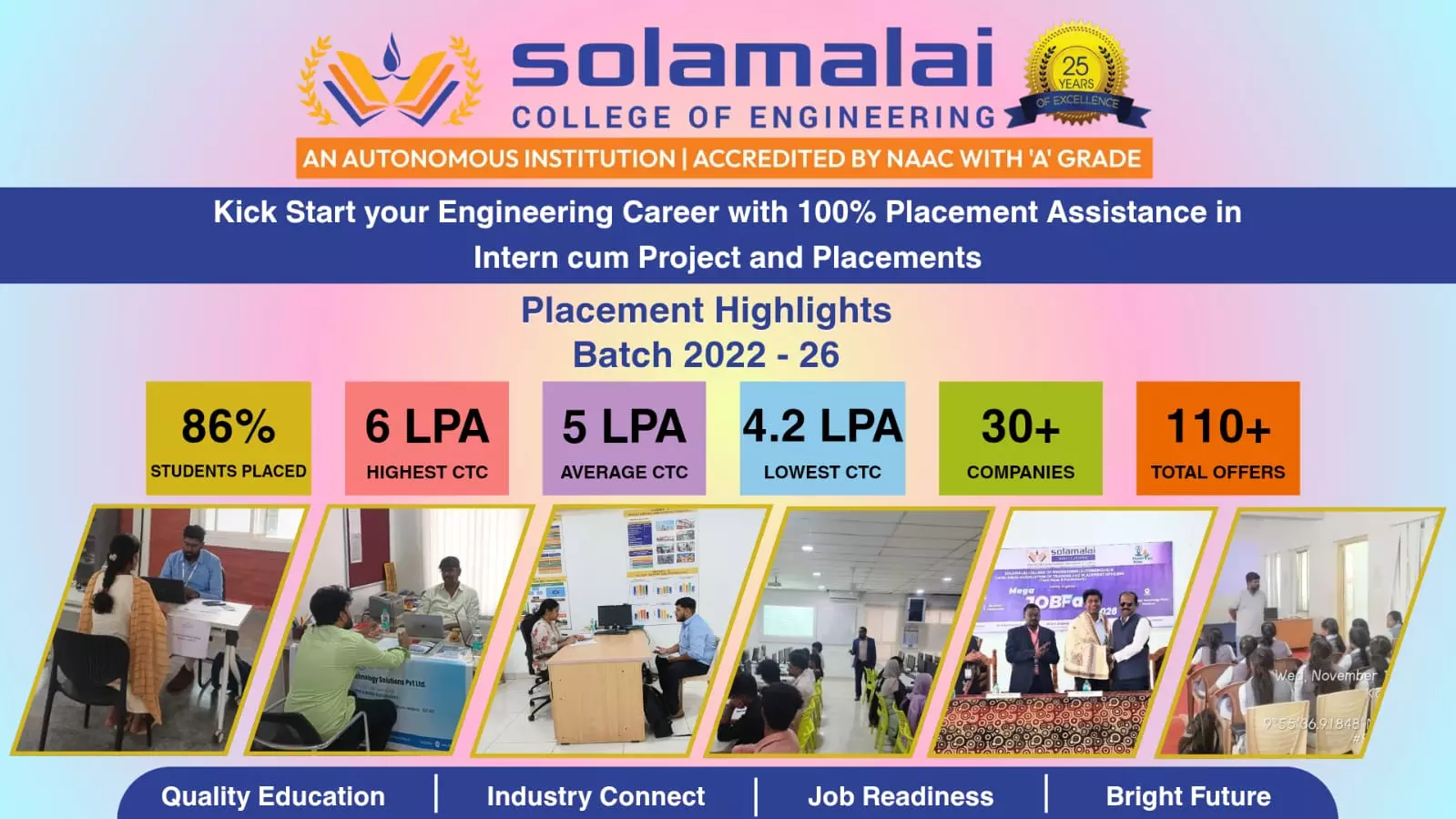
Solamalai College of Engineering maintains placement-related activities and publishes placement statistics and company information. Its placement records include recruitment from organisations across sectors, including technology, engineering, construction, and services.
The value of placement support is not simply the number of companies that visit a campus. It also lies in helping students understand what employers expect and giving them opportunities to prepare before entering the recruitment process.
Finding the Right Engineering Path
There is no single definition of the ideal engineering college for every student.
A student interested in software development may value computing facilities and technology exposure, while someone interested in civil or mechanical engineering may look more closely at laboratories, projects, workshops, and industry interaction.
Students and parents can therefore compare programmes, curriculum, facilities, faculty, practical exposure, career support, campus activities, and admission requirements before making a decision.
For those exploring a Madurai Engineering College, Solamalai College of Engineering offers multiple academic pathways along with opportunities for practical learning, technical participation, industry interaction, innovation, and career development.