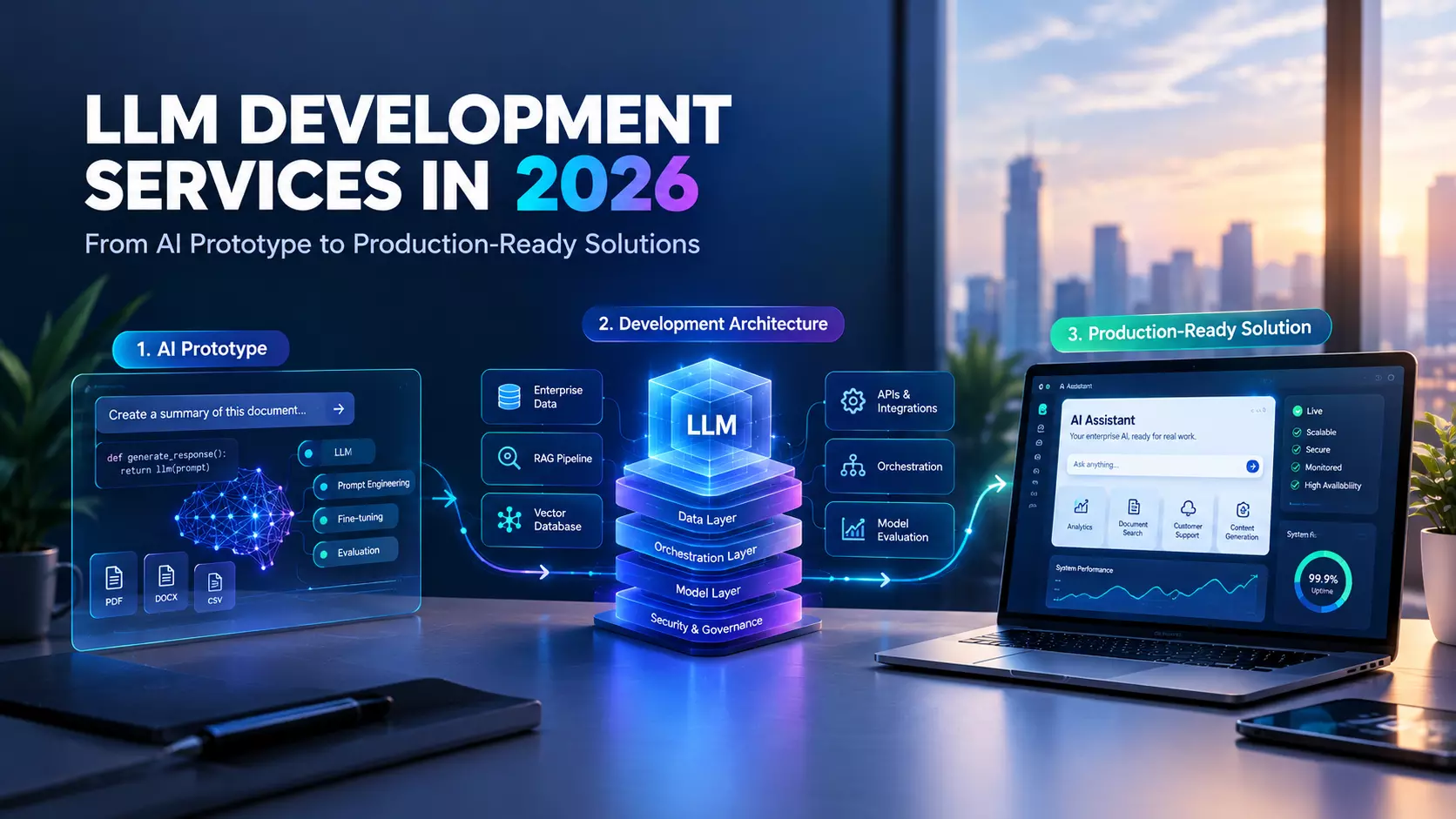
LLM Development Services in 2026: From AI Prototype to Production-Ready Solutions
Large language models (LLMs) are changing how businesses automate workflows, analyze information, deliver customer support, and build intelligent applications.
However, turning an AI prototype into a reliable business solution requires more than connecting an application to an AI model. It involves data preparation, model selection, system integration, security, testing, and continuous optimization.
LLM development services help businesses design, build, deploy, and maintain AI-powered applications that solve specific business problems.
These services can include custom LLM development, retrieval-augmented generation (RAG), model fine-tuning, AI application integration, and production deployment.
In 2026, businesses need solutions that go beyond impressive demonstrations. They need production-ready AI systems that deliver accurate results, protect sensitive data, manage operational costs, and scale with business growth.
What Are LLM Development Services?
LLM development services involve building and integrating applications powered by large language models to support specific business requirements.
These services help organizations transform existing data, workflows, and customer interactions into intelligent, AI-driven experiences.
Common applications include AI chatbots, enterprise knowledge assistants, document processing systems, intelligent search, content automation, and AI agents.
Depending on the use case, an LLM development company may use existing models through APIs, customize open-source models, fine-tune a model on domain-specific data, or combine LLMs with RAG and enterprise systems.
The objective is to select an approach that balances accuracy, performance, security, scalability, and total cost of ownership.
Why Businesses Need LLM Development Services in 2026
Businesses are moving beyond AI experimentation to measurable operational outcomes. A successful implementation should address a defined business challenge rather than introduce AI without a clear purpose.
Key business benefits include:
- Improved operational efficiency: Automate repetitive tasks such as document classification, information extraction, and internal knowledge retrieval.
- Better customer experiences: Build AI assistants that answer questions, provide relevant information, and support customers around the clock.
- Faster decision-making: Summarize large volumes of business information and help employees find relevant insights.
- Knowledge management: Make internal documents, policies, and organizational knowledge easier to access.
- Scalable business processes: Handle growing volumes of requests without increasing manual effort at the same rate.
For CTOs, CIOs, and product leaders, the priority is to connect these benefits with measurable KPIs, including response accuracy, resolution time, employee productivity, customer satisfaction, and cost per task.
From AI Prototype to Production-Ready LLM Solutions
Moving an LLM application from a proof of concept to production requires a structured development process. Each stage should validate both technical feasibility and business value.
1. Identify the Business Use Case
Start by identifying a specific problem that an LLM can solve. Examples include reducing customer support workload, searching enterprise documents, or automating repetitive document reviews.
Define success criteria before development begins. These may include reducing processing time, improving answer accuracy, or lowering the cost of handling customer requests.
A clearly defined use case helps businesses avoid investing in AI features that fail to deliver meaningful results.
2. Prepare Data and Select the Right Model
The quality of an LLM solution depends on the model, available data, and application architecture. Development teams evaluate model capabilities, context length, latency, deployment requirements, licensing, and expected usage costs.
For applications that need answers grounded in frequently updated company information, RAG can connect an LLM to relevant enterprise documents without retraining the model every time information changes.
Fine-tuning may be appropriate when a model needs to learn specialized terminology, consistent output formats, or particular task behaviors.
Choosing the right approach early helps control development costs and avoid unnecessary complexity.
3. Develop and Validate the Prototype
A proof of concept (PoC) tests whether the proposed solution can address the business problem. Developers build a limited version, connect essential data sources, and evaluate its performance against realistic scenarios.
Testing should cover answer quality, relevance, hallucinations, response time, and user experience.
A successful demonstration is only an initial milestone. Before production, the application needs broader evaluation using representative data, difficult questions, edge cases, and potential security risks.
4. Build a Production-Ready Architecture
Production deployment requires a reliable architecture that supports real users and business workloads. This may include API integrations, retrieval pipelines, vector databases, orchestration, caching, access controls, and cloud infrastructure.
Teams also implement monitoring, logging, error handling, version management, and fallback mechanisms. These capabilities help identify performance problems and maintain service reliability as usage increases.
For enterprise applications, data privacy, permissions, encryption, and auditability should be incorporated into the architecture rather than added as an afterthought.
5. Deploy, Monitor, and Optimize
After deployment, an LLM application must be monitored and improved continuously. Model behavior, business data, user expectations, and usage patterns can change over time.
Production monitoring should track response quality, latency, token consumption, infrastructure costs, failure rates, and user feedback.
Regular evaluations help teams identify inaccurate responses, optimize prompts and retrieval, adjust model selection, and improve the overall user experience.
This ongoing process turns an initial AI implementation into a dependable business capability.
Read: Top 10 AI/ML Development Companies to Watch in 2026
Essential Features of Enterprise LLM Development
When evaluating LLM development services, businesses should look beyond the model itself. A production-ready solution typically requires several supporting capabilities.
- RAG and enterprise search: Ground responses in relevant, authorized business information.
- Secure data integration: Connect CRM, ERP, knowledge bases, document repositories, and other enterprise systems.
- Security and governance: Apply authentication, role-based access, data protection, and appropriate audit controls.
- LLM evaluation: Measure factual accuracy, relevance, consistency, and task completion.
- Performance optimization: Balance response speed, model quality, and infrastructure requirements.
- Scalability and monitoring: Maintain application performance while tracking errors, usage, and operating costs.
The specific architecture should reflect the business use case, risk level, regulatory obligations, and expected workload.
How to Choose the Right LLM Development Company
Selecting an experienced LLM development company can help businesses reduce implementation risks and move from experimentation to deployment more efficiently.
Before choosing a development partner, evaluate these factors:
- Technical expertise: Look for experience with LLM APIs, open-source models, RAG, vector databases, fine-tuning, and enterprise integrations.
- Production experience: Ask how the team handles model evaluation, deployment, monitoring, security, and ongoing maintenance.
- Business understanding: The partner should understand your workflows, target users, success metrics, and operational constraints.
- Security practices: Discuss data handling, access controls, infrastructure options, and requirements for sensitive business information.
- Transparent delivery process: Ensure the engagement includes clear milestones, testing criteria, documentation, and post-launch support.
A capable partner should explain why a particular model and architecture fit your requirements instead of recommending the most complex solution by default.
What Is the Cost of LLM Development Services?
The cost of LLM development depends on application complexity, data readiness, model selection, integrations, security requirements, and deployment scale.
A basic LLM-powered prototype may require relatively limited development, while an enterprise application involving RAG, multiple data sources, strict access controls, extensive testing, and high availability will require greater investment.
Businesses should assess the total cost of ownership, including development, model usage, hosting, data processing, monitoring, maintenance, and future enhancements.
A practical approach is to start with a focused use case, validate measurable business value, and expand the solution as its performance and return on investment become clearer.
Conclusion
In 2026, successful LLM adoption depends on turning AI experimentation into secure, scalable, and measurable business solutions.
From selecting the right model to integrating enterprise data and monitoring production performance, every stage influences the application's long-term value.
Professional LLM development services help businesses navigate these technical and operational challenges while aligning AI capabilities with business objectives.
Albiorix Technology helps businesses explore and develop AI-powered solutions aligned with their product requirements and operational goals.
Whether you are validating an AI prototype or planning an enterprise-grade application, a structured development approach can help you move toward production with greater clarity, control, and confidence.
Ready to turn your AI idea into a production-ready solution? Explore our LLM Development Services to discuss your business requirements and development goals.