LiDAR Market Growth: Key Trends, Innovations, and Future Opportunities
1. Overview of the Global LiDAR Market
Market Definition and Technology Evolution
The LiDAR Market has evolved into a pivotal segment of the global sensing technology industry. LiDAR systems utilize laser-based distance measurement techniques to create accurate three-dimensional models of physical environments. Over the years, improvements in laser optics, computing capabilities, and sensor miniaturization have significantly expanded commercial adoption.
Today's LiDAR solutions offer faster scanning speeds, higher resolution, and seamless integration with artificial intelligence platforms, making them valuable across numerous industrial environments.
Major Industry Applications
LiDAR technology supports diverse applications including autonomous transportation, topographic mapping, environmental conservation, infrastructure inspection, logistics, mining, and renewable energy development.
The technology's exceptional precision enables organizations to improve operational efficiency while reducing manual surveying efforts and enhancing decision-making accuracy.
2. Market Dynamics Influencing Growth
Technological Advancements
Continuous research has transformed the LiDAR Market through innovations such as solid-state sensors, enhanced laser performance, and cloud-based data processing platforms.
Machine learning algorithms now enable faster object recognition and real-time spatial analysis, improving operational performance across multiple sectors.
Expanding Industrial Adoption
Industries increasingly recognize the strategic value of LiDAR for automation and digital transformation initiatives. Manufacturing facilities utilize LiDAR for robotic navigation, while agriculture employees precision mapping to optimize irrigation and crop monitoring.
Growing investments in infrastructure modernization and intelligent transportation systems continue to strengthen market expansion globally.
Read: Emerging Trends Influencing the Future of Fixed-Wing VTOL
3. Competitive Landscape and Industry Challenges
Key Market Trends
Several trends are reshaping the LiDAR Market, including increased investment in autonomous mobility, integration with artificial intelligence, and demand for lightweight, energy-efficient sensors.
Manufacturers are focusing on product innovation, strategic collaborations, and software development to strengthen competitive positioning and address evolving customer requirements.
Barriers to Market Expansion
Although demand continues to increase, market participants face challenges including high implementation costs, cybersecurity concerns, and complex data management requirements.
Organizations also encounter interoperability issues when integrating LiDAR systems with existing digital infrastructure, highlighting the need for standardized industry solutions.
4. Future Prospects of the LiDAR Market
Emerging Innovations
Future advancements are expected to focus on higher-resolution imaging, real-time analytics, edge computing, and enhanced sensor fusion technologies. These innovations will improve system performance while supporting broader commercial deployment.
The combination of LiDAR with artificial intelligence, Internet of Things ecosystems, and advanced robotics will unlock entirely new industrial applications.
Long-Term Growth Potential
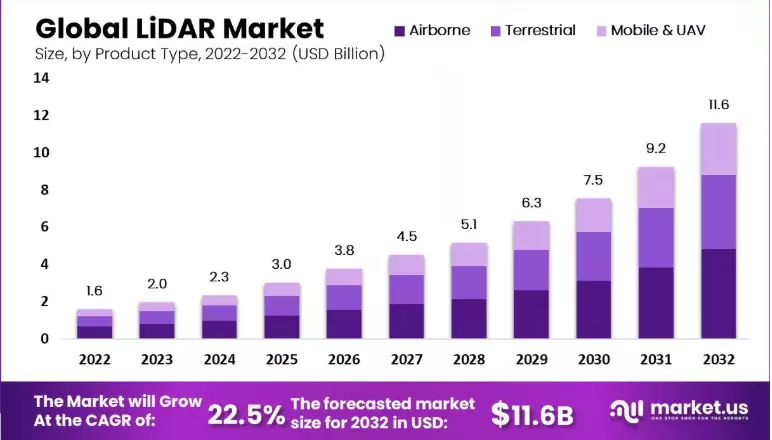
The long-term outlook for the LiDAR Market remains highly favorable. Expanding investments in autonomous systems, smart cities, environmental monitoring, and industrial automation are expected to sustain demand over the coming decade.
As technology becomes more affordable and accessible, LiDAR will continue to play a critical role in enabling data-driven decision-making across industries, reinforcing its importance in the future of digital transformation.