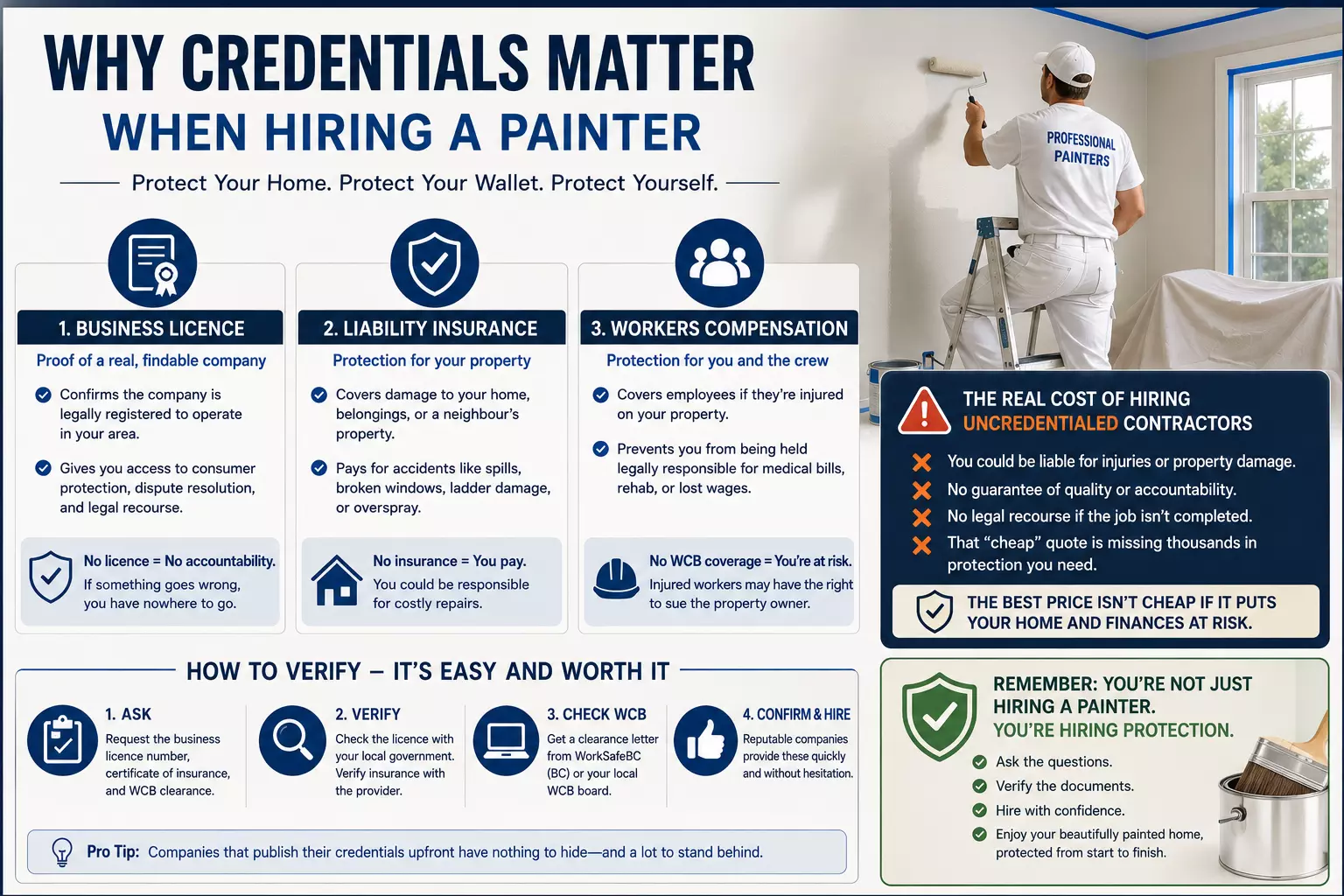
Licensed, Insured and WCB-Covered: Why It Matters More Than the Price
Of all the factors homeowners weigh when hiring a painter, credentials are the least exciting and the most consequential.
Colour is fun to discuss, price is easy to compare, and insurance paperwork is neither, which is why it gets waved through on trust more than any other part of the decision. But the licence, the liability policy, and the workers compensation account are not bureaucratic decoration.
They are the entire legal and financial structure that determines who pays when something goes wrong on your property, and things go wrong on properties often enough that the trades built these systems in the first place.
Companies that treat this seriously tend to say so plainly; some, like established firms that publish their licensing, WCB, and insurance details openly for customers to inspect, have effectively made the paperwork part of their pitch. That transparency is not a formality. It is the clearest available signal about how a company runs everything else.
To understand why these three items outrank price, it helps to walk through what each one actually protects, and what its absence transfers onto you.
The Business Licence: Proof of a Real, Findable Company
A business licence is the humblest of the three credentials, but it establishes something foundational: the company legally exists, operates under a registered name in your jurisdiction, and can be found by the systems that resolve disputes. Unlicensed operators live outside those systems by design.
If the work fails, if a deposit disappears, or if a disagreement escalates, your recourse against a licensed local business includes consumer protection processes, small claims enforcement, and a reputation the company must defend in its own community.
Your recourse against an unlicensed operator working under a casual name is, in practice, a phone number that stops answering. Licensing does not guarantee quality, but its absence guarantees that accountability will be voluntary.
Liability Insurance: Who Pays for the Expensive Accident
Painting involves ladders against your gutters, sprayers near your car, solvents near your landscaping, and heavy equipment moving through your finished rooms.
Professional crews are careful, and accidents happen anyway: the overturned five gallon pail on hardwood, the ladder through a window, the overspray across a neighbour’s vehicle. Liability insurance exists so that when they do, a policy pays rather than a person.
Hire a contractor without it and every accident becomes a negotiation with someone who cannot afford the damage, which means in practice the damage is yours.
Homeowners sometimes assume their own home insurance quietly backstops this, and it may partially, but often with deductibles, exclusions for contracted work, and premium consequences.
The correct arrangement is the contractor’s policy standing in front of yours, and the correct verification is a current certificate of insurance, requested politely and provided without friction. Professionals carry these documents the way drivers carry licences; hesitation is information.
Workers Compensation: The Coverage That Protects You From the Worst Scenario
The least understood credential is the most important one. Workers compensation coverage insures the people on the crew against workplace injury, and painting genuinely is a falls from height trade, one of the more injury prone in construction.
Here is the part homeowners miss: when a worker is injured on your property and their employer carries no coverage, the injured person’s costs do not simply evaporate. Depending on jurisdiction, injured uninsured workers can pursue the property owner, and the sums involved in a serious fall are life altering.
Workers compensation systems exist precisely to prevent this chain, covering the worker’s treatment and wage loss while shielding homeowners and employers from personal suits.
This is why verification matters and why it has been made easy: in British Columbia, WorkSafeBC provides clearance letters confirming that any contractor’s account is registered and in good standing, and requesting one before work begins is standard due diligence, not suspicion
A contractor whose coverage lapses between jobs, or who classifies crew as casual cash labour to avoid premiums, is transferring the tail risk of the entire operation onto whichever homeowner happens to be underneath it when luck runs out.
Read: Why You Should Buy Medical Insurance Online Today
Why the Cheap Uninsured Quote Is Not Actually Cheap
Now the price comparison becomes honest. Licences, liability premiums, and workers compensation contributions cost real money, and legitimate companies build those costs into every quote.
An operator carrying none of them can genuinely undercut the market, and the discount is exactly the value of the protection you are giving up: it is the price of standing personally exposed to property damage, injury liability, and unenforceable warranties.
Framed that way, the credentialed quote is not more expensive; it includes an insurance product the cheap quote silently deletes. The practical procedure is short.
Ask all three questions before discussing colour. Request the licence number, the certificate of insurance, and the workers compensation clearance, and verify each through official channels rather than accepting photocopies at face value.
Companies with nothing to hide respond in minutes, and the best of them, like firms that publish their credentials before being asked, have already answered. Whatever the walls end up costing, this is the part of the job where the real money lives, and it is the one comparison no homeowner should skip.
Frequently Asked Questions
What happens if an uninsured painter is injured at my home?
Depending on your jurisdiction, you may be personally exposed to claims for treatment costs and damages, since no workers compensation coverage exists to absorb them. This is the single largest financial risk in hiring uncredentialed contractors, and it is entirely avoidable by verifying coverage before work begins.
How do I verify a contractor’s insurance and WCB coverage?
Ask for a current certificate of insurance directly and, for workers compensation, use the official verification channel in your region; in British Columbia, WorkSafeBC issues clearance letters online confirming an employer’s standing. Verify rather than accept documents at face value, since certificates can be outdated or altered.
Does my home insurance cover damage caused by a contractor?
Sometimes partially, but frequently with deductibles, exclusions relating to hired work, and knock on effects for your premiums. The correct structure is the contractor’s liability policy responding first. Relying on your own policy to absorb a contractor’s accident is a plan that only reveals its holes after the accident.
Is it rude to ask a painter for proof of insurance and licensing?
No, and professionals interpret the question as a sign of a serious client. Reputable companies field it constantly and respond immediately; many volunteer the documents in their quotes. The only contractors discomfited by the question are the ones whose answer would end the conversation anyway.