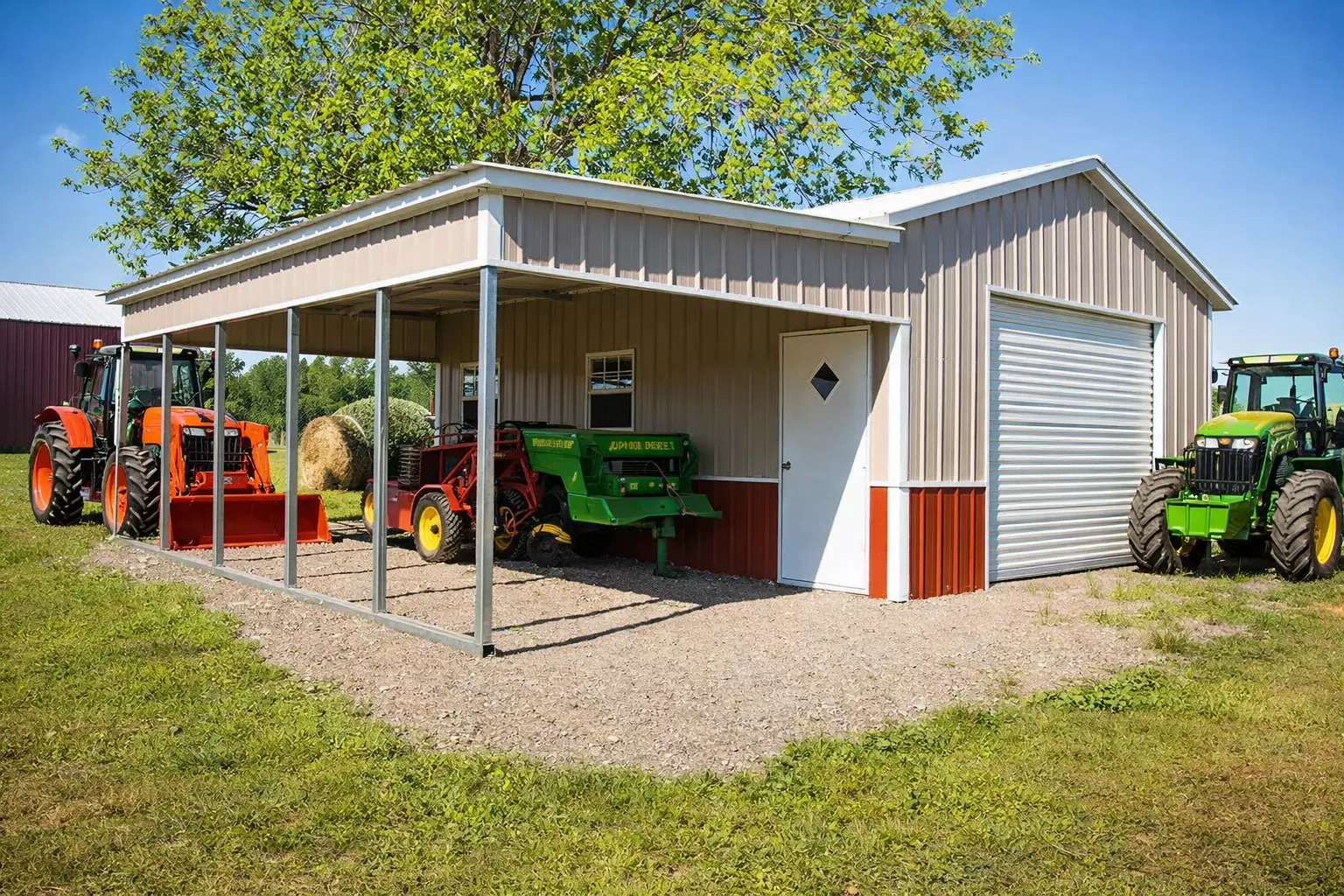
Lean-to Metal Garage Designs That Extend Space Without Major Costs
Do you have a garage, but the available space is not enough now? And you need more space, but your budget isn't enough. In this situation, installing a lean-to on your existing garage helps you meet your needs without heavy lifting or the cost of a new structure.
Or if you are planning to build a new building, consider installing a lean-to steel garage. Make the first move itself the best with this decision, so you don't have to spend on a new space. But before making any decision, learn everything about a prefab lean-to garage and how its design saves more.
What Is a Lean-to Metal Garage?
A lean-to metal garage is an extension that attaches to the side of an existing metal building. It shares one wall with the main structure and has a single-sloped roof that leans away from the main building. Instead of standing as a separate structure, a lean-to becomes part of the original building's layout. This reduces material use and simplifies construction.
Lean-to garages can be open on the sides or fully enclosed. They can be narrow or wide, short or long, depending on available space and intended use. Because they connect directly to an existing building, they feel like a natural extension rather than a separate add-on.
Why Lean-to Designs Are Cost-Effective
Lean-to metal garages are considered one of the most budget-friendly expansion options because they use smart structural design to reduce both material and labor costs. Instead of building a full structure from scratch, a lean-to takes advantage of what already exists.
1. Uses an Existing Wall
One of the biggest cost advantages of a lean-to is that it shares a wall with the main building. This means there is no need to build a full fourth wall with columns, framing, and exterior panels. Using an existing wall reduces the amount of steel required and simplifies structural design. Fewer materials directly translate into lower overall cost.
2. Simpler Roof Structure
Lean-to garages use a single-slope roof rather than a complex multi-sided roof system. A simpler roof design requires fewer trusses, fewer connectors, and fewer roof panels. Because the structure is straightforward, manufacturing and installation costs stay lower. The reduced complexity also minimizes the chance of installation errors.
3. Faster Installation
Since lean-to garages attach to an existing building, much of the main structural work is already done. Crews spend less time assembling, framing, and aligning components. Shorter installation time means fewer labor hours, which helps keep total project cost down. It also allows you to start using the space sooner.
4. Smaller Foundation Requirements
A lean-to often requires only a partial foundation extension rather than a full slab or full perimeter footing system. In many cases, only the outer posts need footings. This reduces concrete usage and excavation work. Less foundation work equals lower construction expense.
5. Lower Permit and Design Complexity
Lean-to additions are usually simpler to design and engineer than new standalone buildings. Fewer structural calculations and drawings are needed. This can reduce engineering fees and simplify the permitting process, saving both time and money.
Common Uses for Lean-to Metal Garages
Lean-to metal garages are popular because they can support many different purposes. Their open or enclosed design allows owners to adapt the space based on changing needs. Whether for residential, agricultural, or small commercial use, lean-tos provide practical coverage and organization.
Vehicle Parking and Protection
One of the most common uses for lean-to garages is vehicle parking. Cars, trucks, motorcycles, ATVs, and utility vehicles can be parked under the lean-to to stay protected from sun, rain, snow, and hail. This reduces exterior wear and helps preserve paint and interiors. The easy access design also makes daily parking convenient.
Equipment and Tool Storage
Lean-to garages work well for storing lawn equipment, tractors, trailers, and maintenance tools. Instead of crowding the main building, bulky items can be kept in the lean-to area. This improves organization and frees up interior space for other uses.
Workshop or Project Space
Many people turn lean-tos into small workshops or project zones. The covered area allows welding, woodworking, repairs, or hobby projects to be done outdoors while still being protected from the weather. Adding partial side panels can improve comfort.
RV, Boat, and Large Vehicle Shelter
Lean-to garages are excellent for storing large vehicles such as RVs, campers, or boats. The tall clearance and open access make parking easier. This prevents costly outdoor storage fees and keeps valuable vehicles closer to home.
Farm and Property Operations
On farms or rural properties, lean-tos are used for hay storage, feed protection, and equipment staging. Having supplies close to the main barn improves workflow and efficiency.
Popular Lean-to Metal Garage Design Options
Lean-to metal garages are highly flexible and can be designed in different ways depending on available space, building layout, and intended use. Choosing the right design option ensures that the lean-to not only adds space but also improves accessibility, organization, and functionality.
Single-Side Lean-To
The single-side lean-to is the most common and simplest design option. In this layout, the lean-to is attached to one side of an existing building, creating a straightforward extension.
This design works especially well for vehicle parking, equipment storage, or a covered workspace. It is ideal when land is available on only one side of the structure or when a clean, minimal expansion is preferred. Single-side lean-tos are easy to plan, cost-effective, and quick to install.
Wraparound Lean-To
Wraparound lean-tos extend along two or more sides of a building, forming continuous covered areas around the structure. This creates multiple zones that can be used for different purposes.
For example, one side can be used for parking, while the other serves as storage or workspace. This design is useful for properties that require frequent access from different directions. Wraparound lean-tos also improve workflow by reducing the need to move equipment long distances.
Open Lean-To
Open lean-tos have a roof but no side walls. This design allows maximum airflow and easy entry and exit.
Open lean-tos are well-suited for parking vehicles, storing large equipment, or working on projects that require ventilation. They are usually the most affordable option and offer quick access.
Read: Modern TV Unit Design Ideas to Upgrade Dubai Homes
Enclosed Lean-To
Enclosed lean-tos include side walls and may have doors or windows. This design provides better protection from wind, rain, snow, and theft.
Enclosed lean-tos are ideal for storing valuable tools, equipment, or materials that require security and weather protection. Many owners combine open and enclosed sections within one lean-to structure for added flexibility.
Typical Dimensions and Layout Ideas
Instead of thinking about lean-to size as fixed numbers, it is more helpful to think in terms of what you plan to store and how you will move around the space.
If your goal is simple vehicle parking, a lean-to width of around 12 to 15 feet usually provides comfortable clearance for cars, small trucks, or motorcycles. This width allows doors to open without hitting posts and gives space to walk around the vehicle.
For larger vehicles such as RVs, boats, or trailers, wider lean-tos between 16 to 20 feet are more practical. The extra width improves turning space and reduces the risk of bumping mirrors or sides.
Length is often matched to the side of the existing building. Many lean-tos run 20, 30, or 40 feet long, depending on available space and storage needs. Longer lean-tos work well when multiple vehicles or long equipment must be parked in a row.
Layout planning should also consider:
- Where vehicles will enter and exit
- Whether doors or openings are needed
- How close the lean-to sits to driveways or access roads
A good layout keeps movement smooth and avoids tight turns.
When a Lean-To Is Better Than a Full Addition
A lean-to metal garage becomes the better choice when your primary goal is functionality rather than creating a finished indoor living space. In many practical scenarios, lean-tos provide exactly what is needed without the cost and complexity of a full addition.
When You Only Need Covered Space
If you mainly want to shield vehicles, equipment, or materials from rain, snow, and direct sunlight, a lean-to delivers that protection efficiently. You get a roof and structural support without paying for enclosed walls, insulation, interior framing, or climate control systems. For parking, equipment staging, and outdoor work, covered space is often all that is required.
When The Budget Is limited
Full additions involve extensive materials, foundation work, framing, and labor. These costs add up quickly. Lean-tos use fewer materials and simpler construction methods, which makes them much more affordable. If you need more space but must stay within a strict budget, a lean-to offers strong value.
When You Need Space Quickly
Lean-to structures are faster to manufacture and install because they connect to an existing building and use straightforward designs. There are fewer construction steps, fewer components, and less site preparation. This allows you to gain usable space in weeks instead of months.
When Future Changes Are Likely
If you are unsure about long-term needs, a lean-to gives flexibility. You can later enclose it, extend it, or repurpose it as storage, parking, or workspace. Full additions are more permanent and harder to modify.
The Bottom Line:
Lean-to metal garage designs offer a smart way to extend usable space without major construction costs. They use your existing building as a foundation for growth, making expansion simple, fast, and affordable. Whether you need more parking, storage, or workspace, a lean-to garage delivers practical value and long-term flexibility. For anyone looking to add space without overspending, lean-to designs are one of the smartest building upgrades available.