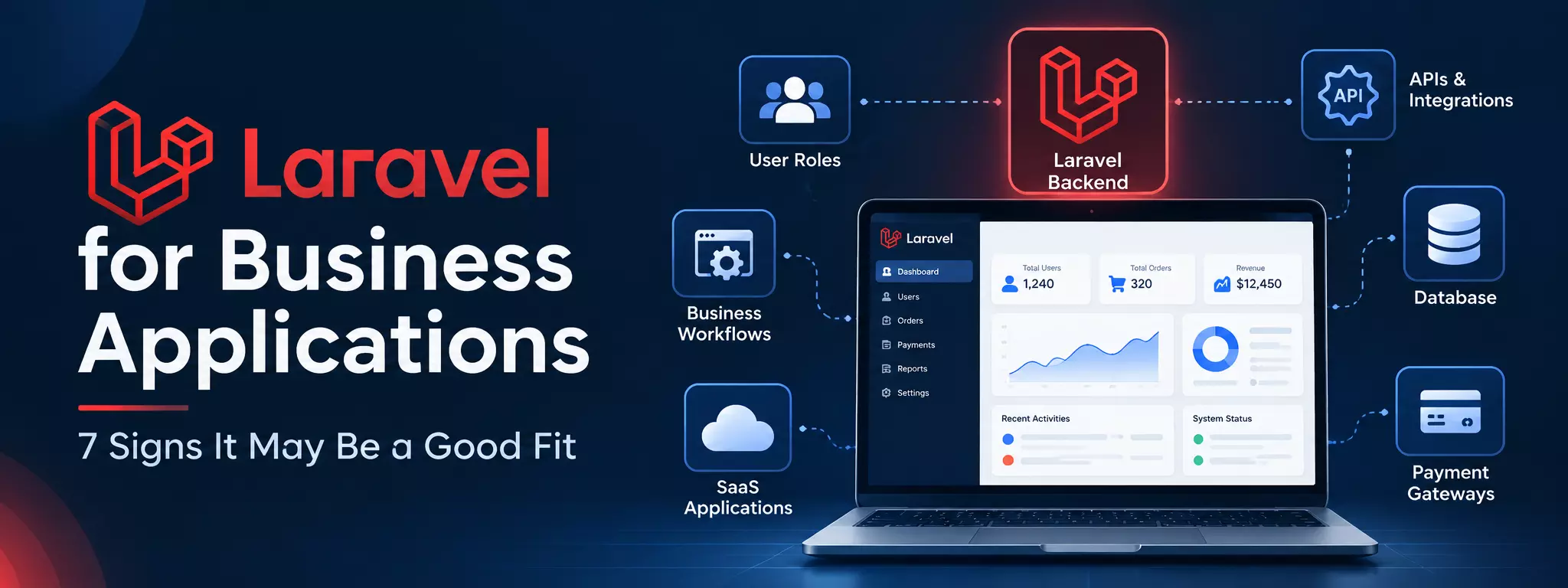
7 Signs Laravel May Be the Right Choice for Your Business Application
Laravel can be a practical choice for businesses that need custom web applications, backend systems, APIs, portals, or SaaS platforms with specific workflows and database requirements.
The framework should not be selected only because it is popular. The right technology depends on how your application needs to handle users, data, integrations, business rules, and long-term maintenance.
For businesses evaluating custom backend development, professional Laravel Development Services can support architecture planning, API development, database workflows, integrations, testing, and ongoing improvements.
Here are seven signs that Laravel may be a good fit for your business application.
1. Your Business Needs Custom Workflows
Ready-made software is often designed for general use.
If your team depends on spreadsheets, manual approvals, repeated data entry, or workarounds, a custom application can be built around the way your business actually operates.
A Laravel-based system can support business-specific workflows, approval processes, user actions, and backend logic without forcing your team to adapt to a generic platform.
2. You Need Multiple User Roles and Permissions
Many business applications need more than a basic admin and customer login.
Your platform may need separate access for:
- administrators
- employees
- managers
- customers
- vendors
- partners
Laravel can support authentication and authorization so users can access only the features and information relevant to their role.
3. Your Application Needs API Integrations
Modern business applications often need to connect with other systems.
Common integrations include:
- payment gateways
- CRM platforms
- ERP systems
- analytics tools
- mobile applications
- cloud services
- external APIs
A Laravel backend can manage these connections through APIs while keeping business logic and data handling organized in one application layer.
4. Your Business Relies on Database-Driven Processes
Laravel can be useful when an application needs to manage structured business data such as:
- users
- orders
- bookings
- subscriptions
- transactions
- inventory
- reports
The framework provides tools for working with application data, but performance still depends on good database design, efficient queries, caching, and suitable infrastructure.
Read: Top 10 Custom Web Application Development Companies
5. You Are Building a SaaS Platform or Business Portal
Laravel can also be used for SaaS products, customer portals, admin dashboards, and internal business platforms.
These applications may require:
- user authentication
- role-based access
- billing integrations
- dashboards
- reporting
- APIs
- background processes
For projects that involve several connected systems or complex business workflows, Custom Software Development may be a better way to evaluate the complete solution rather than focusing on one framework alone.
6. Your Existing Laravel Application Is Becoming Difficult to Maintain
An older Laravel application may become harder to manage over time.
Common warning signs include:
- outdated framework versions
- old PHP dependencies
- difficult integrations
- poor documentation
- slow development
- recurring bugs
- increasing maintenance effort
This does not automatically mean the application needs to be rebuilt.
A technical review should first determine whether upgrading, refactoring, or rebuilding is the most practical option.
7. You Need a Reliable Backend for a Mobile Application
Laravel can also serve as the backend for a mobile application.
A typical setup may look like:
Mobile App
↓
API
↓
Laravel Backend
↓
Database
↓
Cloud Infrastructure
In this type of architecture, the backend can manage authentication, business logic, database operations, and third-party integrations while the mobile app handles the user interface.
When Laravel May Not Be the Right Choice
Laravel is not automatically the best framework for every project.
Another technology may be more suitable when:
- your existing system already depends heavily on another technology stack
- the application has highly specialized technical requirements
- a standard SaaS product already solves the problem
- the project is too small to justify custom development
- your internal team is already built around another backend ecosystem
The right framework should follow the product requirements, not the other way around.
Final Thoughts
Laravel can be a strong option for business applications that need custom workflows, APIs, database-driven features, user permissions, or third-party integrations.
Its value comes from how well it supports the overall application architecture, not simply from the framework name.
Before choosing Laravel, review your workflows, users, integrations, data requirements, hosting environment, and long-term maintenance needs.
A good technology decision starts with the business problem first and the framework second.