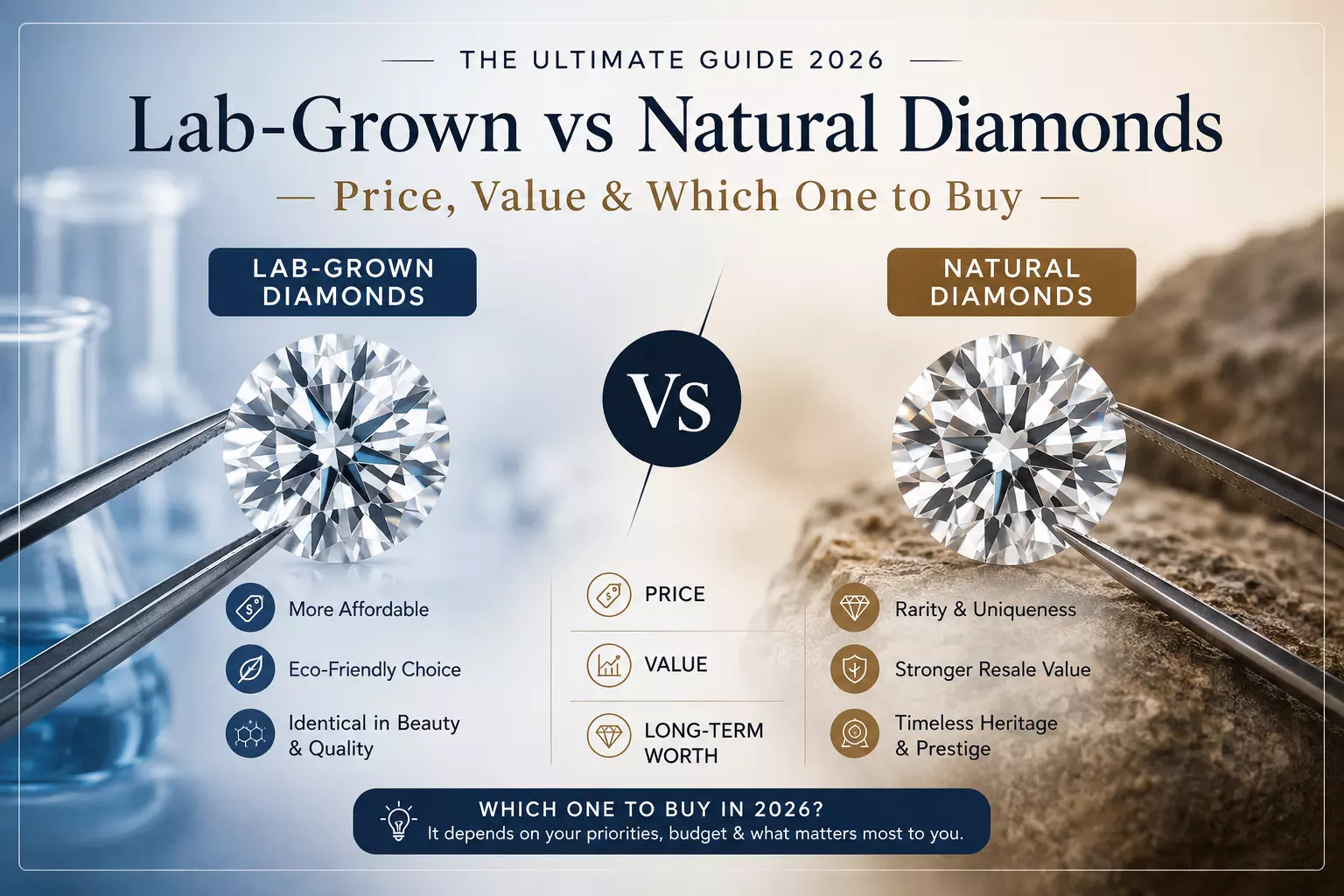
Lab-Grown vs Natural Diamonds in 2026: Price, Value & Which One to Buy
If you're shopping for a diamond in 2026, you're facing a decision that would have been almost unthinkable a decade ago. Two stones sit in front of you. Both are pure carbon, crystallized in the same structure. Both score a 10 on the Mohs hardness scale, refract light identically, and pass a diamond tester. One costs $5,000. The other costs under $1,000.
The only difference is where they came from - and what happens to their value after you buy them.
This guide breaks down the real numbers behind lab-grown and natural diamond pricing in 2026, what "value" actually means for each, and how to decide which one deserves your money.
First, the science: they really are the same stone
Let's clear this up before talking money. A lab-grown diamond is not a simulant like cubic zirconia or moissanite. It is a diamond - carbon atoms arranged in the same cubic crystal lattice as a mined stone, with the same hardness, the same brilliance, and the same fire.
Natural diamonds form roughly 100 miles beneath the Earth's surface over billions of years, carried up through rare volcanic kimberlite pipes.
Lab-grown diamonds are created in weeks using one of two methods: HPHT (High Pressure High Temperature), which recreates those underground conditions with massive hydraulic presses, or CVD (Chemical Vapor Deposition), which grows the crystal layer by layer from carbon-rich gas.
CVD stones tend to be the purer of the two and dominate the colorless engagement-ring market, while HPHT is often used for fancy colored diamonds.
Specialized gemological equipment can detect subtle differences in fluorescence patterns and trace elements, but nothing your eye - or most jewelers' eyes - will ever see. Both types are graded on the same 4Cs (cut, color, clarity, carat) by the same labs, GIA and IGI.
The difference between them is entirely about origin, scarcity, and economics. Which brings us to the numbers.
The price gap in 2026: wide, and now structural
After years of steep decline, lab-grown diamond prices largely stabilized through late 2025 and into 2026. The falling knife has hit the floor - wholesale prices now sit near production cost,
meaning the era of "just wait, they'll get cheaper" is essentially over. Natural diamond prices, meanwhile, have stayed relatively stable, anchored by mining costs and deliberate scarcity positioning.
Here's roughly what the US retail market looks like in early-to-mid 2026 for well-cut round brilliants in the popular F–H color, VS clarity range:
Carat weight
Natural diamond
Lab-grown diamond
Savings
0.5 ct
$1,000 – $1,800
$150 – $300
~80–85%
1.0 ct
$4,500 – $6,500
$700 – $1,400
~75–85%
2.0 ct
$18,000 – $24,000
$1,700 – $4,200
~80–90%
A few things worth noting about these ranges:
The gap widens with size. At half a carat, you save a couple of thousand dollars. At two carats, you save the price of a car. This is because natural diamond prices climb exponentially with carat weight (large rough is genuinely rare), while lab-grown prices climb far more gently (growing a bigger crystal just takes more time in the reactor).
Where you buy matters enormously. Direct-to-consumer lab-grown sellers now list 1-carat stones for as little as $300–$700, while traditional retail can charge double or triple for the same certified specification. In 2026, retail structure - showroom overhead, marketplace fees, distribution layers - often explains more of the price than the diamond itself.
Certification still commands a premium. GIA-graded stones are priced higher than IGI-graded stones at identical specs, largely as brand signaling rather than visible quality.
To put the price collapse in perspective: a 1-carat lab-grown diamond averaged around $3,400 at US retail in early 2020. Today, comparable stones routinely sell under $1,000 - a decline of roughly 70–88% depending on the channel. Natural diamonds over the same period? Essentially flat.
What buyers are actually doing with the savings
The market has voted decisively. According to The Knot's 2026 Real Weddings Study, lab-grown diamonds now account for roughly 55–61% of engagement ring center stones - up from about half just two years ago- and a supermajority among Gen Z buyers.
But the more interesting statistic is what happened to stone sizes. The average lab-grown center stone has grown from about 1.3 carats in 2019 to roughly 2.5 carats in 2026, while the average natural center stone sits around 1.1–1.2 carats. Buyers aren't just pocketing the savings - many are dramatically upgrading.
In practice, the same budget buys very different rings:
- ~$3,000: a 0.5-carat natural stone in a modest setting, or a 2-carat lab-grown stone with money left for the band.
- ~$6,000: roughly a 1-carat natural diamond, or a 2+ carat lab-grown diamond in a premium setting.
- ~$10,000: a 1.2–1.5 carat natural stone, or a 3-carat-plus lab-grown stone with a designer setting.
This is why the industry conversation has shifted. The question in 2026 is less "natural or lab?" and more "what does the price gap let me upgrade - the stone, the metal, or the setting?"
The value question: here's where natural diamonds fight back
Price is what you pay. Value is what you keep. And this is the one dimension where the comparison genuinely favors natural diamonds.
Natural diamonds retain meaningful resale value. On the secondary market, natural stones typically hold somewhere between 20% and 60% of their original retail price, depending on quality, certification, and where you sell. They function — imperfectly, but genuinely - as a store of value, and historically their prices have been stable to gently rising.
Lab-grown diamonds retain very little. Because supply is effectively unlimited and production costs keep falling, secondhand lab-grown stones fetch a small fraction of retail - often 10–40% at best through trade-in programs, and far less on open resale markets. The more honest framing: a lab-grown diamond behaves like a high-end tech product, not a traditional precious gem. Its value is in its immediate beauty and performance, not future appreciation.
Two important caveats keep this honest, though:
- Most people never sell their engagement ring. If the ring stays on a finger for fifty years, resale value is academic. What matters is what you enjoyed and what you didn't spend.
- "Retaining 40% of $5,000" still means losing $3,000. A natural diamond isn't an investment either - you buy at retail and sell at wholesale. The gap is just smaller than with lab-grown.
There's also the emotional dimension of value, which is real even if it doesn't show up in a spreadsheet. A natural diamond is a billions-of-years-old geological object with genuine rarity; for some buyers, that story and heirloom quality are the point, and no lab-grown stone can replicate it. For others, the idea of paying a 5–15x premium for an origin story feels absurd. Neither instinct is wrong.
Read: Lab-Grown Diamonds vs. Natural: Which Engagement
Ethics and sustainability: closer than the marketing suggests
Lab-grown diamonds are often sold as the unambiguously ethical choice, and they do have real advantages: no mining, no land disruption, no conflict-diamond supply-chain risk, and generally a lower environmental footprint — especially from producers running on renewable energy grids.
That said, the picture has nuance. Diamond growing is energy-intensive, and stones grown on coal-heavy grids carry a meaningful carbon footprint.
On the other side, the natural diamond industry supports significant employment in producing countries, and traceability programs have improved considerably. If ethics is your deciding factor, ask specific questions: where was the stone grown or mined, and what's the energy source or certification behind it?
Buying tips for 2026 (either type)
Insist on certification. As lab-grown prices have fallen, listings have appeared at suspiciously low prices - sometimes under $150 for a claimed "1ct D/VVS" - with no independent grading report. A legitimate IGI or GIA certificate includes a report number laser-inscribed on the stone's girdle, verifiable at igi.org or gia.edu. "D color" without a third-party certificate is just a marketing adjective.
Prioritize cut above everything. Cut quality drives sparkle more than color or clarity, and it's the one factor that's obvious across the room. With lab-grown prices this low, there's little reason to accept anything below excellent.
Shop directly where you can. The spread between direct-to-consumer and traditional retail pricing for identical certified lab-grown stones is enormous in 2026. Compare the certificate, not the showroom.
Don't over-optimize clarity. VS2 and even SI1 stones are typically eye-clean. Paying for VVS clarity buys peace of mind under a microscope, not visible beauty.
Watch the setting and metal. With gold and platinum prices elevated in 2026, the setting now represents a larger share of total cost than it used to - sometimes the largest variable in a lab-grown purchase. Budget accordingly.
So which one should you buy?
There's no universal answer, but there is a clear framework.
Buy lab-grown if:
- Your priority is the most beautiful stone possible for your budget
- You want a larger carat weight, better color, or higher clarity than natural prices allow
- You'd rather redirect $4,000–$15,000 toward a honeymoon, a home down payment, or savings
- You don't plan to resell, and financial "value retention" isn't why you're buying jewelry
- Ethical sourcing without mining matters to you
Buy natural if:
- The rarity, geological origin, and heirloom narrative genuinely matter to you or your partner
- Some degree of resale or trade-in value is important
- You're buying a piece intended to be passed down and appraised across generations
- You're comfortable paying a significant scarcity premium for something finite
For most buyers in 2026 - and the market share numbers back this up - lab-grown is the pragmatic choice: an identical stone, dramatically bigger or dramatically cheaper, with the main trade-off being resale value most people never realize anyway. Natural diamonds remain the right call for buyers who value what a lab can't manufacture: rarity itself.
Whichever you choose, buy a certified stone, prioritize the cut, and pick the diamond that matches your definition of value - because in 2026, both options are, quite literally, the real thing.