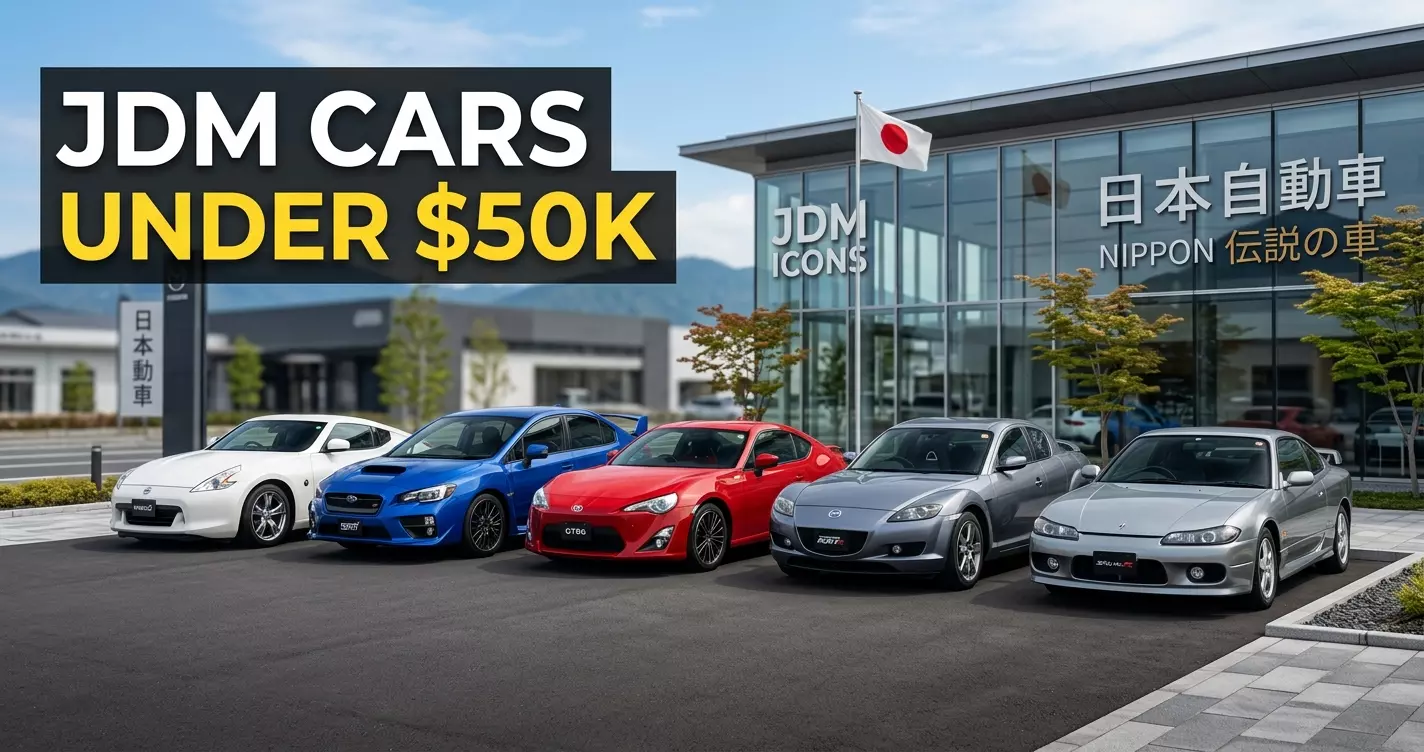
JDM Sports Cars Under $50,000: Which Models Deserve Attention?
The appeal of Japanese performance cars has never depended solely on having an enormous budget.
Some of the most interesting choices in the JDM market combine sharp handling, distinctive engineering, strong tuning potential, and genuine enthusiast appeal without crossing the $50,000 threshold.
For buyers searching for JDM cars under $50k, the challenge is less about finding a fast Japanese car and more about identifying one that offers the right balance of performance, condition, rarity, usability, and long-term value.
The market includes everything from lightweight rear-wheel-drive coupes to turbocharged icons and sophisticated all-wheel-drive machines.
Prices can vary substantially depending on model year, mileage, condition, specification, import eligibility, and provenance. That makes careful research essential.
For enthusiasts looking beyond mainstream sports cars, several models deserve serious consideration.
What Makes a JDM Sports Car Worth Buying?
Price alone does not determine whether a Japanese sports car is a smart purchase. A desirable example should ideally offer a combination of performance, mechanical character, parts availability, and a strong enthusiast community.
Key factors include:
- Engine reliability and maintenance history
- Availability of replacement and performance parts
- Chassis condition and previous accident history
- Transmission and drivetrain condition
- Import and registration requirements
- Factory specification and originality
- Resale demand among enthusiasts
A car with a lower purchase price can quickly become expensive if it requires extensive mechanical work after import. Condition should therefore remain a priority over simply chasing the cheapest listing.
Best JDM Cars Under $50k
Nissan 370Z
The Nissan 370Z remains one of the most accessible ways into modern Japanese rear-wheel-drive performance. Its 3.7-liter naturally aspirated V6 produces strong power without relying on turbocharging, while the traditional coupe layout gives it an engaging character.
It is also relatively practical compared with some older JDM choices. Buyers can find examples with manual transmissions, and the model has a well-established aftermarket.
Why consider it?
- Naturally aspirated V6
- Rear-wheel drive
- Six-speed manual available
- Strong aftermarket support
- Relatively modern mechanical package
Subaru WRX STI
For buyers who prioritize all-weather performance, the WRX STI deserves attention. Its turbocharged boxer engine, symmetrical all-wheel-drive system, and rally-inspired chassis make it fundamentally different from lightweight rear-wheel-drive coupes.
Clean examples can approach the upper end of the $50,000 budget depending on specification and market. Buyers should pay particular attention to maintenance history, modifications, clutch condition, and evidence of hard use.
Toyota GT86 / Subaru BRZ
The Toyota GT86 and Subaru BRZ demonstrate that performance does not always require huge horsepower. Their lightweight chassis, low seating position, rear-wheel drive, and balanced handling make them excellent driver's cars.
They are particularly attractive for enthusiasts who value cornering ability over straight-line acceleration. A well-maintained example can also leave room in the budget for suspension, wheels, tires, or other carefully chosen upgrades.
Mazda RX-8
The Mazda RX-8 is one of the more unconventional options in the market. Its rotary engine gives it a character that few modern sports cars can replicate, while the chassis offers excellent balance and surprisingly useful rear access.
However, this is not a model to buy without mechanical knowledge. Rotary-engine condition is critical, and prospective buyers should investigate compression, servicing, cooling-system condition, and oil consumption before committing.
Nissan Silvia S15
The Nissan Silvia S15 is among the most desirable choices for enthusiasts interested in classic JDM styling and tuning potential. Its compact dimensions, rear-wheel-drive layout, and turbocharged variants have made it a particularly influential name in Japanese performance culture.
Prices for clean, desirable examples can vary significantly, so staying below $50,000 may require careful shopping. Import eligibility and vehicle history should also be verified before purchase.
Comparing the Best Options
Model
Engine Character
Drivetrain
Main Strength
Buyer Consideration
Nissan 370Z
3.7L V6
RWD
Power and usability
Check service history
WRX STI
Turbo boxer
AWD
All-weather performance
Modifications and maintenance
Toyota GT86/BRZ
Naturally aspirated flat-four
RWD
Handling balance
Lower straight-line power
Mazda RX-8
Rotary
RWD
Unique character
Specialist maintenance
Nissan Silvia S15
Turbocharged four-cylinder
RWD
JDM appeal and tuning
Price and import eligibility
Read: Find the Best Wheel Brands for Reliability Safety and Comfort
Affordable JDM Cars: What Should Buyers Check?
Finding affordable JDM cars is only the first step. The condition of the individual vehicle can have a much greater impact on ownership costs than the model itself.
1. Verify the Auction History
Japanese auction documentation can reveal important information about mileage, condition, previous repairs, interior quality, and structural issues. Buyers should not rely solely on photographs or seller descriptions.
2. Inspect the Mechanical Condition
Engine health, transmission operation, cooling systems, suspension, brakes, and drivetrain components deserve close attention. Older performance cars may have been modified or driven aggressively, making a thorough inspection especially important.
3. Calculate the Complete Cost
The purchase price is not the final figure. A realistic budget should account for:
- Vehicle purchase price
- Auction or sourcing fees
- Inland transportation
- Export documentation
- Shipping
- Import duties and taxes
- Registration
- Repairs or preventative maintenance
A car listed at $40,000 may ultimately cost considerably more after the complete import process.
Why Japanese Sports Cars Still Deserve Attention
The strongest appeal of Japanese sports cars is their diversity. Buyers can choose a lightweight handling-focused coupe, a turbocharged all-wheel-drive performance car, or a naturally aspirated rear-wheel-drive machine without being limited to a single formula.
For enthusiasts searching for JDM cars for sale in America, availability is also increasingly important. The right sourcing process can open access to vehicles that may not appear regularly in conventional local inventories.
For a particularly specific specification, buyers can also request a JDM car based on their preferred model, year, transmission, mileage, condition, and budget rather than settling for whatever is already available.
Smart Buying Strategy for a $50,000 Budget
A disciplined approach can make a significant difference.
- Set an all-in budget: Do not spend the entire $50,000 on the vehicle itself.
- Choose the right model: Prioritize reliability, parts availability, and intended use.
- Research market prices: Compare several examples rather than judging one listing in isolation.
- Verify vehicle history: Auction records and inspection information can expose problems early.
- Allow for maintenance: Keep a reserve for tires, fluids, brakes, suspension, and unexpected repairs.
- Confirm import requirements: Eligibility and registration rules should be checked before purchase.
Conclusion
The market for JDM cars under $50k offers considerably more variety than the price point might suggest.
The Nissan 370Z provides modern V6 performance, the WRX STI brings rally-bred all-wheel-drive capability, while the GT86 and BRZ focus on balance and driver involvement.
The RX-8 offers rotary character, and the Silvia S15 delivers classic JDM appeal for buyers willing to navigate a more specialized market.
The smartest purchase is not necessarily the rarest or fastest car. It is the example with the right combination of condition, history, specification, running costs, and enthusiast value.
With careful research and realistic budgeting, $50,000 can still open the door to some genuinely memorable Japanese performance cars.