Java Developer vs Full Stack Developer: Which Career Is Better?
Choosing between a Java Developer and a Full Stack Developer career can be challenging for aspiring IT professionals.
Both roles offer exciting opportunities in software development, but they differ in responsibilities, technical skills, and career scope. Understanding these differences can help you choose the right learning path and prepare for industry requirements.
Who Is a Java Developer?
A Java Developer primarily works with the Java programming language to build reliable, secure, and scalable applications. Their responsibilities include writing code, developing backend systems, fixing bugs, integrating databases, and maintaining existing software.
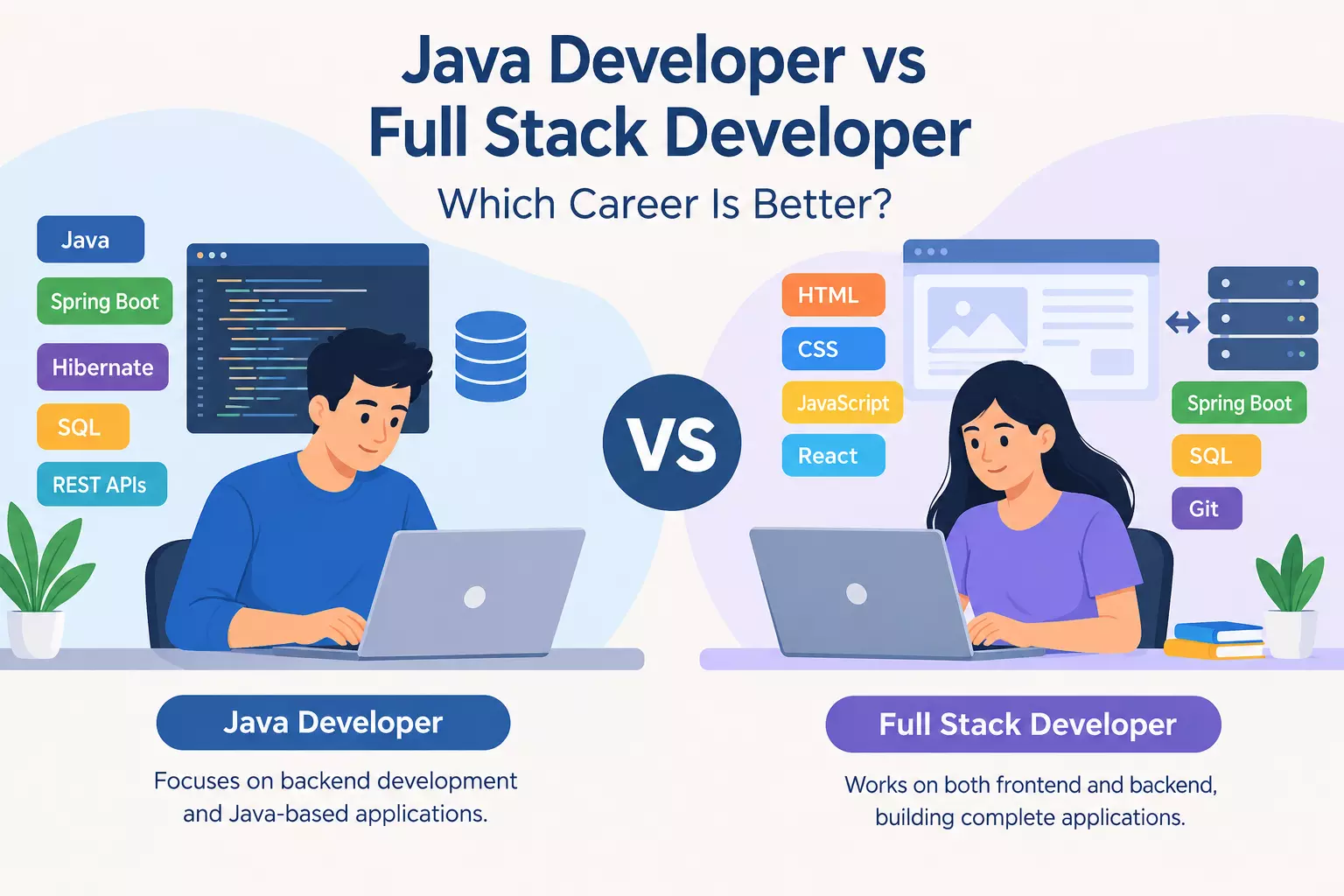
Java Developers commonly work with technologies such as Spring Boot, Hibernate, REST APIs, SQL, and microservices. Their skills are valuable in industries such as banking, healthcare, e-commerce, and enterprise software development.
For beginners interested in backend programming, enrolling in Java full stack developer training in Hyderabad can also help build a strong foundation in Java while introducing practical development tools used by modern IT companies.
Who Is a Full Stack Developer?
A Full Stack Developer works across both frontend and backend development. Along with creating application logic and server-side functionality, they develop user-facing interfaces and connect them to databases and APIs.
Full Stack Developers often use tools like Java, HTML, CSS, JavaScript, React, Spring Boot, SQL, and Git. They have a wide range of technical skills that let them see how all parts of an app connect, including the user interface and the database.
Students looking for a practical Java full stack development course in Hyderabad can explore training that combines programming fundamentals, frontend technologies, backend development, database management, and real-world projects.
Read: Key Java Language Concepts Every Developer Must Know
Java Developer vs Full Stack Developer: Key Differences
The main difference lies in the area of work. A Java Developer usually works on creating applications with Java, mainly for the back end parts of computer systems.
A Full Stack Developer, on the other hand, works on multiple parts of an application, including both the frontend user interfaces and the backend services.
Java Developers typically focus on Java programming, business logic, APIs, and database integration. Full Stack Developers need additional knowledge of frontend frameworks, responsive design, and application architecture.
Neither role is automatically better than the other. Java development suits learners who enjoy programming logic and backend engineering, while full stack development suits those who prefer working across different technologies and building complete applications.
Which Career Should You Choose?
Your decision should depend on your interests, existing skills, and long-term career goals. If you enjoy solving complex programming problems and building backend systems, Java development may be the right choice.
If you want broader development skills and the ability to create end-to-end applications, full stack development may be more suitable.
Both career paths require continuous learning, problem-solving ability, and hands-on experience. Building projects, practising coding, learning version control, and understanding software development workflows can strengthen your job readiness.
Conclusion
Java Developers and Full Stack Developers both play important roles in modern software development. While Java Developers focus more deeply on Java-based systems, Full Stack Developers work across frontend and backend technologies.
Choosing the right training program can help you develop practical skills and build a strong foundation for your IT career. Focus on your interests, practise consistently, and choose a learning path that matches your professional ambitions.