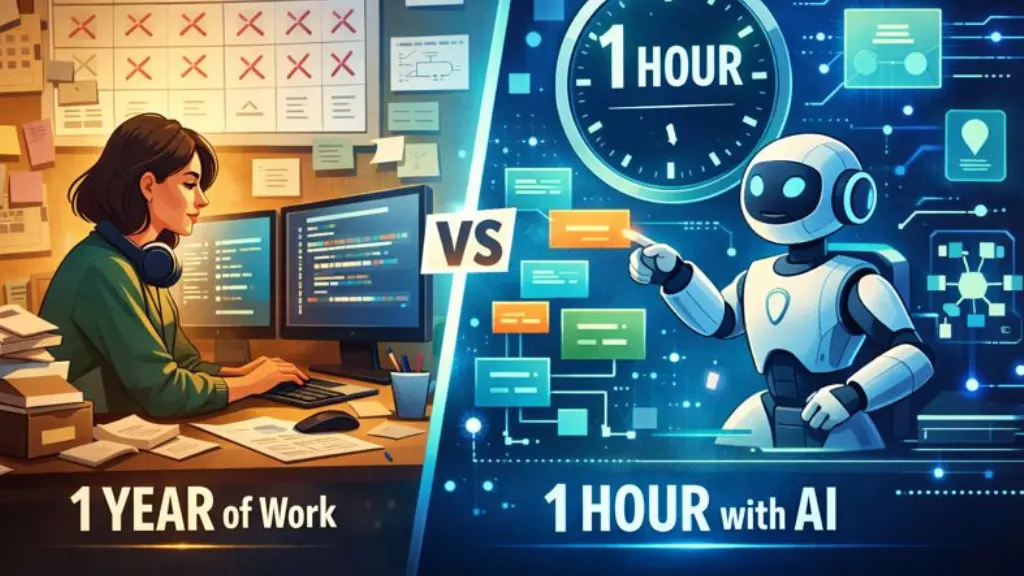
Jaana Dogan Reveals How Claude Code AI Matched Google’s Year-Long Work in One Hour
A Google Engineer’s One-Hour Shock That Sparked a Global Debate
When Jaana Dogan, a principal engineer at Google working on the Gemini API, shared her experience with an AI coding tool on X, it instantly became a trending topic. Her blunt statement — “I’m not joking and this isn’t funny” — captured the disbelief many engineers feel as artificial intelligence rapidly reshapes software development.
Dogan revealed that Claude Code, an AI-powered coding assistant developed by Anthropic, managed to build in one hour what her Google team had been working on for nearly a year. The post quickly went viral, crossing millions of views and igniting discussions about productivity, innovation, and the future role of human engineers.
What Was the Problem Claude Code Solved?
The task wasn’t simple or trivial. Dogan’s team had been working on distributed agent orchestrators — systems that coordinate multiple AI agents so they can work together effectively. These systems are complex, involving architectural trade-offs, scalability concerns, and long-term reliability.
According to Dogan, Google teams had tried several approaches throughout 2024, but consensus on a final design remained elusive. Large organizations often face this challenge, where multiple stakeholders, infrastructure constraints, and legacy systems slow decision-making.
Curious about how far AI coding tools had come, Dogan decided to test Claude Code on the same problem.
A Three-Paragraph Prompt, No Secret Data
To stay within policy and avoid using proprietary information, Dogan created a simplified version of the problem using only public concepts. Her prompt was intentionally lightweight — just three paragraphs outlining the challenge at a high level.
What followed surprised her.
Within an hour, Claude Code generated a working prototype that closely resembled the architectural patterns Google engineers had spent months building and debating. While Dogan acknowledged the result wasn’t production-ready and needed refinement, she described the quality of the output as “shocking,” especially given the minimal input.
“I gave Claude Code a description of the problem, it generated what we built last year in an hour,” she wrote.
Not Perfect, But a Powerful Starting Point
Dogan was careful to emphasize that Claude Code didn’t magically solve everything. The generated system still required polishing, testing, and real-world validation. However, she stressed that the real breakthrough was speed — the ability to go from idea to usable prototype without months of meetings and iterations.
She encouraged skeptics of AI coding agents to try them on problems where they already have deep expertise. When engineers understand a domain well, the acceleration AI provides becomes impossible to ignore.
Google, Gemini, and the Competitive Landscape
When asked whether Google uses Claude Code internally, Dogan clarified that it is allowed only for open-source projects, not internal development. Another user questioned when Google’s own AI, Gemini, would reach similar capabilities. Her response was direct:
“We are working hard right now. The models and the harness.”
Despite the competitive undertone, Dogan made it clear that AI development is not a zero-sum game. She openly praised Anthropic’s work, calling Claude Code impressive and saying it motivated her to push Google’s efforts even further.
How Fast AI Coding Has Evolved
Dogan also shared a striking timeline of AI-assisted programming:
- 2022: AI completed single lines of code
- 2023: It handled entire sections
- 2024: It worked across multiple files and simple apps
- 2025–2026: It can now create and restructure entire codebases
She admitted that just two years ago, she believed today’s capabilities were still five years away. “Quality and efficiency gains in this domain are beyond what anyone could have imagined,” she wrote.
Why This Moment Matters
The viral reaction to Dogan’s post reflects a broader realization across the tech world. AI tools like Claude Code aren’t just assistants anymore — they’re becoming accelerators that bypass bureaucracy, legacy constraints, and slow iteration cycles.
Jaana Dogan’s experience isn’t about AI replacing engineers. It’s about a new reality where one hour of AI-assisted work can rival a year of traditional development — and the industry is only beginning to grasp what that means.