IVF vs Test Tube Baby Myths | Perambalur Fertility Centre
When couples begin exploring fertility treatments, they often come across terms like "IVF" and "test tube baby." Many people assume they are different procedures, while others believe common myths that create unnecessary fear and confusion.
If you've been searching for IVF vs test tube baby explained, understanding the facts can help you make informed decisions about your fertility journey.
At Dr. Aravind's IVF Fertility & Pregnancy Centre, helping couples understand fertility treatments with accurate information is an important part of quality patient care.
What Is IVF?
In Vitro Fertilization (IVF) is one of the most effective assisted reproductive treatments available today. During IVF, mature eggs are collected from the ovaries and fertilized with sperm in a specialized laboratory. The resulting embryos are carefully monitored, and a healthy embryo is transferred into the uterus to establish pregnancy.
IVF has helped millions of couples worldwide overcome various fertility challenges and build healthy families.
What Is a Test Tube Baby?
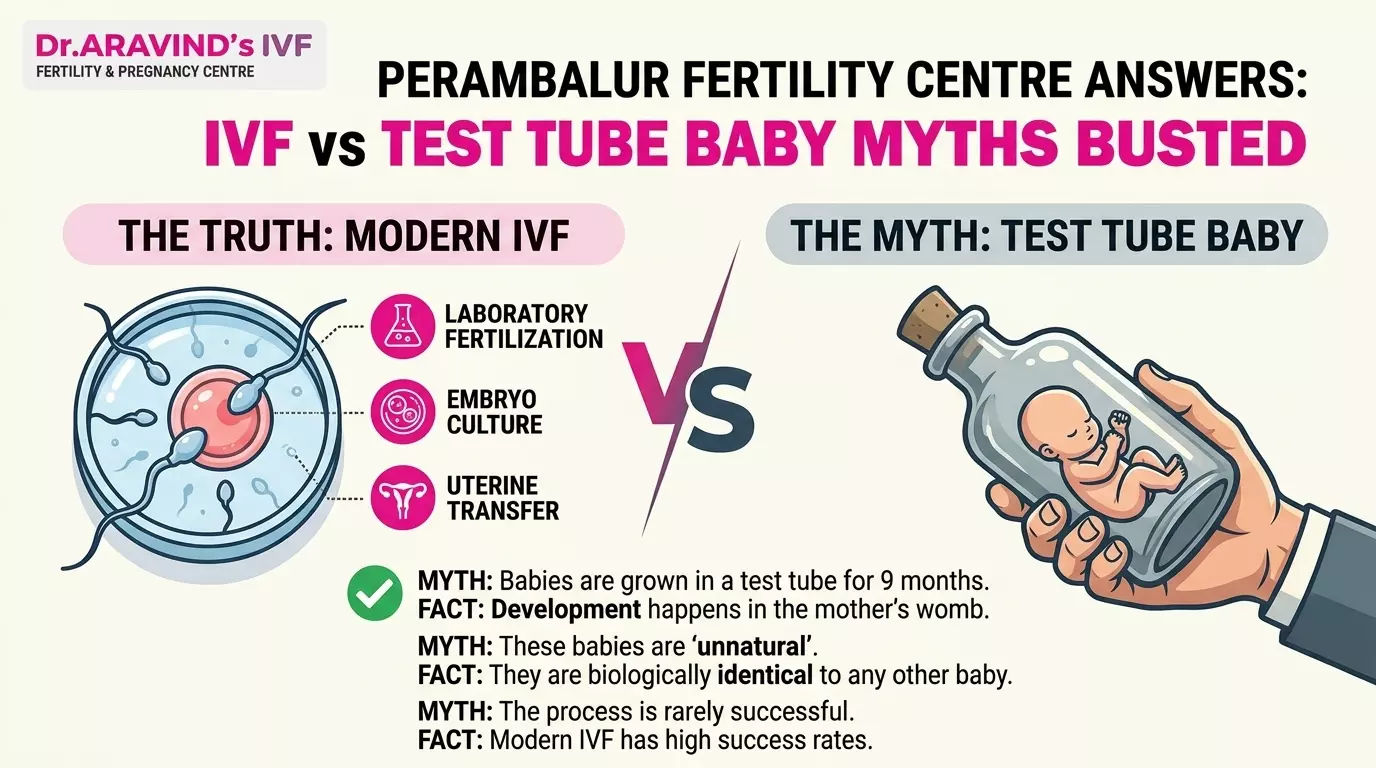
A "test tube baby" is simply a baby conceived through IVF treatment. The term became popular decades ago when IVF was first introduced, but it is no longer medically accurate.
Fertilization does not happen inside a test tube. Instead, eggs and sperm are combined in a laboratory culture dish under carefully controlled conditions. After fertilization, the embryo develops for several days before being placed into the uterus, where the pregnancy continues naturally.
Common Myths About IVF and Test Tube Babies
Many misconceptions still surround IVF treatment. Let's separate myth from fact.
Myth 1: IVF and Test Tube Baby Are Different Treatments
Fact: They are the same. IVF is the medical procedure, while "test tube baby" refers to a baby conceived through IVF.
Myth 2: Test Tube Babies Are Not Healthy
Fact: Babies born through IVF grow and develop just like naturally conceived babies. Once the embryo is transferred, pregnancy progresses naturally inside the uterus.
Myth 3: IVF Always Leads to Twins
Fact: Modern IVF commonly involves transferring a single healthy embryo, significantly reducing the chance of multiple pregnancies.
Myth 4: IVF Is Only for Older Women
Fact: IVF can help couples of different age groups facing infertility caused by blocked fallopian tubes, male infertility, ovulation disorders, endometriosis, or unexplained infertility.
Myth 5: IVF Guarantees Pregnancy
Fact: While IVF offers excellent success rates, pregnancy depends on several factors, including age, egg quality, sperm quality, embryo health, and overall reproductive health.
How Does IVF Treatment Work?
The IVF process follows several carefully planned steps:
- Fertility medications stimulate the ovaries.
- Mature eggs are collected through a minor procedure.
- Eggs and sperm are combined in a laboratory.
- Healthy embryos develop over several days.
- One selected embryo is transferred into the uterus.
- Pregnancy is confirmed through a blood test about two weeks later.
Every IVF treatment plan is personalized to suit the couple's medical condition and fertility goals.
Who Can Benefit from IVF?
IVF may be recommended for couples experiencing:
- Blocked or damaged fallopian tubes
- Male factor infertility
- Endometriosis
- Polycystic Ovary Syndrome (PCOS)
- Unexplained infertility
- Repeated failed IUI cycles
- Age-related fertility decline
If you are looking for a trusted Fertility Centre in Perambalur, consulting experienced fertility specialists can help determine the most suitable treatment based on your individual needs.
Read: IVF Treatment in India: A Journey of Hope and Possibility
Benefits of IVF
IVF offers several advantages for couples trying to conceive:
- Helps overcome multiple infertility conditions
- Provides higher pregnancy chances in suitable candidates
- Allows careful embryo monitoring before transfer
- Supports couples after unsuccessful fertility treatments
- Offers personalized treatment plans based on individual fertility factors
With modern technology and experienced fertility teams, IVF continues to improve outcomes for many hopeful parents.
When Should You Consult a Fertility Specialist?
You should consider seeking medical advice if:
- You are under 35 and have tried to conceive for one year.
- You are over 35 and have been trying for six months.
- You have irregular menstrual cycles.
- You have experienced recurrent miscarriages.
- You have a diagnosed fertility condition affecting either partner.
Early fertility evaluation often improves treatment options and success rates.
Frequently Asked Questions
1. Is IVF different from a test tube baby?
No. A test tube baby is simply a baby conceived through IVF treatment.
2. Is IVF painful?
Most IVF procedures involve only mild discomfort and are performed with patient comfort in mind.
3. Can IVF help after failed IUI?
Yes. Many couples move to IVF after unsuccessful IUI treatments and achieve successful pregnancies.
4. How long does one IVF cycle take?
A typical IVF cycle usually takes around 4 to 6 weeks.
5. Can lifestyle affect IVF success?
Yes. Maintaining a healthy weight, eating a balanced diet, avoiding smoking, and managing stress may support fertility treatment outcomes.
Conclusion
Many of the fears surrounding IVF come from outdated information and common myths. Understanding the facts helps couples feel more confident about their treatment options.
IVF and test tube baby are not different procedures—they describe the same medical process that has helped millions of families worldwide.
If you want reliable information before beginning your fertility journey, learning about IVF vs test tube baby explained is an excellent place to start with guidance from experienced fertility specialists at Dr. Aravind's IVF Fertility & Pregnancy Centre.