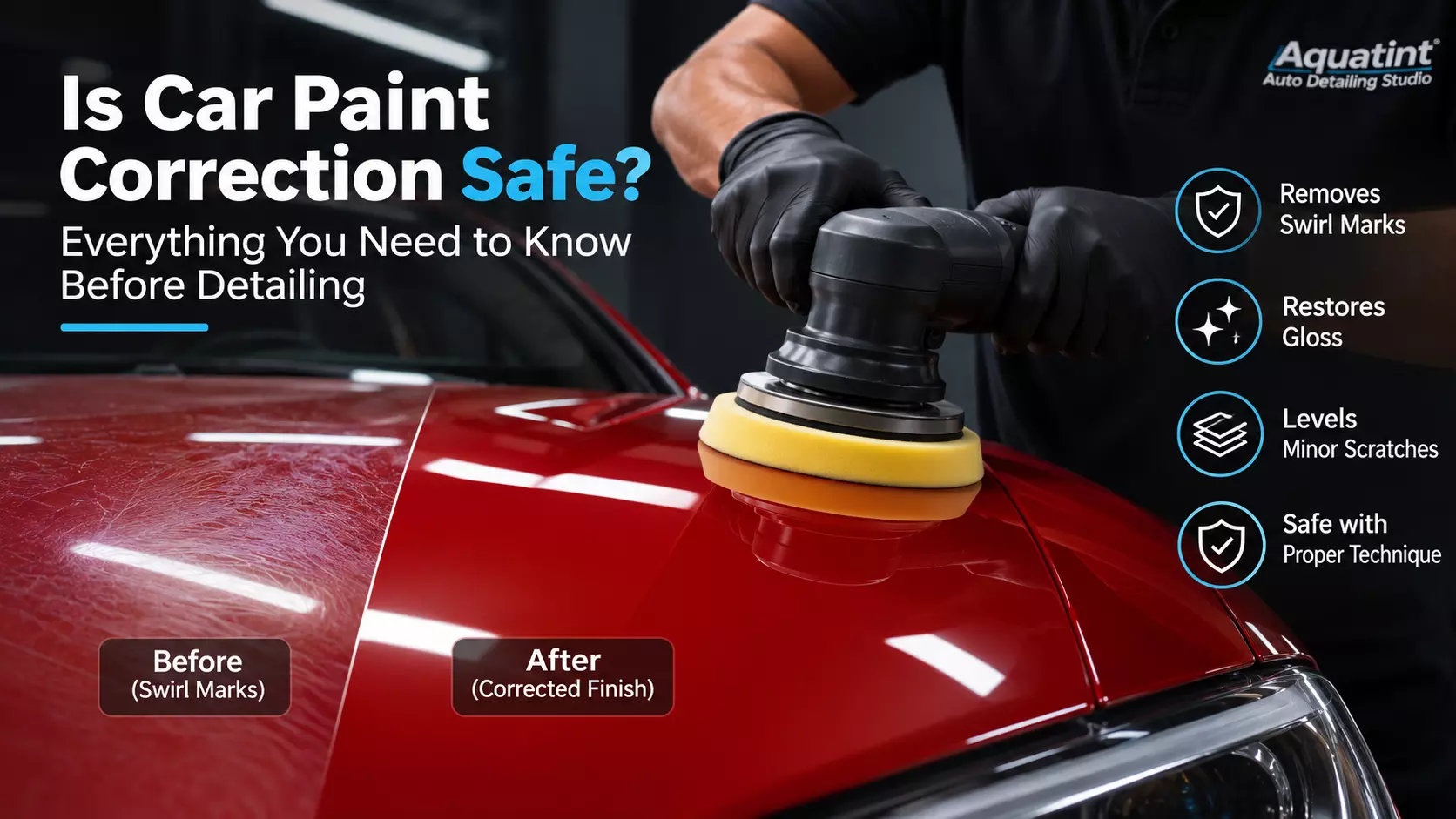
Is Car Paint Correction Safe? Read This Before You Start Detailing
A shiny car feels great to drive. Still, the idea of "correction" can make you uneasy. Will it make your paint thin? Could it do harm?
So many people wonder, is car paint correction safe? This guide answers that honestly. You will find out the risks, see why clear coat thickness matters, and learn how to pick the right detailer.
A Quick Look at Car Paint Correction
Car paint correction is a detailing method that clears swirl marks, light scratches, water spots, and oxidation from the clear coat. A trained technician uses a polisher, pads, and compounds to level the surface by a tiny amount. You get a smooth, glossy finish.
It is different from a simple wax or wash because it improves the paint itself. Most cars benefit after years of washing and sun. See our professional car detailing services and how expert detailing can bring your vehicle back to its best.
Is Car Paint Correction Safe? The Quick Answer
Yes, when a trained professional does it on healthy paint. It removes a very thin layer of clear coat, often just a few microns. Risks appear only with poor technique, wrong products, or paint that is already too thin.
Safety depends on the detailer's skill and your paint's condition.
Why Your Clear Coat Thickness Matters
Clear coat is the top protective layer of the paint. Many cars have only 40 to 50 microns of it, which is thinner than a sheet of paper.
A good detailer measures it first using a paint thickness gauge. Is car paint correction safe on all panels? That depends on thickness. Here is why:
- Healthy factory paint usually handles correction well.
- Thin or repainted panels need a lighter hand.
- Cutting too much can cause clear coat failure.
- Gauge readings show how much paint is safe to take off.
Does Paint Correction Hurt the Paint?
No, not when it is done properly. A skilled detailer takes off just the minimum needed to level scratches and tests a small area first. Harm happens when someone rushes, uses harsh compounds or strong pads, or polishes paint that was already thin.
Is Paint Correction Bad for Your Car? Risks to Be Aware Of
Not when it is done right. Still, here are the car paint correction risks:
- Burn-through: Too much heat or pressure can go through the clear coat.
- Holograms: The wrong pads or technique leave light buffer trails.
- Over-polishing: Correcting again and again slowly thins the paint.
- Edge damage: Edges and body lines have thinner paint.
- Product haze: Rough compounds can dull the finish.
Almost all risks come from poor skill and not the process itself.
https://medium.com/@zscleansandiego/effective-techniques-for-car-odor-removal-d98ddc3df93e
The Paint Correction Process, Step by Step
Knowing the paint correction process helps you feel sure about it. A careful detailer will:
- Wash the car and decontaminate the paint.
- Measure the paint thickness with a gauge.
- Test a small spot with a light polish.
- Machine polish in controlled passes.
- Wipe the panel and inspect it under bright light.
- Finish with a sealant or ceramic coating to protect the shine.
Safety Checklist: Questions to Ask Before You Book
Is car paint correction safe at every shop? Not always. Check these first:
- Ask if they measure clear coat thickness.
- Ask what pads and compounds they use.
- Look at reviews and before-and-after photos.
- Be wary of very low prices, which often mean rushed work.
- Tell them about past repaints or accidents.
These questions go a long way in protecting your car.
Not sure whether your paint can handle it? Visit our Baner studio for a professional paint assessment and honest advice. Explore our car paint correction service and see how we restore your car's gloss while caring for its clear coat.
When You Should Not Do Paint Correction
In some cases, it is smarter to wait. Skip or delay it if:
- The paint is already very thin from past polishing.
- The clear coat is peeling or cracking.
- A panel has a fresh repaint that has not cured.
- Scratches are deeper than the clear coat.
A good detailer will be open with you.
Conclusion
So, is car paint correction safe? Yes, when a trained detailer checks your clear coat thickness and uses the proper method. Pick skill over speed, ask questions, and protect the shine afterward.