Iron-On or Sew-On Patches: Which One Is Better?
Are you confused about choosing between gluing or sewing your custom patch? Iron-on patches give you easy heat application, whereas sew-on patches provide lasting wearability and durability for clothing items like jackets and uniforms.
Discover Which Patch Fits Your Lifestyle
You spent hours picking out the perfect patches for your favorite jacket, and then you saw it curling at the edges after just one wash or ripping the fabric during application.
An awesome custom apparel job can turn into a time-consuming and money-losing venture if the wrong attachment technique is selected.
Each fabric used in garments has its own response to heat, pressure, thread tension, and usage over time, so there is no magic fix that is applicable to every situation.
Knowing the performance of each technique in the real world ensures that your custom-designed pieces remain sharp, secure, and completely flat over the years.
What Is An Iron-On Patch?
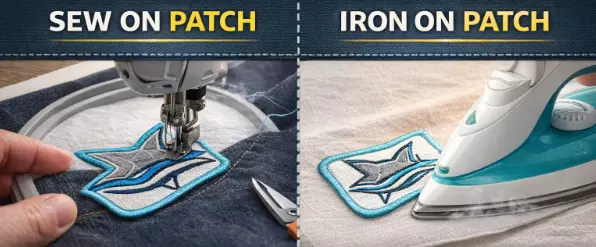
Iron-on patches are decorative or branded patches that have an adhesive on the back that becomes activated when it is heated.
They are secured to clothing with a hot press or an iron, which makes them an easy choice for those who wish to customize their clothes without the need for sewing.
If used properly on appropriate materials, they form a safe seal and allow jackets, bags, uniforms, and other materials to be customized without the hassle of factory production.
What Are Sew-On Patches?
Sew-on patches are permanent fabric, embroidered, woven, or PVC patches sewn around the edges. They are not adhesive-backed and are good for almost all types of fabrics, unlike the heat-activated ones.
They offer a tight stitch that is ideal for uniforms, workwear, sportswear, backpacks, and clothes that are washed regularly or worn all day.
Save Installation Time With Fast Heat-Activated Backing Solutions
Heat-activated adhesives transformed apparel customization by enabling anyone to transform a garment into something new in less than two minutes with no needle, no thread, no pin.
Iron On Patches are simply ironed on to strong cotton or canvas with a basic household iron set to high heat and applied with pressure.
A slight layer of clear polymer backing is melted by the heat, and the patch fibers are permanently fused into the fabric of your garment.
This way you get rid of the hand-sewing, and it is the perfect option for the fast track of preparing for events, school clothing, or bulk wardrobe changes.
Ensure Maximum Durability With Heavy-Duty Stitched Attachments
Stitched attachments ensure unmatched durability when exposed to extreme outdoor environments, friction, or washing your gear frequently.
The traditional needlework secures the patch firmly to the fabric by being stitched through the weave itself, thus forming a mechanical bond that will not melt, peel, or degrade under hot water.
It is ideal to stitch on thick materials such as leather, thick denim, canvas backpacks, and tactical jackets, which don't handle high iron temperatures. Since thread is flexible, stitched emblems will naturally bend and move with the garment, without cracking.
This is a traditional technique that ensures artwork stays secure in any conditions or environment.
Protect Delicate Synthetics By Avoiding Extreme Ironing Temperatures
Fragile modern materials such as nylon windbreakers, light waterproof shells, and athletic jerseys made of polyester do not perform well under high temperatures.
A hot iron can burn, stain, or even melt the surrounding portion of a synthetic fiber garment.
Sew-on patches are a method for safe customization of technical clothing without risk of thermal damage. Hand sewing or a fine-needle sewing machine is used to attach emblems in just the correct spot on lightweight jackets without leaving behind a permanent stain.
This soft-touch method maintains the quality of high-performance technical clothing and brings a personal touch.
Extend Product Life With Smart Hybrid Attachment Methods
When it comes to workwear or travel gear, you don't always need to adhere to a single type of attachment.
Iron-on patches paired with just a simple outer stitch around the edge yield a strong hybrid product for fast performance and highest strength.
The heat-activated adhesive keeps the patch securely in place during sewing, without the need for awkward fabric pins that create holes in the fabric.
After fusing, doing a quick stitch around the patch secures the corners permanently and prevents peeling. This double layer system provides you with complete assurance for valuable outerwear.
Read: Ostrich Embroidery Designs for Custom Embroidered Back
Express Unique Personal Style Using Custom-Designed Patches
Personalized artwork on plain clothes can transform ordinary clothes into expressions of individuality, making them instantly recognizable in any setting.
Ordering Embroidered Patches leaves you with absolute freedom in selecting patterns, shapes, colors, and textured thread for your logo.
Custom patches offer a polished retail look, whether you're fostering team pride, marketing your business, or simply adding a creative touch to your event.
Accompanying your custom artwork with the right attachment method guarantees your unique creation looks intentional, feels comfortable, and remains visually appealing over time.
Avoid Common Installation Mistakes
Quality patches can be of no use if they are not properly placed.
Overheating, improper stitching, uneven pressure, or incorrect placement can often have adverse effects on durability and overall appearance.
It is best to carefully read the application instructions and prepare the fabric in advance for the best final result and to minimize edge lifting and wear.
Consider Future Replacement And Repairs
Clothing can change with the passage of time.
A few patches may need to be changed out over time due to updates to the brand, fashion changes, or garment repairs.
Pre-planning for future removals ensures that you will select the best attachment method for maximizing flexibility in the future. Time and effort are saved by planning.
FAQs
What patch holds up longer on clothes?
Sew-on patches tend to offer more durability over time since the patch is sewn on, which means it will stay in place for a long occasion, even if you wash it many times or use it a lot. Iron-on patches work well if applied properly, but may need extra reinforcement in clothes that are subject to use and motion.
Can all fabrics be used with iron-on patches?
No. Certain delicate fabrics, temperature-sensitive materials, and specialized textiles may not be able to withstand the temperature needed to activate the adhesive. Please review the label directions for garment care before use to make sure the garment will not be harmed by the recommended heat level.
Is it possible to iron-on a patch and then sew around it?
Yes. Some people use a mixture of both techniques, applying the adhesive and then stitching around the edges. This is a convenient way to position and offers strength for clothing that is washed frequently or used a lot every day.
What would be the best type of attachment for uniforms?
Most patches that are attached to uniforms are best suited to a sewn technique because they are washed, stretched, and moved often. Good quality stitching will make them more professional in appearance and reduce the risk of lifting corners in frequent use.
Can patches be taken off without harming the fabric?
There are several methods of patch removal, and the success of each process greatly depends on the way the patch attaches and its quality. Generally, the garment will not be seriously damaged by proper patch removal techniques, but you will need to take your time during the removal process.
Conclusion
It’s not an issue of choosing one supreme victor between the two methods: iron-on & sew-on.
Just choose the right method based on the type of material, the usage frequency, the level of durability required, and the amount of time you can invest in applying patches.
Considering all these factors, you will find it much simpler to choose the perfect method of applying patches that will last you for many years to come.