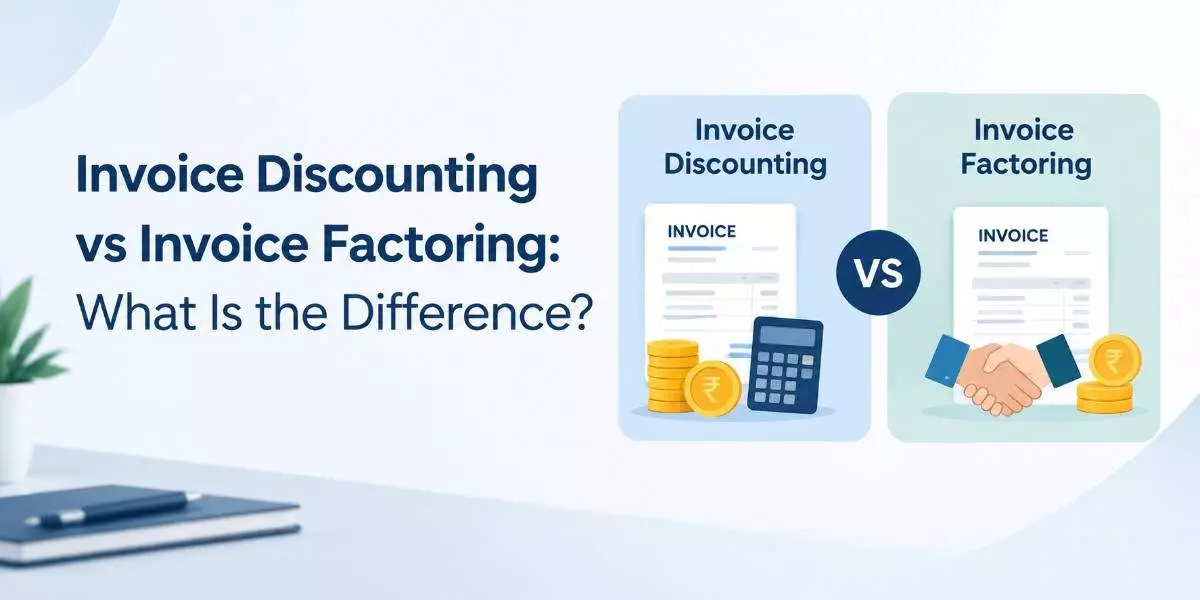
Invoice Discounting vs Invoice Factoring: What Is the Difference?
Businesses often sell products or services on credit. While credit sales can help build strong customer relationships, they can also create a cash flow gap.
The business may have completed the sale and raised an invoice, but the payment may not arrive for 30, 60, or even 90 days.
This is where invoice-based financing can help. Two commonly used options are invoice discounting and invoice factoring. Both allow businesses to access funds against outstanding invoices, but the way they work is different.
Understanding the difference between invoice discounting and invoice factoring can help MSMEs and business owners choose an option that fits their cash flow requirements.
What Is Invoice Discounting?
Invoice discounting is a form of short-term financing where a business raises funds against its unpaid invoices. Instead of waiting until the buyer makes the payment, the business can receive a major portion of the invoice value earlier from a financier.
For example, suppose an MSME has raised an invoice of ₹5 lakh on a corporate buyer with a payment period of 60 days. Rather than waiting for two months, the business can use invoice discounting to access funds against that invoice.
Once the buyer makes the payment, the financing arrangement is settled after applicable charges.
Invoice discounting allows the business to maintain control over its customer relationships and collections. In many arrangements, the buyer may continue dealing directly with the business without knowing that the invoice has been financed.
What Is Invoice Factoring?
Invoice factoring is another way of raising funds against outstanding invoices. In factoring, a business transfers or assigns its receivables to a factor, which provides funds against those receivables.
The factor may also take responsibility for managing collections from the customers, depending on the type of factoring arrangement.
For example, if a business has ₹5 lakh in outstanding invoices, it may assign those receivables to a factoring company. The factor provides an agreed amount upfront and collects the invoice payment from the customer when it becomes due.
Factoring can therefore involve not just financing but also receivables management and collection services.
Invoice Discounting vs Invoice Factoring: Key Difference
The biggest difference is in who manages the receivables and collections.
With invoice discounting, the business generally continues to manage its own sales ledger and customer collections while using its invoices to access working capital.
With factoring, the factor may take over the management and collection of the receivables, depending on the agreement.
Here are some other important differences.
1. Control Over Customer Collections
In invoice discounting, the business generally retains control over its customer collections. It continues to deal with customers and follows up for payments.
In factoring, the factor may manage the collection process. This can reduce the administrative work for the business.
2. Customer Relationship
Invoice discounting can allow businesses to maintain direct relationships with their customers. The financing arrangement may not necessarily change how the business communicates with buyers.
With factoring, customers may deal directly with the factoring company for payment, depending on the arrangement.
3. Services Provided
Invoice discounting is mainly focused on providing working capital against unpaid invoices.
Factoring can combine financing with services such as receivables management, credit monitoring and collection support.
The exact services depend on the factoring agreement.
4. Confidentiality
Invoice discounting can often be structured so that customers are not directly involved in the financing arrangement.
Factoring may involve notifying customers that the receivables have been assigned to a factor, particularly in arrangements where the factor manages collections.
The structure can vary between providers and agreements.
5. Collection Responsibility
Under invoice discounting, the business generally remains responsible for collecting payments from customers.
Under factoring, the factor may take responsibility for collecting payments from customers.
This can be useful for businesses that want to reduce the time and resources spent on receivables management.
Read: Why Bajaj Finance in Shahpura Dindori Is Chosen for Loans
How Does Invoice Discounting Work?
The process of invoice discounting is relatively straightforward.
Step 1: Raise an invoice
The business supplies goods or services to its customer and raises an invoice.
Step 2: Submit the invoice for financing
The eligible invoice is submitted to a financier or an invoice financing platform.
Step 3: Financing is provided
After the invoice and transaction are assessed, the business receives funds against the invoice, subject to the applicable terms and charges.
Step 4: Customer makes the payment
The buyer pays the invoice according to the agreed payment terms.
Step 5: Financing is settled
The amount received from the buyer is used to settle the financing arrangement, after applicable charges and adjustments.
How Does Invoice Factoring Work?
The factoring process usually involves these steps:
Step 1: Business raises invoices
The business sells goods or services and raises invoices for its customers.
Step 2: Receivables are assigned to the factor
The business enters into an agreement with a factoring company and assigns eligible receivables.
Step 3: Business receives funds
The factor provides an agreed percentage of the invoice value upfront.
Step 4: Customer pays the invoice
The customer makes the payment, generally to the factor or as instructed under the agreement.
Step 5: Balance is settled
After receiving payment, the factor releases any remaining amount after deducting applicable fees, charges or other adjustments.
Invoice Discounting vs Invoice Factoring: Which Is Different for MSMEs?
There is no single option that suits every business. The right choice depends on how the business manages its receivables and what it expects from the financing arrangement.
Invoice discounting may be suitable for businesses that:
- Want working capital against outstanding invoices
- Prefer to manage customer collections themselves
- Want to maintain direct customer relationships
- Have an established receivables management process
- Need short-term liquidity without outsourcing collections
Factoring may be considered by businesses that:
- Want to reduce the burden of collecting receivables
- Need financing along with receivables management
- Have limited internal resources for collection activities
- Prefer to outsource parts of their credit and collection process
Businesses should also compare the financing cost, eligibility requirements, repayment structure, customer involvement and other terms before selecting an option.
Can TReDS Be Used for Invoice Discounting?
TReDS, or the Trade Receivables Discounting System, provides a digital platform for financing eligible trade receivables of MSMEs.
On TReDS, an MSME can upload eligible invoices or receivables. After the buyer accepts the transaction, financiers can participate in financing the receivable. The MSME can then receive funds before the original invoice due date, subject to the transaction terms.
RXIL (Receivables Exchange of India Limited) is a TReDS platform that helps MSMEs access working capital by facilitating invoice and bill discounting. Businesses can use the platform to connect eligible trade receivables with financiers and access funds against approved invoices.
This makes TReDS relevant for MSMEs looking for an organised way to convert eligible trade receivables into working capital.
Final Thoughts
Invoice discounting and invoice factoring both help businesses unlock funds tied up in unpaid invoices, but they are not exactly the same.
Invoice discounting primarily focuses on financing against invoices while the business generally continues to manage its receivables and collections. Factoring can combine invoice financing with receivables management and collection services.
For MSMEs, the decision should be based on their working capital requirements, customer relationships, collection process, financing costs and the level of receivables management they want to retain.
Before choosing an option, businesses should understand the terms of the arrangement and compare the overall cost with the cash flow benefits it can provide.