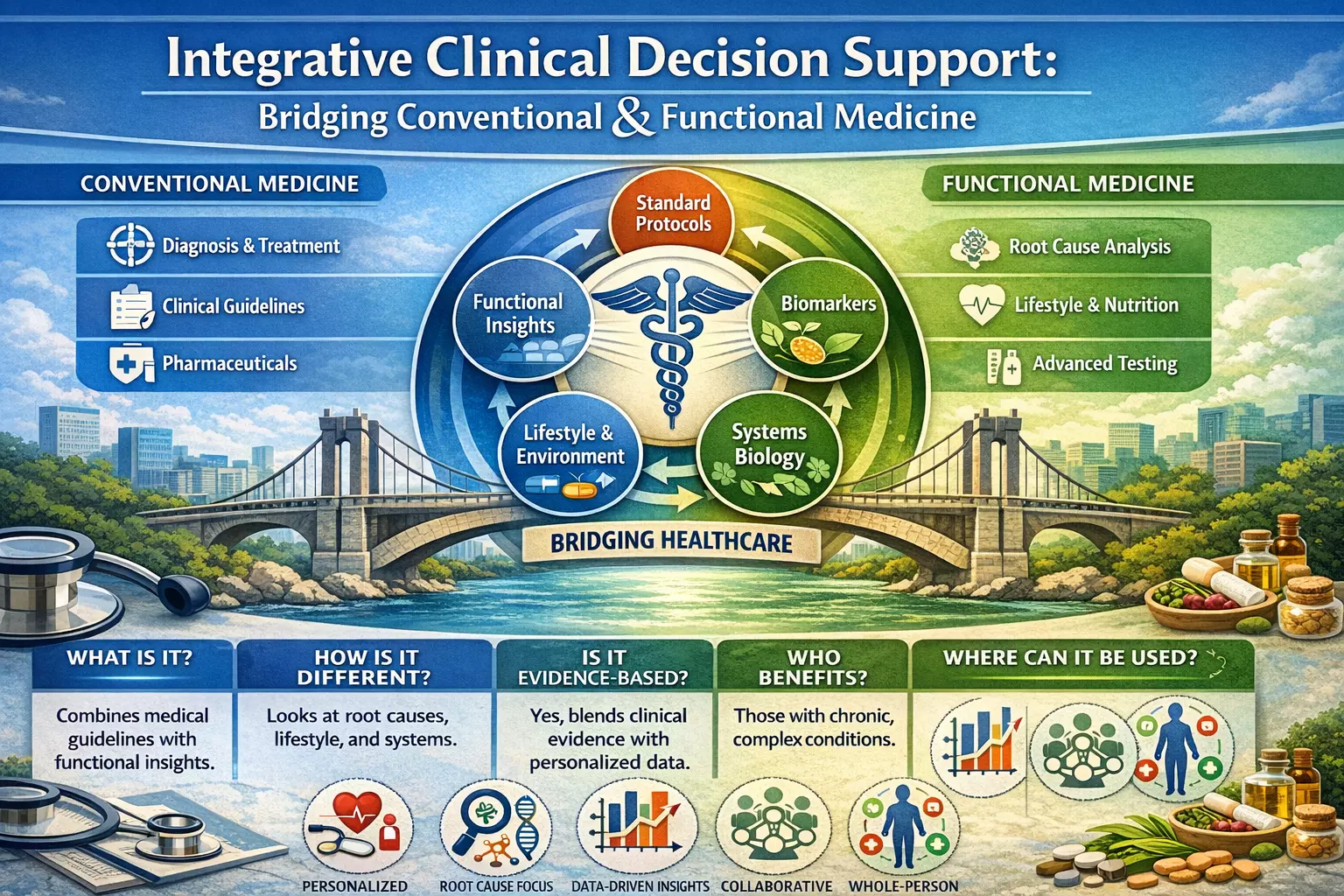
Integrative Clinical Decision Support: Bridging Conventional and Functional Medicine
Modern healthcare is at a crossroads. On one side stands conventional medicinal medicine— proof-based totally, protocol-pushed and essential for acute care and ailment control. On the other side is functional medicine—structures-oriented, customized, and focused on root reasons and prevention.
Although these methods have frequently been used concurrently, integration is the way of the future for healthcare, and clinical decision support (CDS) is a crucial facilitator of this integration.
A strong framework for bridging traditional and practical medicine is provided by integrative clinical decision support, which helps physicians provide highly individualized and scientifically sound care.
The Divide Between Conventional and Functional Medicine
Conventional medication excels in prognosis, standardization, and treatment of well-defined diseases. Clinical guidelines, randomized managed trials, and diagnostic algorithms provide readability and consistency.
However, these strengths can also turn out to be barriers while sufferers present with complicated, persistent, or multi-system conditions—together with autoimmune issues, metabolic disorder, chronic fatigue, or irritable bowel syndrome—where symptoms no longer match well into diagnostic boxes.
Functional medication approaches these identical situations in another way. Rather than asking “What disorder does the patient have?”, it asks “Why is this affected person experiencing dysfunction?” It emphasizes biochemical individuality, lifestyle factors, environmental exposures, and interconnected body systems.
While compelling and often powerful, functional medicine can be information-heavy, time-intensive, and variable in implementation, making scalability and consistency challenging.
Why Clinical Decision Support Matters
Clinical decision support systems are tools designed to assist clinicians in making knowledgeable choices through synthesizing affected person records, clinical knowledge, and evidence-based recommendations. In conventional settings, CDS is already extensively used—flagging drug interactions, recommending preventive screenings, and helping diagnostic pathways.
However, conventional CDS tools are in large part constructed round disorder codes, population averages, and linear algorithms. They aren't designed to deal with the complexity, nuance, and personalization critical to functional medicine. This is where integrative clinical decision support comes in.
What Is Integrative Clinical Decision Support?
Integrative CDS expands the scope of traditional structures via incorporating conventional medical standards and functional medicine frameworks. It brings collectively:
- Standard diagnostics and clinical guidelines
- Advanced biomarker evaluation
- Systems biology and pathway-primarily based thinking
- Lifestyle, nutrition, stress, sleep, and environmental data
- Personalized hazard and resilience factors
Rather than changing medical judgment, integrative CDS complements it—supporting clinicians to see patterns, connections, and possibilities that could in any other case be overlooked.
Bridging Evidence and Personalization
One of the most common critiques of functional medicine is variability in proof. Integrative CDS addresses this challenge by anchoring practical insights inside an established, proof-knowledgeable framework. For example:
- An affected person with insulin resistance may additionally trigger traditional indicators associated with diabetes threat while additionally surfacing practical participants consisting of micronutrient deficiencies, circadian disruption, irritation, and intestine dysbiosis.
- Instead of generic lifestyle advice, CDS can prioritize interventions based on patient-specific data, likelihood of impact, and clinical relevance.
- Recommendations can be tiered by strength of evidence, allowing clinicians and patients to engage in transparent, informed decision-making.
This approach respects the rigor of conventional medicine while preserving the individualized lens of functional care.
Managing Complexity Without Overload
One of the most important challenges clinicians face—specifically in integrative exercise—is cognitive overload. Patients generate good sized amounts of records: labs, genomics, wearables, questionnaires, and histories. Without help, synthesizing these statistics is time-consuming and vulnerable to bias or oversight.
Integrative CDS acts as a sense-making layer, organizing complexity into actionable insights. It can:
- Highlight key imbalances across systems rather than isolated lab abnormalities
- Identify upstream drivers instead of chasing downstream symptoms
- Track progress longitudinally, not just episodic snapshots
- Support shared decision-making by translating data into clear narratives
This not only improves clinical efficiency but also enhances patient engagement and trust.
Supporting Collaboration and Consistency
Integrative care frequently includes multidisciplinary teams—physicians, nutritionists, health coaches, and intellectual fitness experts. Integrative CDS affords a commonplace language and framework, ensuring consistency across providers whilst taking into consideration function-unique insights.
It also supports scalability. As integrative and useful medicine grows past boutique practices into large healthcare systems, generation-enabled choice assist becomes crucial to keep first-rate, protection, and reproducibility.
Frequently Asked Questions
1. What is integrative clinical decision support?
It is a system that mixes conventional medical recommendations with practical remedy insights to support personalized, data-informed medical decisions.
2. How does it differ from traditional clinical decision support?
Traditional CDS focuses on disease protocols, while integrative CDS also considers root reasons, way of life factors, and interconnected frame systems.
3. Is integrative clinical decision support evidence-based?
Yes, it anchors recommendations in established medical evidence while incorporating emerging research and individualized clinical data.
4. Who benefits most from integrative clinical decision support?
Clinicians coping with complex or continual conditions and patients who need customized, whole-person care benefit the most.
5. Can integrative CDS be used in conventional healthcare settings?
Absolutely—whilst designed nicely, it enhances present workflows and supports fee-based, preventive, and collaborative care fashions.
Read: Health Risks of a Sedentary Lifestyle and How to Make
The Future of Integrative Care
As healthcare shifts toward value-based models, prevention, and chronic ailment management, the convergence of traditional and functional remedy is no longer optionally available—it's inevitable. Integrative clinical decision support sits on the coronary heart of this modification.
By combining the strengths of both paradigms, integrative CDS empowers clinicians to deliver care this is:
- Evidence-based yet customized
- Systematic but flexible
- Efficient yet deeply human
The end result is not a compromise among medical philosophies, however an extra entire, resilient, and powerful version of care—one which treats the affected person, not just the disease.