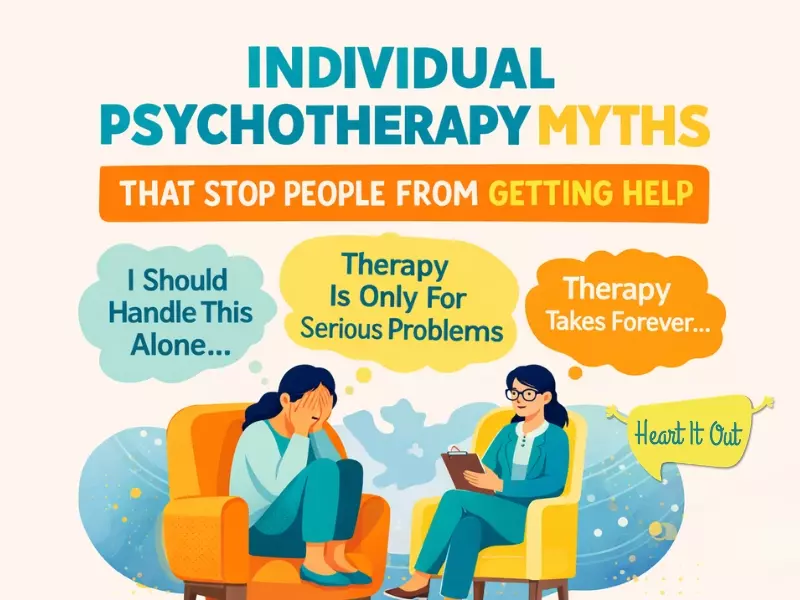
Individual Psychotherapy Myths That Stop People From Getting Help
Many people quietly struggle with stress, anxiety, or emotional confusion—but still hesitate to try individual psychotherapy. Not because help isn’t available, but because of myths that feel convincing.
These myths often sound logical:
"I should handle this on my own."
"Therapy is only for serious problems."
The truth is, these beliefs can delay healing far more than people realize. Let’s break them down—clearly, honestly, and without jargon.
What Is Individual Psychotherapy (In Real Life Terms)?
Instead of textbook definitions, think of individual therapy as:
- A structured conversation focused entirely on you
- A space where your thoughts are explored, not judged
- A process that helps you understand patterns, not just problems
It’s not about being “fixed.” It’s about becoming more aware, more stable, and more in control of your emotional world.
Common Myths About Individual Psychotherapy
1. “Therapy Is Only for Serious Mental Illness”
This is one of the biggest reasons people avoid therapy individual sessions.
Reality:
- Therapy is also for everyday struggles
- Stress, burnout, confusion, relationship issues—all valid reasons
- You don’t need a diagnosis to benefit
Many people start therapy simply because they feel “stuck,” not broken.
2. “I Should Be Strong Enough to Handle It Alone”
This belief often comes from how we were raised.
Reality:
- Emotional strength includes asking for help
- Even highly successful people seek therapy
- You don’t gain strength by suppressing emotions—you gain it by understanding them
Think of therapy as training your mind, not admitting weakness.
3. “A Therapist Will Just Tell Me What to Do”
A common misconception about working with a psychologist in Bangalore or anywhere else.
Reality:
- Therapists don’t give direct instructions like a manual
- They help you uncover your own answers
- The process is collaborative, not authoritative
It’s less about advice and more about insight.
4. “Talking About Problems Will Make Them Worse”
This myth keeps people silent for years.
Reality:
- Avoiding emotions usually intensifies them
- Talking helps organize thoughts and reduce overwhelm
- Therapy creates a safe structure for difficult conversations
Unspoken thoughts don’t disappear—they accumulate.
5. “Therapy Takes Forever to Work”
Some people expect endless sessions with no clear outcome.
Reality:
- Many people notice small changes within weeks
- Therapy is goal-oriented, even if goals evolve
- Progress often shows up in subtle ways: better decisions, calmer reactions
It’s not instant—but it’s not endless either.
6. “Only People Who Can’t Cope Need Therapy”
This myth is quietly harmful.
Reality:
- People who are functioning well still seek therapy
- It’s used for self-improvement, not just crisis management
- Therapy can enhance clarity, confidence, and emotional resilience
You don’t have to be struggling deeply to benefit.
Why These Myths Are So Powerful
These beliefs don’t come from nowhere. They are shaped by:
- Cultural expectations around “being strong”
- Lack of awareness about how therapy actually works
- Fear of being judged
- Past experiences or second-hand stories
Understanding where these myths come from helps reduce their hold.
What Actually Happens in Individual Therapy Sessions?
To remove uncertainty, here’s what typically happens:
- You talk about what’s on your mind—at your pace
- The therapist asks thoughtful, non-judgmental questions
- Patterns in your thoughts or behavior are gently explored
- You begin to connect emotions with actions
There’s no pressure to share everything at once. The process builds gradually.
Signs You Might Be Ready (Even If You’re Unsure)
- You overthink the same situation repeatedly
- You feel emotionally drained without clear reasons
- You want clarity but don’t know where to start
- You handle everything alone—but feel exhausted
These are not “extreme” problems—but they are valid reasons to consider individual psychotherapy.
What Makes Therapy Actually Helpful?
Not all therapy feels the same. What matters most is:
- Feeling understood, not analyzed
- A structured but flexible approach
- A therapist who listens more than they speak
- A space where you can be honest without filtering
The effectiveness of therapy depends less on techniques and more on the quality of connection.
Read: Regaining Calm: A Guide to Severe Panic Attack Treatment in
Conclusion
The biggest problem with these myths is not that they are incorrect—it’s that they delay action.
People wait until things feel unbearable.
But therapy is often most helpful before that point.
You don’t need a breaking point to begin understanding yourself better.
FAQs
1. Is Individual Psychotherapy only for people with mental illness?
No. It’s commonly used for everyday challenges like stress, confusion, and emotional clarity.
2. How do I know if Individual Therapy will help me?
If something has been bothering you repeatedly, therapy can help you understand and manage it better.
3. How long does Therapy Individual usually take?
It varies. Some people benefit in a few sessions, while others continue for deeper self-growth.
4. Can I do therapy even if I don’t know what’s wrong?
Yes. Many people start therapy with unclear feelings rather than specific problems.
5. How do I find the right Psychologist in Bangalore?
Look for someone you feel comfortable with, who listens well, and explains things clearly—not just someone with credentials.
A Thought After Doing Real Research
After exploring different approaches and understanding how therapy actually works, one thing becomes clear: the experience depends heavily on the people providing it.
Some platforms focus too much on process, while others genuinely focus on people.
During this research, Heart It Out stood out—not because of marketing claims, but because of how clearly they explain therapy, how approachable their process feels, and how they focus on real human experiences rather than labels.
If someone is considering taking that first step, it’s worth exploring spaces that feel safe, simple, and genuinely understanding.