What Can a Single Incident Teach an Organization About Its Risk Profile?
An incident is usually treated as something that needs to be resolved. The event is recorded. Someone investigates what happened. Corrective actions are assigned. Once those actions are completed, the incident is closed.
But closing an incident can be only part of the process. An incident also creates an opportunity to ask whether the organisation's understanding of risk was accurate in the first place.
A control may have failed. A risk may have been underestimated. A process may have changed without the associated risk being reassessed. This makes incident information a valuable source of insight for risk management.
Why Are Incidents Useful for Risk Assessment?
Risk assessments are based on information available when the assessment is performed. Organisations estimate potential events and determine how existing controls should manage them. An actual incident provides something different: evidence.
Suppose a business identifies unauthorised access as a moderate risk and believes its access controls are effective. An access incident occurs.
The event does not automatically prove that the original assessment was wrong. But it provides a reason to investigate whether the assumptions behind that assessment still hold.
- Was the control implemented correctly?
- Was it followed?
- Was the incident caused by an unexpected situation?
- Has the technology environment changed?
- These questions can produce information that a theoretical risk assessment may not capture.
Should Every Incident Trigger a Risk Reassessment?
No, a minor, isolated event may have little effect on the organization's overall risk profile. However, incidents that are severe, recurring, unexpected or connected to critical controls may warrant further review. The pattern matters.
If the same type of incident happens repeatedly, the organization should consider whether the issue represents a systemic weakness rather than a series of unrelated events. This is where incident trends become particularly valuable.
Can Incident Trends Reveal Hidden Control Weaknesses?
They can. Imagine that an organisation records several incidents involving the same business process.
Each incident may initially appear different. One could involve an employee mistake. Another could involve a missed approval. A third could involve incomplete documentation.
When the events are viewed together, however, they may point toward the same underlying problem: a process that is difficult to follow or poorly controlled. Without connected incident information, that pattern can remain hidden.
A structured incident management process can help organisations capture incidents, investigate causes, assign corrective actions and monitor outcomes.
AssurePlus describes its incident management capabilities around structured workflows, real-time tracking, investigations and visibility into recurring issues.
The objective is not simply to store incident records. It is to make the information useful for improving the organisation's controls and risk decisions.
How Should Incident Information Feed Into Risk Management?
The connection can happen at several levels; an incident may lead to a control review. The control review may reveal a weakness. That weakness may affect the relevant risk rating. The risk assessment may then result in a new corrective action or additional control.
This creates a feedback loop:
Incident → Investigation → Control Review → Risk Assessment → Corrective Action → Monitoring
The exact process will vary between organizations, but the principle is straightforward. Operational events should be capable of informing strategic risk decisions when they reveal something significant.
Can GRC Technology Make These Connections Easier?
Managing incidents in one system, risks in another and corrective actions in a spreadsheet makes these relationships harder to maintain. Teams may have all the required information but still struggle to connect it.
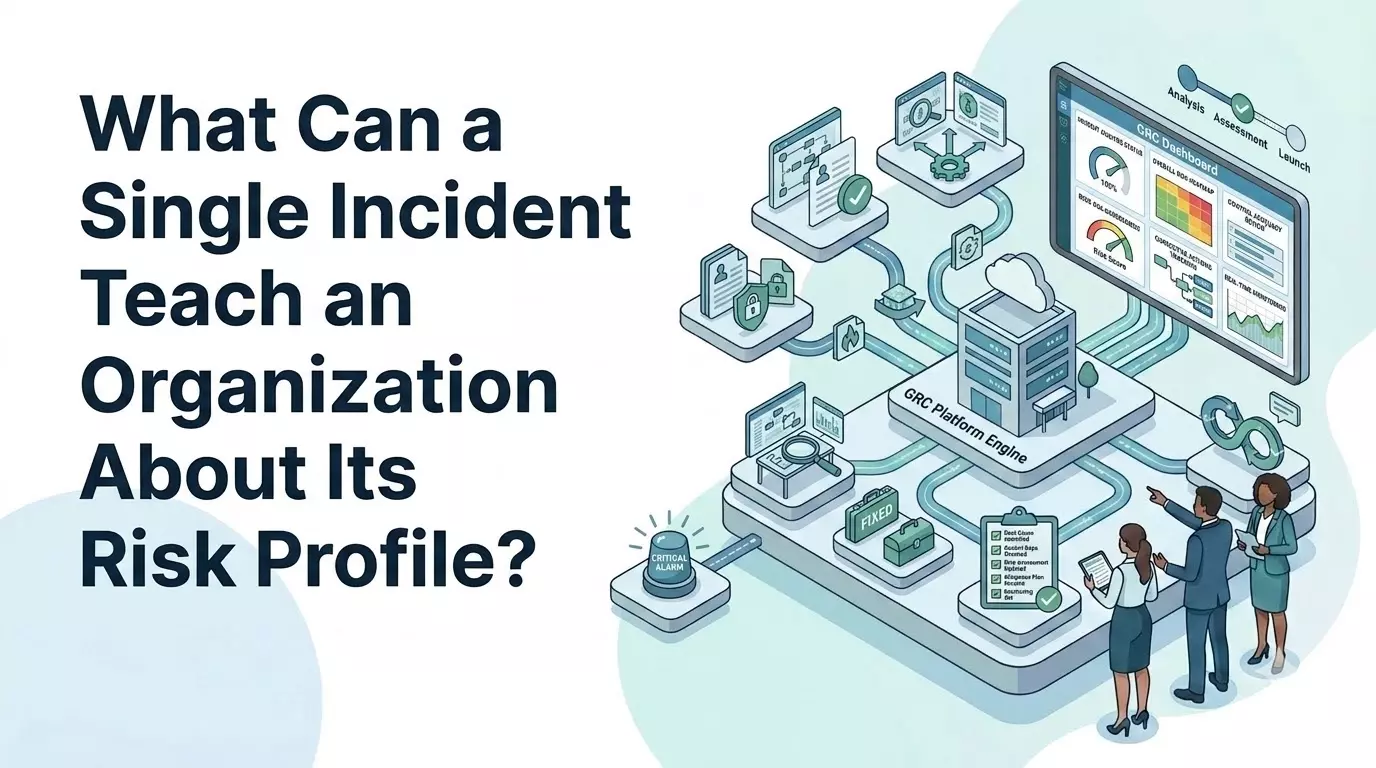
A unified GRC platform can bring risk, incident, compliance, audit and control information into a shared environment. This can help governance teams understand how an operational event relates to broader organizational exposure.
For example, a repeated incident can be associated with a particular risk or control. The relevant owner can then investigate whether the existing treatment remains appropriate. The technology does not decide whether a risk rating should change. It provides the context needed for people to make that decision.
Read: How Video Analytics Software Enhances Workplace Safety
What About Incidents Involving Personal Information?
Privacy-related incidents deserve particular attention because they can reveal weaknesses in information-handling practices. The Office of the Australian Information Commissioner encourages organisations to consider privacy impacts when developing projects involving new or changed ways of handling personal information.
It also emphasises integrating privacy impact assessments with broader risk-management and planning processes. An incident can therefore provide a reason to revisit the assumptions made during an earlier privacy assessment.
Perhaps information is accessible to more people than expected. Perhaps a process has changed. Perhaps a third-party arrangement has introduced a new information flow. The incident becomes a signal that the organisation's understanding of the risk may need updating.
How Can Organisations Avoid Treating Incidents as Isolated Events?
The first step is to look beyond the individual case. After resolving an incident, organizations can ask:
- Has this happened before?
- Is the same control involved?
- Does the incident relate to an existing risk?
- Was the original risk assessment based on assumptions that have changed?
- Could the same issue occur somewhere else?
These questions can transform incident management from a reactive process into a source of continuous improvement.
Why Does This Matter to Leadership?
Leadership teams need to understand not only what incidents occurred but what those incidents reveal about the organisation's risk environment. One isolated event may require little strategic attention. A recurring pattern can be very different.
If several incidents point to the same control weakness, the organisation may need to reconsider its risk treatment, allocate resources differently or redesign the underlying process. This is why incident reporting should not end with a closed case.
The information can have value long after the immediate problem has been resolved.
Conclusion
An incident tells an organisation that something happened. A well-managed incident process can help explain why it happened and what it means for future risk.
When incidents are connected to controls, risk assessments, corrective actions and compliance activities, organisations can identify patterns that would otherwise remain hidden.
The goal is not to treat every incident as a reason to rewrite the risk register. It is to recognise when an incident provides meaningful evidence that the organisation's understanding of a risk, control or process needs to change.
The most valuable incident is therefore not simply the one that gets closed. It is the one the organisation learns from.