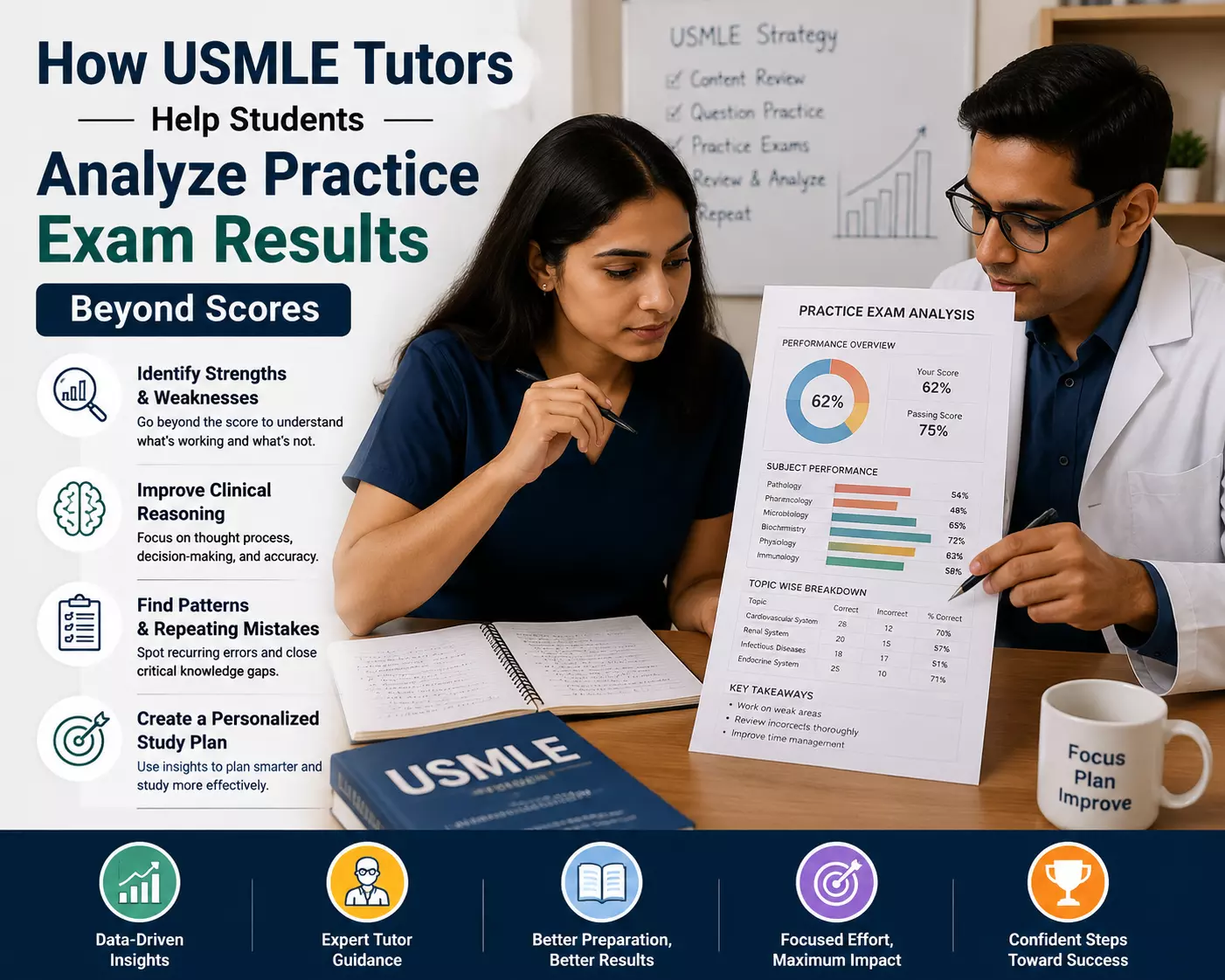
How USMLE Tutors Help Students Build Long-Term Retention for Exam Success
Preparing for the United States Medical Licensing Examination (USMLE) requires medical students and International Medical Graduates (IMGs) to learn and retain a significant amount of medical information.
From basic sciences and disease mechanisms to clinical management and treatment decisions, students must remember complex concepts and apply them accurately during high-pressure exam situations.
One of the biggest challenges students face is not learning new information but retaining it over months of preparation. Many students spend hours reviewing material but struggle to recall important concepts when solving USMLE-style questions.
Effective learning requires more than repeated reading. Students need structured strategies that support long-term memory, active recall, and meaningful understanding of medical concepts.
Experienced USMLE Tutors help students develop these strategies by identifying learning challenges, improving study methods, and creating personalized approaches for better retention.
Through personalized USMLE Tutors guidance, medical students can build stronger memory systems and prepare more effectively for Step 1, Step 2 CK, and future residency goals.
Why Long-Term Retention Is Important for USMLE Preparation
The USMLE evaluates whether students can apply medical knowledge rather than simply recognize facts. This means students must remember concepts long after initial learning and use them in unfamiliar clinical scenarios.
Long-term retention is important because USMLE preparation often involves:
- Large volumes of medical information
- Multiple months of preparation
- Integration of different medical subjects
- Complex clinical applications
- Repeated practice assessments
Many students experience difficulty because they rely on passive learning methods. Reading notes repeatedly or watching lectures without active engagement may create a temporary understanding but does not always lead to strong recall.
Building lasting knowledge requires strategies that strengthen memory connections and improve the ability to retrieve information when needed.
How USMLE Tutors Help Students Build Effective Retention Strategies
Experienced USMLE Tutors help students move beyond traditional study habits by focusing on evidence-based learning approaches.
Tutors evaluate:
- Current study methods
- Knowledge retention challenges
- Subject weaknesses
- Practice question performance
- Learning preferences
Based on this evaluation, they help students create personalized strategies that improve how information is learned, reviewed, and recalled.
Instead of simply increasing study hours, students learn how to make their study time more productive.
Using Active Recall to Strengthen Medical Knowledge
Active recall is one of the most effective techniques for improving long-term memory. It involves actively retrieving information from memory instead of passively reviewing material.
For USMLE preparation, active recall can include:
- Answering practice questions
- Explaining concepts without notes
- Creating self-testing methods
- Reviewing flashcards
- Teaching concepts to others
USMLE Tutors help students apply active recall techniques effectively by identifying which concepts require repeated practice and which topics need deeper understanding.
For example, instead of repeatedly reading cardiovascular physiology notes, students may practice explaining cardiac cycles, hemodynamic changes, and related clinical scenarios from memory.
This process strengthens understanding and improves recall during examinations.
Improving Retention Through Spaced Repetition
Medical students must remember thousands of concepts throughout their USMLE preparation journey. Reviewing information only once or twice is rarely enough for long-term retention.
Spaced repetition helps students review information at strategic intervals before forgetting occurs.
A structured repetition approach may include:
- Initial concept learning
- Short-term review
- Practice question application
- Periodic revision
- Final exam review
A USMLE Step 1 Tutor can help students apply these methods to foundational science subjects such as:
- Pathology
- Physiology
- Pharmacology
- Microbiology
- Biochemistry
This approach allows students to maintain strong knowledge throughout long preparation periods.
Connecting Medical Concepts for Better Memory
One of the most effective ways to improve retention is understanding relationships between concepts.
Medical knowledge is interconnected, and students remember information better when they understand how different topics relate.
For example, understanding diabetes requires connecting:
Insulin physiology
Pancreatic function
Metabolic pathways
Pharmacological treatments
Clinical complications
USMLE Tutors help students create these connections rather than memorizing isolated facts.
This integrated approach is especially valuable because USMLE questions often combine multiple disciplines within a single clinical scenario.
How Clinical Application Improves Knowledge Retention
Information becomes easier to remember when students understand how it applies in real medical situations.
A USMLE Step 2 Tutor helps students strengthen retention by connecting medical knowledge with clinical decision-making.
Students learn through:
- Patient case discussions
- Clinical reasoning exercises
- Diagnosis practice
- Treatment decision analysis
- Management scenarios
For example, instead of memorizing medication side effects separately, students learn how drug mechanisms influence patient management decisions.
This practical application helps create stronger memory pathways.
The Role of Question-Based Learning in Long-Term Recall
Practice questions are not only tools for measuring performance. They are also powerful learning methods.
Each question helps students:
- Apply medical concepts
- Identify knowledge gaps
- Recognize clinical patterns
- Improve recall ability
- Develop reasoning skills
Through USMLE Tutoring, mentors help students use question banks more effectively by focusing on explanations and learning opportunities.
Students learn that reviewing incorrect answers is just as important as answering questions correctly.
Understanding why an answer is wrong helps prevent similar mistakes in the future.
Personalizing Retention Strategies Through 1-on-1 USMLE Tutoring
Every student has different learning challenges. Some students struggle with remembering facts, while others understand concepts but have difficulty recalling them during exams.
Through 1-on-1 USMLE Tutoring, students receive personalized guidance based on their specific needs.
Individualized support can include:
- Study method evaluation
- Memory improvement strategies
- Subject-specific approaches
- Progress monitoring
- Learning technique adjustments
This allows students to develop a preparation system that matches their learning style and goals.
Read: High Salary Courses After 12th for a Bright Future
How Online USMLE Tutoring Supports Consistent Learning
Many medical students and IMGs prepare for USMLE exams while managing medical school, clinical rotations, research, or professional responsibilities.
Online USMLE Tutoring provides flexible access to personalized academic guidance.
Benefits include:
- Flexible learning schedules
- Remote mentorship
- Regular progress reviews
- Personalized feedback
- Continuous preparation support
For students preparing from different locations, online tutoring provides a practical way to maintain consistency throughout the USMLE journey.
Building Retention Strategies for Step 1 and Step 2 CK
A successful USMLE preparation strategy requires different retention approaches for Step 1 and Step 2 CK.
For Step 1, students need strong memory foundations in:
- Basic sciences
- Disease mechanisms
- Biological processes
- Drug actions
- For Step 2 CK, students must retain information related to:
- Clinical guidelines
- Patient management
- Diagnostic approaches
- Treatment decisions
A USMLE Step 1 & Step 2 Tutoring approach helps students develop memory strategies that support both foundational knowledge and clinical application.
Common Mistakes That Reduce Knowledge Retention
Many students unintentionally weaken their retention by using ineffective study methods.
Common mistakes include:
- Relying only on passive reading
- Memorizing without understanding
- Avoiding practice questions
- Studying topics only once
- Using too many resources without review planning
- Ignoring previous mistakes
Improving retention requires consistent active engagement with medical concepts.
Building Strong Foundations for Future Medical Practice
Long-term retention is not only important for USMLE success but also for future clinical practice. Physicians must continuously recall medical knowledge and apply it to patient care.
Developing effective learning strategies during USMLE preparation helps students build habits that support lifelong medical learning.
DedicatedPrep supports medical students and graduates through structured USMLE preparation, personalized mentorship, and exam-focused strategies designed around individual goals.
Conclusion
Long-term retention and recall are essential components of successful USMLE preparation. Medical students must learn how to store, review, and apply large amounts of medical information effectively.
Experienced USMLE Tutors help students develop stronger learning strategies through active recall, spaced repetition, clinical application, and personalized guidance.
Through effective USMLE Tutoring, medical students, IMGs, and residency applicants can improve knowledge retention, strengthen exam readiness, and build a stronger foundation for future medical success.
FAQs
1. Why is long-term retention important for USMLE preparation?
Long-term retention helps students recall medical concepts during complex USMLE questions and apply knowledge effectively in clinical scenarios.
2. How do USMLE Tutors improve memory and recall strategies?
USMLE Tutors help students develop effective study methods, including active recall, spaced repetition, question-based learning, and personalized review strategies.
3. Can a USMLE Step 1 Tutor help improve knowledge retention?
Yes. A USMLE Step 1 Tutor can help students strengthen foundational science knowledge and create strategies for remembering important concepts.
4. How does 1-on-1 USMLE Tutoring support personalized learning?
1-on-1 USMLE Tutoring provides customized guidance based on a student’s learning challenges, goals, and preparation progress.
5. Is Online USMLE Tutoring effective for improving study consistency?
Yes. Online USMLE Tutoring allows students to receive flexible mentorship and maintain consistent preparation habits throughout their exam journey.