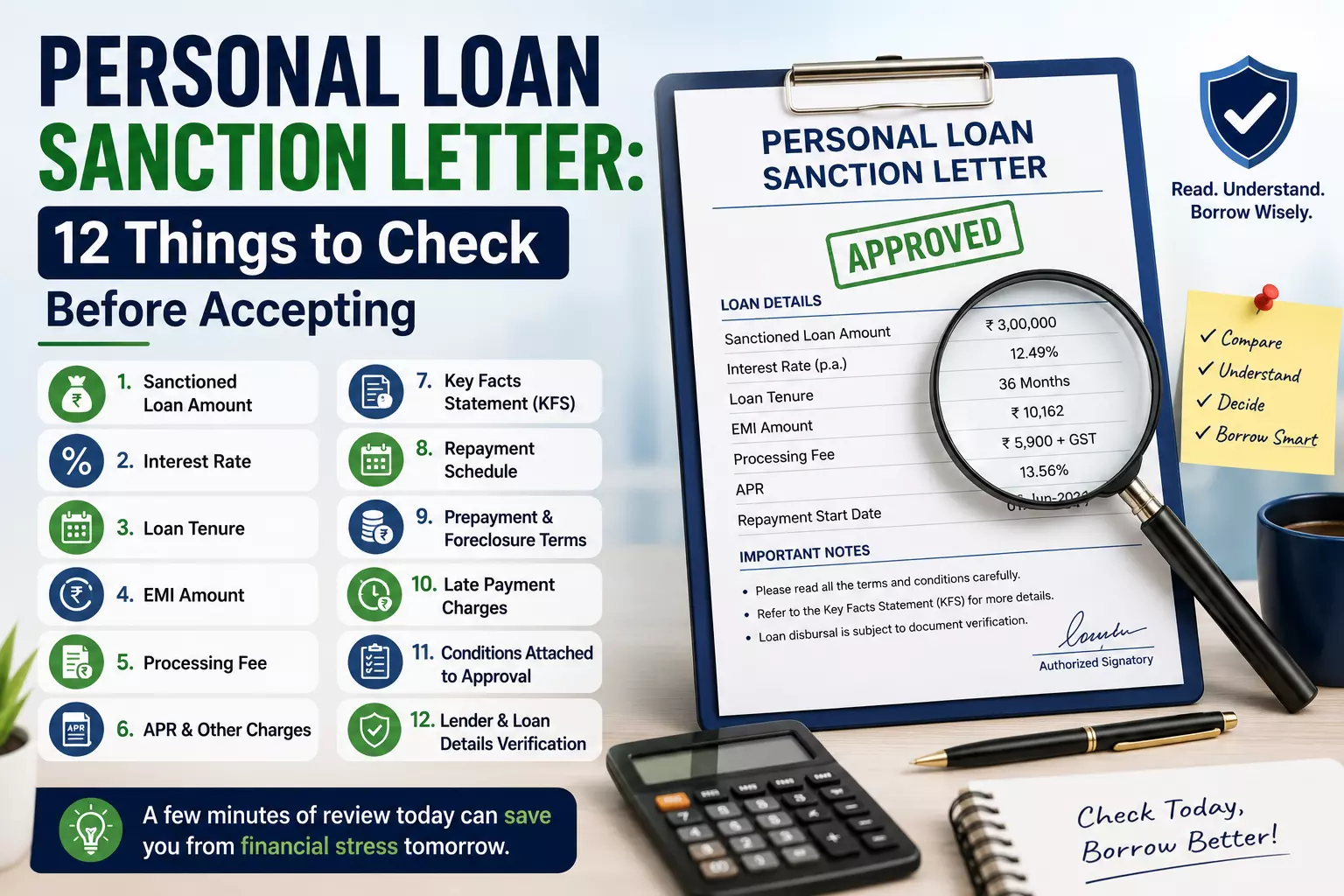
How to Read a Personal Loan Sanction Letter: 12 Things to Check Before Accepting
Receiving a personal loan sanction letter can feel like the final step before getting your money. However, a personal loan sanction letter is more than an approval notification. It contains important information about the loan amount, interest rate, tenure, EMI, fees, repayment conditions, and other terms.
Before accepting a loan, you should carefully read the loan sanction letter instead of looking only at the approved amount.
A personal loan approval letter can contain terms that affect the total cost of borrowing. Understanding these details can help you compare offers and avoid unexpected charges later.
Here are 12 things you should check in your personal loan sanction letter before accepting the offer.
What Is a Personal Loan Sanction Letter?
A personal loan sanction letter is a document issued by a lender after evaluating your loan application and deciding to offer you credit subject to the stated terms and conditions.
The loan sanction letter generally communicates important details such as:
- Sanctioned loan amount
- Personal loan interest rate
- Loan tenure
- EMI
- Processing fees
- Applicable charges
- Repayment terms
- Other conditions attached to the approval
A personal loan sanction letter does not necessarily mean that funds have already been disbursed. Disbursement may happen after you accept the terms, complete required formalities, and satisfy applicable conditions.
1. Check the Sanctioned Loan Amount
- The first thing to check in your personal loan sanction letter is the sanctioned loan amount.
- The sanctioned amount is the amount the lender has approved based on its assessment of your income, credit profile, repayment capacity, and other eligibility criteria.
- Don't assume that the amount you receive in your bank account will always be identical to the sanctioned amount.
- Applicable processing fees or other permitted charges may affect the net amount disbursed.
- For example:
- Sanctioned amount: ₹2,00,000
- Applicable processing charges: ₹2,000 plus applicable taxes
- The amount credited to your account could therefore be lower.
- Check both the sanctioned loan amount and the expected net disbursal.
2. Verify the Personal Loan Interest Rate
- The personal loan interest rate is one of the most important details in your personal loan sanction letter.
- Check whether the stated rate matches the rate you were shown during the application process.
- Your personal loan interest rate directly affects your EMI and total interest cost.
- A small difference in the rate can become significant over a longer loan tenure.
- Don't rely only on a salesperson's verbal explanation. The applicable personal loan interest rate should be checked in the formal loan documentation.
3. Check the Loan Tenure
- The loan tenure tells you how long you will repay the loan.
- For example, a loan tenure could be 12, 24, 36, 48 or 60 months, depending on the lender and loan product.
- A longer loan tenure can reduce the monthly EMI, but it may increase the total interest paid.
- A shorter loan tenure can result in a higher EMI while potentially reducing the overall interest cost.
- Make sure the loan tenure mentioned in the personal loan sanction letter is the period you actually agreed to.
4. Confirm the EMI Amount
Your personal loan EMI is the amount you are expected to pay according to the repayment schedule.
Check whether the EMI in the personal loan sanction letter matches your calculations.
Your personal loan EMI generally depends on:
- Loan amount
- Interest rate
- Loan tenure
Use a personal loan EMI calculator to independently verify the approximate EMI.
If the EMI shown by the lender is significantly different from your calculation, ask for clarification before accepting the loan.
Read: How to Get Instant Approval for Personal Loan (Without the Stress)
5. Check the Processing Fee
- The processing fee can reduce the amount you actually receive from the loan.
- A personal loan sanction letter may specify the applicable processing fee as a percentage of the loan amount or as a fixed amount.
- For example, if ₹3 lakh is sanctioned and the processing fee is 2%, the basic fee would be ₹6,000 before considering applicable taxes.
- Don't overlook this amount when comparing personal loan offers.
- A loan with a slightly lower interest rate but a substantially higher processing fee may not necessarily be the cheapest option.
6. Look for APR and Other Charges
When reviewing your personal loan sanction letter, check the disclosed APR (Annual Percentage Rate) where applicable.
The APR can provide a broader view of the annualised cost of credit, incorporating applicable charges as required under the relevant lending framework.
Also check for other disclosed charges, such as:
- Processing charges
- Late-payment charges
- Bounce charges
- Prepayment or foreclosure charges, where applicable
- Other applicable fees
The APR and other cost disclosures can help you compare the actual cost of different personal loan offers.
7. Check the Key Facts Statement
For applicable loans, carefully review the Key Facts Statement (KFS) before accepting the loan.
The Key Facts Statement is designed to present important loan information in a standardised format.
Compare the information in your Key Facts Statement with the personal loan sanction letter and other documents.
Pay particular attention to:
- Loan amount
- APR
- Interest rate
- Repayment schedule
- Charges
- Important terms and conditions
If something appears inconsistent, ask the lender for clarification before proceeding.
8. Verify the Repayment Schedule
Your personal loan sanction letter may provide information about the repayment structure.
Check:
- First EMI date
- EMI amount
- Number of instalments
- Repayment frequency
- Final repayment date
Understanding the repayment schedule helps you plan your monthly finances.
If you already have other EMIs, add the new personal loan EMI to your existing obligations to determine your total monthly debt burden.
9. Check Prepayment and Foreclosure Conditions
- If you expect to repay the loan early, carefully check the prepayment and foreclosure conditions in the loan sanction letter and associated documents.
- Depending on the product and applicable rules, charges or conditions may apply.
- For example, you may want to close a personal loan early after receiving a bonus or selling an asset.
- Understanding the foreclosure terms before accepting the loan can prevent surprises later.
- Don't assume that every lender has identical prepayment rules.
10. Check Late-Payment and Default Charges
Your personal loan sanction letter may specify what happens if you fail to pay an EMI on time.
Review applicable:
- Penal charges
- Late-payment charges
- Bounce charges
- Other overdue-related costs
Missing an EMI can also affect your credit profile.
Therefore, make sure the personal loan EMI fits comfortably into your monthly budget before accepting the loan.
11. Check the Conditions Attached to Approval
A personal loan sanction letter may contain conditions that must be satisfied before disbursement.
For example, the lender may require:
- Completion of documentation
- Verification of information
- Acceptance of loan terms
- Submission of required documents
- Completion of applicable KYC requirements
A loan sanction letter should therefore not be interpreted as unconditional access to funds.
Read the conditions carefully and complete the required steps only after understanding them.
12. Verify the Lender and Loan Details
Finally, verify that the personal loan sanction letter comes from the actual lender or authorised entity involved in the loan.
Check:
- Lender name
- Official contact details
- Loan account/reference number
- Sanctioned amount
- Interest rate
- EMI
- Tenure
- Applicable charges
If you applied through a digital lending platform, remember that the platform or app may not necessarily be the actual lender.
Understanding who is actually providing the credit is particularly important before sharing sensitive financial information or making payments.
Personal Loan Sanction Letter vs Loan Agreement
- A personal loan sanction letter and a loan agreement are not necessarily the same document.
- The sanction letter communicates the lender's approval and key terms.
- The loan agreement contains the contractual terms governing the borrowing relationship.
- You should review both documents carefully before accepting the loan.
- Don't assume that the sanction letter alone contains every term that will apply throughout the loan.
Example: Reading a Personal Loan Sanction Letter
Suppose you receive a personal loan sanction letter with the following details:
Loan Detail
Example
Sanctioned amount
₹3,00,000
Interest rate
13% p.a.
Loan tenure
36 months
Approx. EMI
₹10,108
Processing fee
As disclosed
APR
Check KFS
First EMI date
As specified
Prepayment terms
As specified
Before accepting the offer, don't simply look at the ₹3 lakh sanctioned loan amount.
Check the personal loan interest rate, EMI, loan tenure, processing fee, APR, net disbursal and total repayment.
This gives you a much better understanding of what the loan will actually cost.
What to Do If You Find an Error
If information in your personal loan sanction letter doesn't match what you were expecting, don't ignore it.
Contact the lender through its official customer-service channel and ask for clarification.
Pay particular attention to differences involving:
- Interest rate
- Sanctioned loan amount
- EMI
- Loan tenure
- Processing fees
- APR
- Repayment dates
- Other charges
Do not accept or sign the loan documents until you understand the discrepancy.
Personal Loan Sanction Letter Checklist
Before accepting your personal loan sanction letter, check:
☑ Sanctioned loan amount
☑ Personal loan interest rate
☑ Loan tenure
☑ Personal loan EMI
☑ Processing fee
☑ Applicable taxes and charges
☑ APR
☑ Key Facts Statement
☑ Net disbursal
☑ Repayment schedule
☑ Prepayment/foreclosure conditions
☑ Late-payment charges
☑ Conditions before disbursement
☑ Actual lender details
Final Thoughts
A personal loan sanction letter is an important document that should never be accepted without careful review.
The approved loan amount is only one part of the decision. You should also understand the personal loan interest rate, EMI, loan tenure, processing fee, APR, repayment schedule, and other applicable charges.
The personal loan sanction letter should be consistent with the Key Facts Statement and other formal loan documents provided by the lender.
Before accepting the offer, calculate the total repayment and make sure the EMI fits comfortably within your budget.