How to Plan, Prepare, and Execute a Successful Pond Liner Project
Building a pond, whether for aquaculture, irrigation, or landscaping purposes, is a significant investment that requires careful planning and execution. The success of the project hinges not just on design and excavation but on the right choice, placement, and maintenance of the pond liner.
A pond liner isn't merely a waterproof barrier; it is a critical structural element ensuring the pond’s durability, functionality, and ecological balance. Avoiding rushed decisions and understanding the nuances of the process can dramatically increase the lifespan of your pond while minimizing maintenance costs.
Defining the Project Scope and Objectives
Before selecting materials or breaking ground, defining the pond's purpose is essential. Will it serve decorative, agricultural, aquaculture, or stormwater management functions? Each purpose requires distinct design considerations and liner specifications. Overlooking this foundational step often leads to poor material choices and structural inefficiencies.
A clear project scope includes:
- Identifying the pond’s primary function and any secondary uses.
- Estimating water capacity and usage cycles.
Understanding objectives early prevents future compromises, especially when water retention and ecosystem balance are critical.
Conducting Site Assessment and Soil Analysis
The location and soil type significantly impact the effectiveness of the pond liner. Conducting a thorough site assessment helps identify potential risks, such as soil instability, contamination, or high groundwater levels. A soil compaction test is recommended to assess whether the subgrade can support the pond structure without shifting, especially in expansive clay or sandy soils.
A study published by the American Society of Agronomy notes that pond failures due to soil instability account for over 35% of liner degradation cases in agricultural applications. This statistic underscores the importance of proper site evaluation.
Moreover, assessing for underlying sharp objects, roots, or debris ensures that the liner won’t suffer from unseen punctures post-installation. Removal of these hazards and proper subgrade preparation must precede the deployment of any liner.
Selecting the Right Pond Liner Material and Thickness
Pond liner materials vary significantly, each with its own advantages, depending on the project type. Common options include EPDM rubber, PVC, HDPE, and reinforced polyethylene. Thickness typically ranges from 20 to 60 mils, with industrial-grade projects demanding thicker membranes.
Key considerations when choosing liner material:
- Durability against UV exposure, chemical interactions, and mechanical stress.
- Flexibility for ease of installation over contours and complex shapes.
The best geomembrane for high-capacity aquaculture or agricultural ponds is one that is thicker and resistant to chemicals. In such situations, it makes sense to purchase Custom Pond Liner Geomembrane product, which provide a precise fit and reduce the likelihood of seam failure. Particularly in large-scale farming operations where water containment is crucial, this customized method lowers installation problems.
Designing the Pond Layout and Edge Treatments
Both practical purpose and ease of care are accommodated by an effective pond layout. The pond's long-term usability is enhanced by the addition of gradual slopes, designated maintenance access points, and sediment collection stations. Although steep walls may enhance volume, they also make maintenance more dangerous and increase the chance of liner sliding.
Edge treatments are just as important. Inadequate anchoring may cause liner displacement, UV exposure, and eventual deterioration. Weighted edges and anchor trenches are two methods that assist fix the liner firmly without sacrificing appearance.
- Anchor trenches should be at least 12 inches deep for small ponds and deeper for larger reservoirs.
- Weighted edges using flat stones or geomembrane-specific fasteners prevent wind uplift and liner displacement.
Planning these aspects during the design phase ensures the liner remains intact throughout the pond's lifecycle.
Preparing the Subgrade and Installing Underlayment
What is underneath the pond liner has a significant impact on its integrity. The subgrade should be completely compacted, free of sharp items, and shaped to the final shape of the pond. By acting as a cushion, this layer keeps the liner from coming into direct contact with potentially abrasive surfaces.
Installing a geotextile underlayment serves multiple purposes:
- It protects the liner from punctures and abrasions.
- It helps distribute loads evenly across the liner surface.
According to the Geosynthetic Research Institute, underlayment can increase liner life by 50%, particularly in high-stress applications such as ponds used for animal watering. Long-term protection against soil movement and mechanical wear is provided by this extra layer, which is often overlooked.
Deploying and Positioning the Pond Liner
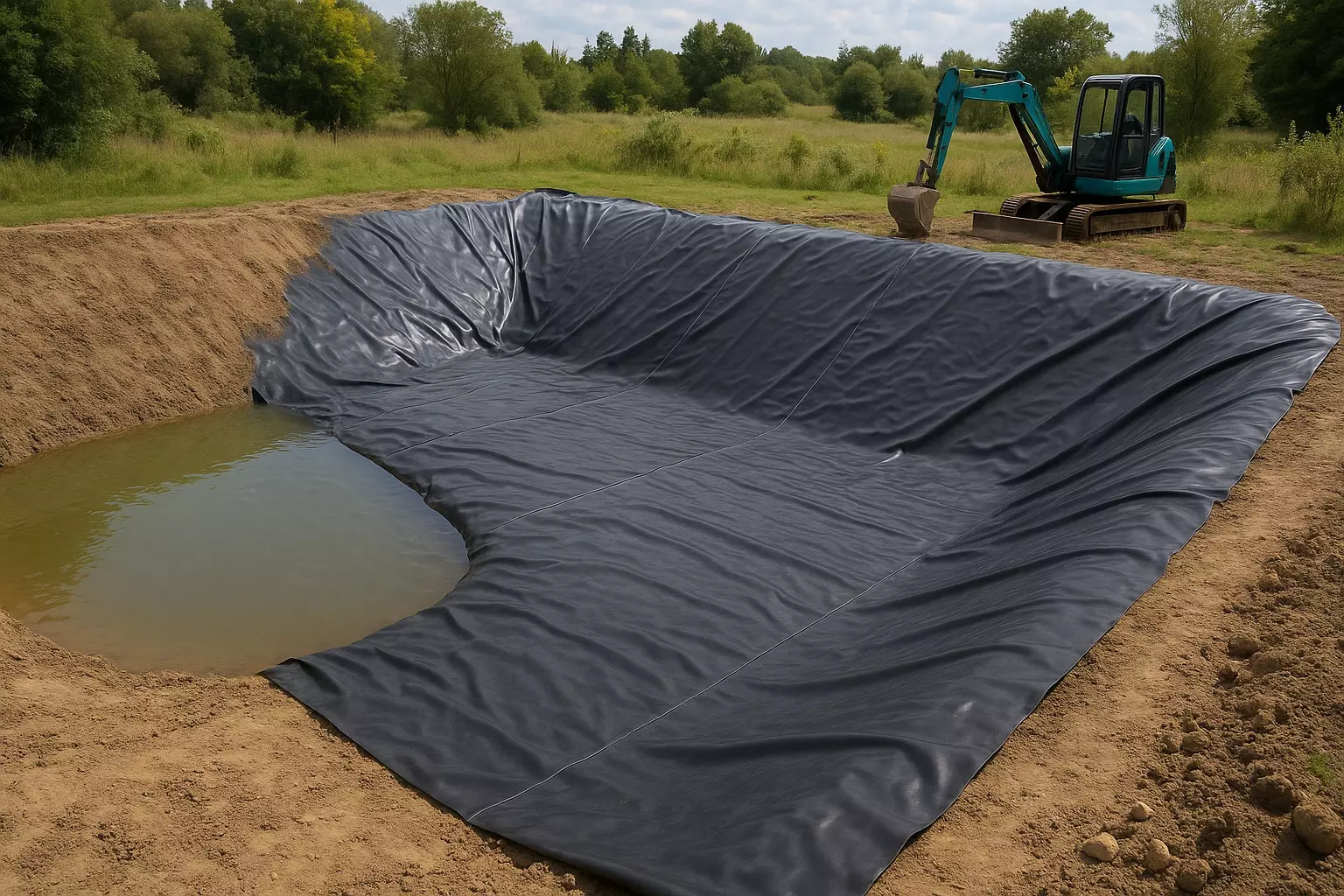
For larger projects, pond liner deployment calls for a team, patience, and accuracy. Smooth the liner over features gently without straining as you start to unfold it from the center outward. Steer clear of acute creases or folds since these may create weak spots when subjected to hydrostatic pressure.
During installation, wind may cause disruptions. To avoid unintentional displacement, work on calm days or temporarily secure the liner with sandbags along the margins. Secure anchoring can be achieved later if the liner is positioned around the pond perimeter with an even overlap.
"Success in any construction project isn't about rushing the process—it's about respecting every layer that goes unseen."
Ensuring the liner is correctly positioned before filling prevents the need for time-consuming adjustments and potential damage during the filling process.
Managing Seams, Overlaps, and Liner Welding
Correctly handling seams and overlaps is crucial for ponds that need many liner coverings. Thermal welding equipment or industry-grade adhesives must be used to seal seams. The liner material determines the technique; for HDPE, extrusion welding is usually necessary for maximum strength.
It is advised to test seams after sealing, particularly in containment ponds that pose a high danger. Before water is added, seam integrity can be verified by conducting an air lance or vacuum box test.
For guidance on welding techniques and quality checks, Geosynthetica provides in-depth resources on geomembrane applications and field best practices.
Filling the Pond and Monitoring Liner Performance
Regular maintenance is required to ensure that pond liners last as long as feasible. Frequent inspections help identify potential damage early, especially after storms or periods of heavy use. Trash removal, maintaining proper water chemistry, and controlling aquatic vegetation all help prevent liner damage.
Aeration systems reduce the buildup of gas underneath the liner, which could cause bubbling or floating. The liner is shielded from UV radiation and mechanical damage from animals or machinery by the addition of protective layers, such as plant zones or rock beds.
Implementing Long-Term Maintenance and Protection Strategies
To ensure pond liners last as long as possible, regular maintenance is necessary. Regular inspections help detect potential damage early, particularly after storms or periods of high usage. Liner damage is avoided by removing trash, maintaining the correct water chemistry, and controlling aquatic vegetation.
Aeration systems reduce the accumulation of gas beneath the liner, which can cause floating or bubbling. By adding protective layers, such plant zones or rock beds, the liner is protected from UV rays and mechanical harm from animals or machinery.
Preventative measures include:
- Regular inspection of seams and edge treatments.
- Managing water levels to prevent overflow or desiccation.
Failing to maintain these aspects can result in avoidable repair costs or the need for complete liner replacement.
FAQs
What is the best time of year to install a pond liner?
Mild weather conditions, typically spring or fall, are ideal for liner installation. Extreme temperatures can affect material flexibility and sealing effectiveness.
How often should a pond liner be inspected?
At least twice a year, with additional checks after heavy rains or storms. High-traffic ponds may require quarterly inspections.
Can a pond liner be repaired if punctured?
Yes, punctures can often be repaired using patch kits designed for the specific liner material. However, seam failures or extensive damage may require professional assessment.
Is it necessary to use a protective underlayment?
While not mandatory, using an underlayment significantly reduces the risk of punctures and extends the liner’s service life, especially in areas with rocky or root-filled soil.
While not mandatory, using an underlayment significantly reduces the risk of punctures and extends the liner’s service life, especially in areas with rocky or root-filled soil.
Practical Reflections to Keep Your Project Moving Forward
A successful pond liner project combines practical planning with technical expertise. The slightest details—exact measurements, precise material selection, and meticulous installation procedures—often make the difference between a functioning pond and a recurring maintenance problem.
Take the concept of hydraulic resilience, a specialized term that refers to a liner's ability to remain intact when water pressure fluctuates. This element becomes particularly important in ponds that undergo seasonal cycles of filling and draining. Another unique concept is geomembrane creep, which refers to the slow displacement of the liner material under continuous loading. This phenomenon is frequently seen in pond walls with steep slopes.
According to the International Association of Geosynthetic Installers, approximately 65% of pond liner repairs are actually the result of avoidable installation mistakes or neglected site conditions. This realization highlights the importance of diligence at every stage of a project.
Your pond liner project can not only satisfy expectations but also establish a benchmark for durability and endurance by combining tried-and-true methods with proactive maintenance and utilizing reliable resources.