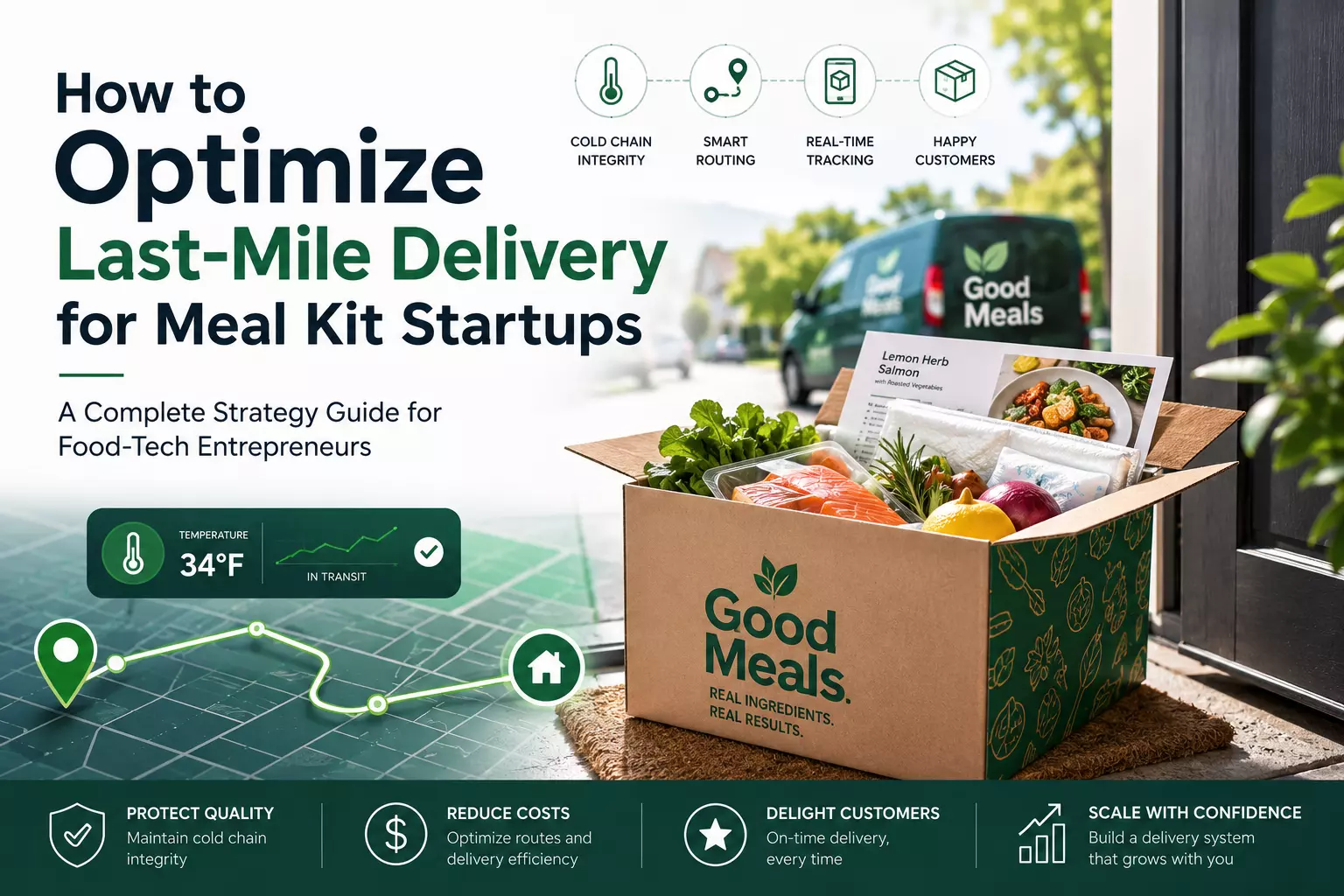
How to Optimize Last-Mile Delivery for Meal Kit Startups
The Last-Mile Problem in Meal Kit Delivery
Imagine this: a customer signs up for their first meal kit subscription, eagerly awaiting a box of fresh ingredients to cook a restaurant-quality dinner at home.
But when the box arrives, the proteins are warm, the ice packs have melted, and half the produce is wilted. They cancel before week two.
This scenario plays out thousands of times a day across the meal kit industry and it almost always comes down to a single, critical failure point: last-mile delivery.
Last-mile delivery refers to the final leg of the supply chain the movement of goods from a distribution hub or fulfillment center directly to the end customer's door.
It sounds simple, but for meal kit startups, it's the most expensive, complex, and high-stakes phase of the entire logistics journey.
Studies show last-mile delivery accounts for up to 53% of total shipping costs and is the number one driver of customer satisfaction (or dissatisfaction).
In this guide, we'll break down exactly how to optimize last-mile delivery for meal kit startups covering cold chain logistics integrity, smart routing, the right logistics software solutions, and when to partner with a logistics app development company to build a custom tech stack.
Why Last-Mile Delivery Is Critical for Meal Kit Startups
Meal kit businesses face a unique convergence of challenges that most e-commerce companies never encounter. Let's explore why last-mile delivery is not just a cost center it's the beating heart of your business model.
Customer Retention Hinges on Delivery Experience
In the subscription economy, customer lifetime value (LTV) is everything. A single failed delivery a box that arrived late, damaged, or warm can trigger an immediate cancellation.
Research from McKinsey shows that 84% of consumers are unlikely to return after just one poor delivery experience.
For meal kit brands, the stakes are even higher. Customers are not just receiving a parcel; they are expecting a curated culinary experience. When last-mile delivery fails, the entire brand promise collapses with it.
Spoilage Risk Destroys Margin and Trust
Unlike apparel or electronics, meal kit contents are perishable. Proteins, dairy, and fresh produce have narrow temperature tolerance windows. A delay of even two to three hours during warm months can render an entire box unsellable and unsafeable.
For startups operating on thin margins, the cost of a single spoiled box between refunds, replacement shipments, and lost customer revenue can be catastrophic at scale.
The Competitive Landscape Makes Delivery a Differentiator
Players like HelloFresh and Blue Apron have invested hundreds of millions into delivery infrastructure. For emerging meal kit startups to compete, they cannot simply match on price or recipe variety they must win on the delivery experience.
Customers who receive their meal kits reliably, on time, and in perfect condition become brand advocates. Those who don't become one-star reviews.
Industry Growth Demands Scalable Delivery Systems
The global meal kit delivery market is projected to exceed $20 billion by 2027, growing at a CAGR of over 12%.
For startups riding this growth wave, last-mile delivery infrastructure must be built to scale not just to survive today's order volume, but to handle 5x or 10x growth without breaking.
The Cold Chain Logistics Challenge
At the core of every meal kit delivery problem is a cold chain logistics challenge. Understanding this is essential before optimizing anything else.
What Is Cold Chain Logistics?
Cold chain logistics refers to a temperature-controlled supply chain that ensures perishable goods maintain their required temperature range from origin to end destination.
For meal kit brands, this means keeping proteins between 32°F–40°F (0°C–4°C), dairy at similar ranges, and produce at appropriate humidity levels throughout packaging, transit, and last-mile delivery.
Any break in the cold chain even a brief one compromises food safety and product quality.
This is why cold chain logistics is not merely a logistical consideration; it's a food safety and legal requirement.
Common Cold Chain Failures in Last-Mile Delivery
Understanding where cold chain logistics typically breaks down helps you design systems that prevent failures:
Delayed routes: Traffic, failed delivery attempts, or inefficient routing add hours to delivery windows, accelerating temperature rise.
Driver errors: Improper vehicle temperature settings, leaving boxes in unventilated vehicles, or delayed handoffs all compromise the cold chain.
Inadequate packaging: Under-investing in insulation choosing thin foam liners or insufficient gel packs is a false economy that costs far more in refunds and churn.
Unpredictable weather: Summer heatwaves and winter freezes both present cold chain logistics risks that require dynamic packaging and routing adjustments.
Best Practices for Cold Chain Integrity
Leading meal kit operations invest in the following to protect their cold chain logistics:
Phase-change materials (PCMs): Advanced gel packs that maintain specific temperatures longer than dry ice, reducing spoilage risk on extended routes.
Insulated packaging innovation: Multi-layer liners, vacuum-insulated panels, and wool-based insulation that maintain internal temperatures for 24–48 hours.
IoT temperature sensors: Real-time temperature tracking devices embedded in shipments that alert dispatchers if temperature thresholds are breached during transit.
Delivery time-slot compression: Reducing the window between fulfillment center departure and customer delivery, prioritizing shorter last-mile delivery routes.
Key Strategies to Optimize Last-Mile Delivery for Meals
With the cold chain challenge framed, let's explore the tactical and strategic levers meal kit startups can pull to optimize last-mile delivery for meal operations.
Route Optimization
Static delivery routes are the enemy of efficient last-mile delivery. Dynamic route optimization uses real-time data traffic conditions, delivery density clustering, driver availability, and customer time-window preferences to build the most efficient routes automatically.
For meal kit startups, route optimization has a dual purpose: it reduces fuel costs and driver hours while also minimizing time in transit, which directly protects cold chain logistics integrity.
Key capabilities to look for in route optimization:
Time-window routing: Customers select delivery windows; the system automatically clusters and sequences stops to honor them efficiently.
Dynamic re-routing: Real-time traffic data triggers automatic route adjustments to avoid delays.
Failed delivery logic: Automated instructions for safe drop-off locations reduce wasted attempts and keep cold chain exposure minimal.
Micro-Fulfillment Centers and Dark Kitchens
One of the most powerful strategies for optimizing last-mile delivery for meal brands is moving fulfillment closer to the customer through micro-fulfillment centers.
By positioning smaller, temperature-controlled satellite hubs within dense urban delivery zones, meal kit startups can dramatically reduce transit times from hours to minutes in some cases.
This is especially powerful in Tier-1 cities where customer density is high but traffic congestion makes long-distance delivery unreliable.
The dark kitchen model, borrowed from the food delivery industry, applies the same principle: small, decentralized prep and storage nodes that feed last-mile delivery routes without the overhead of full distribution centers.
Crowdsourced and Hybrid Delivery Models
No single delivery model works for every meal kit startup at every stage of growth. The smartest operators build a hybrid model:
Owned fleet: Maximum control over cold chain logistics and delivery experience, but high fixed costs. Best for dense urban core routes.
Third-party logistics (3PL) partners: Flexible capacity, lower fixed cost, but less control over cold chain and customer experience. Best for suburban and rural coverage.
Gig-driver networks: Highly flexible and scalable, but require robust app-based monitoring to maintain cold chain compliance and delivery quality standards.
The right mix depends on your delivery density, geography, and order volume. The key is building logistics software solutions that can orchestrate all three models from a single dispatch dashboard.
Real-Time Tracking and Customer Communication
For meal kit customers, uncertainty is almost as bad as a late delivery. Implementing real-time tracking live map views, SMS/push notifications at key milestones, and accurate ETAs transforms the delivery experience from anxiety-inducing to trust-building.
Best practices for customer communication in last-mile delivery for meal kit operations:
Proactive delay alerts: Notify customers immediately if a delivery will be late, with a revised ETA.
Proof-of-delivery (POD): Photo confirmation of delivery location, especially important for contactless drop-offs.
Post-delivery feedback loops: Automated surveys after delivery capture cold chain failures and route issues before they become reviews.
Logistics Software Solutions That Power Meal Kit Delivery
Technology is the connective tissue between every strategy described above.
The right logistics software solutions don't just automate dispatch they unify cold chain monitoring, route optimization, driver management, and customer communication into a single operational platform.
Why Generic Tools Fall Short
Off-the-shelf e-commerce shipping tools were built for ambient-temperature parcel delivery. They don't understand time-slot delivery windows, cold chain temperature alerts, or the perishability logic that governs meal kit operations.
Meal kit startups need logistics software solutions with capabilities specifically designed for perishable, time-sensitive, subscription-based delivery at scale.
Must-Have Capabilities in Logistics Software Solutions
Route optimization engine: AI-powered dynamic routing with time-window constraints and cold chain exposure minimization.
Cold chain monitoring dashboard: Real-time temperature sensor integration with automated alerts and logging for compliance.
Driver mobile application: Offline-capable apps with POD capture, navigation, and real-time dispatch updates.
Customer notification engine: Automated SMS, push, and email updates with live map tracking links.
Analytics and reporting: Delivery performance KPIs, failed delivery analysis, cold chain breach reporting, and route efficiency metrics.
ERP and subscription management integration: Seamless data flow between order management, inventory, and delivery systems.
Platform Comparison
Here's a quick overview of leading logistics software solutions used by meal kit operators:
Platform
Best For
Key Feature
Pricing Model
Onfleet
Mid-size operations
Driver app + analytics
Per-task pricing
Circuit
Small-scale startups
Route optimization
Subscription
Bringg
Enterprise meal kits
Multi-carrier dispatch
Custom enterprise
Custom-built
Scaling startups
Full control + integration
Development cost
Note: Custom-built platforms developed by a specialized logistics app development company offer the highest degree of control and integration but require upfront investment and a clear technical roadmap.
Read: What Is a Courier Delivery App and How Does It Work?
When to Partner With a Logistics App Development Company
There comes a point in every growing meal kit startup's journey when off-the-shelf logistics software solutions simply can't keep up. This is when partnering with a dedicated logistics app development company becomes a strategic investment, not just a tech decision.
Signs You've Outgrown Generic Delivery Tools
- Your delivery SLAs are slipping despite route optimization settings.
- Your drivers use three different apps that don't talk to each other.
- Cold chain breach incidents are increasing as order volume grows.
- You can't integrate your subscription platform with your dispatch system without custom scripts.
- Your customer-facing tracking page is a third-party embed that doesn't match your brand.
What a Logistics App Development Company Builds for Meal Kit Brands
A specialized logistics app development company brings deep expertise in building custom delivery infrastructure tailored to perishable, time-sensitive operations. Key deliverables include:
Custom driver app: Native mobile app with offline capability, integrated navigation, cold chain checklists, POD capture, and real-time dispatch communication.
White-label customer tracking portal: Branded real-time tracking experience embedded into your website or app, not a third-party redirect.
Automated dispatch engine: Rules-based auto-assignment of orders to drivers based on location, vehicle capacity, and cold chain compliance history.
Cold chain monitoring dashboard: Real-time IoT sensor integration with automated breach alerts, logging, and compliance reporting.
Subscription and ERP integration: Deep two-way data sync between your meal kit subscription platform, inventory system, and delivery operations.
Build vs. Buy: A Decision Framework
Build custom when: Order volume exceeds 1,000 deliveries/day, you operate across multiple cities or delivery models, SLA breaches are costing you more than a custom build would, and you need deep integration with proprietary systems.
Buy/configure when: You're under 500 deliveries/day, your routes are geographically concentrated, and your delivery model is standard.
Questions to Ask a Logistics App Development Company
- Have you built delivery platforms for perishable goods or meal kit operations specifically?
- How do you handle cold chain monitoring integration which IoT platforms do you support?
- What is your approach to driver app offline functionality?
- Can you show us a case study of a subscription-based delivery client?
- What does a typical MVP timeline and cost range look like for a meal kit logistics platform?
Conclusion Turn Last-Mile Delivery Into Your Competitive Advantage
Last-mile delivery is not a cost to minimize it's an experience to optimize. For meal kit startups, mastering the final mile means mastering customer trust, retention, and sustainable growth.
The five pillars of last-mile delivery excellence for meal kit brands are:
Cold chain logistics integrity packaging, temperature monitoring, and route design that protect product quality end-to-end.
Smart routing dynamic, AI-powered routing that honors customer time windows and minimizes cold chain exposure.
The right delivery model a hybrid fleet strategy that balances control, cost, and scalability.
Real-time visibility customer communication systems that build trust and capture issues before they become cancellations.
Purpose-built technology logistics software solutions (or a custom platform built by a logistics app development company) that unifies every moving part.
The meal kit brands that win in the next decade will be the ones that treat last-mile delivery for meal operations as a core product not an afterthought.
The investment in the right technology, cold chain logistics processes, and delivery infrastructure pays back in customer lifetime value, reduced churn, and a brand reputation built on reliability.