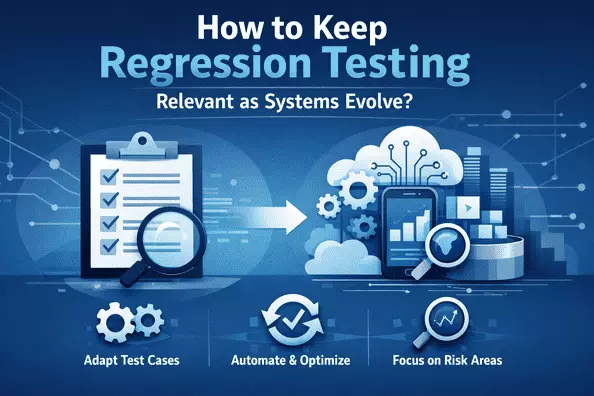
How to Keep Regression Testing Relevant as Systems Evolve?
Modern software systems rarely stay still. Microservices replace monoliths, APIs evolve independently, releases move from monthly to daily, and infrastructure becomes increasingly dynamic.
In this environment, regression testing remains essential—but only if it evolves alongside the system. Otherwise, it risks becoming slow, brittle, and disconnected from real user behavior.
Regression testing was originally designed to ensure that existing functionality continues to work after changes. That goal hasn’t changed.
What has changed is how often systems change, how many components are involved, and how difficult it is to predict impact. Keeping regression testing relevant today requires rethinking what to test, when to test, and how to maintain test value over time.
Why Traditional Regression Testing Loses Effectiveness?
As systems evolve, regression test suites often grow uncontrollably. Teams keep adding tests for new features but rarely remove outdated ones.
Over time, this leads to long execution times, frequent false failures, and tests that validate behavior no longer important to the business.
Another common issue is tight coupling between tests and implementation details. UI-level tests, brittle mocks, or hardcoded assumptions break whenever internal changes occur—even if user-facing behavior remains correct. Instead of catching meaningful regressions, tests become obstacles to change.
Finally, many regression testing strategies fail to adapt to architectural shifts. A test suite designed for a monolithic application struggles when the system becomes API-driven, event-based, or distributed across multiple services.
Reframing Regression Testing Around System Evolution
To stay relevant, regression testing must shift from “testing everything” to “protecting what matters most.” This starts with understanding how the system is changing and which behaviors are critical to preserve.
Rather than focusing on individual features, modern regression testing emphasizes behavioral guarantees. These include API contracts, data integrity, workflow outcomes, and performance characteristics that users depend on.
When tests validate outcomes instead of internal steps, they remain stable even as implementation details evolve. This approach aligns regression testing with system evolution rather than fighting against it.
Prioritize Regression Coverage Based on Risk
Not all regressions are equally costly. A minor UI inconsistency does not carry the same risk as a broken payment flow or data corruption. Keeping regression testing relevant means prioritizing tests based on business impact and failure likelihood.
High-risk areas typically include:
- Public APIs consumed by external clients
- Core user workflows
- Data transformations and persistence logic
- Integrations with third-party systems
By mapping regression tests to these risk zones, teams can reduce test bloat while increasing confidence. Lower-risk scenarios can be tested less frequently or moved to exploratory testing instead of remaining in the automated regression suite forever.
Align Regression Testing with CI/CD Realities
In fast-moving delivery pipelines, regression testing must provide fast and reliable feedback. Running the entire regression suite on every change is rarely practical. Instead, teams should adopt layered regression testing.
This often includes:
- Lightweight regression tests running on every commit
- Service-level or API regression tests running on pull requests
- Full regression suites executed on scheduled or pre-release builds
The goal is not to reduce coverage, but to align regression testing effort with deployment velocity. When feedback arrives quickly and consistently, teams trust the tests instead of bypassing them.
Keep Regression Tests Close to Real Usage
One reason regression testing loses relevance is that it drifts away from how systems are actually used in production. Tests based on artificial inputs or outdated assumptions fail to reflect real-world behavior.
In API-first and backend-heavy systems, capturing real traffic patterns can dramatically improve regression quality. Production-like data highlights edge cases, sequencing issues, and integration behaviors that scripted tests often miss.
Some teams use tools like Keploy to record real API interactions and convert them into regression tests, helping ensure that evolving systems continue to support actual user behavior without manually rewriting test cases after every change.
Design Regression Tests for Change, Not Stability
Ironically, the best regression tests are designed with change in mind. Tests that assert exact response payloads, internal database states, or UI layouts tend to break frequently during refactors.
Instead, resilient regression testing focuses on:
- Contract validation rather than full payload comparison
- Semantic correctness instead of exact values
- Idempotency, ordering, and error handling guarantees
For example, validating that an API response adheres to a schema is often more valuable than checking every field value. This allows systems to evolve internally while preserving externally visible behavior.
Regularly Prune and Refresh the Regression Suite
Regression testing relevance depends on active maintenance. Tests that no longer represent current behavior, business priorities, or architectural reality should be removed or rewritten.
A practical rule is to treat regression tests like production code:
- Review failing tests for value, not just correctness
- Remove tests that no longer protect meaningful behavior
- Update tests when business logic intentionally changes
Periodic regression suite audits help prevent slow, fragile test pipelines and keep feedback actionable.
Embrace Observability to Inform Regression Strategy
Modern observability tools provide deep insight into system behavior—latency patterns, error rates, and unexpected edge cases. These signals can guide regression testing decisions.
For example:
- Frequently failing endpoints deserve stronger regression coverage
- Rare but high-impact failures should be converted into regression tests
- Performance regressions can be detected early through baseline comparisons
By using real system signals, regression testing evolves based on evidence rather than assumptions.
Read: Do These Services Include Testing and Quality Assurance?
Regression Testing as a Living Safety Net
Regression testing should not be viewed as a static checklist but as a living safety net that evolves with the system. As architectures change, delivery speeds increase, and user expectations grow, regression testing must adapt in scope, design, and execution.
When regression tests focus on critical behaviors, reflect real usage, and align with delivery workflows, they remain a powerful tool—not a maintenance burden. In evolving systems, relevance is not achieved by adding more tests, but by continuously refining what regression testing is meant to protect. Done right, regression testing doesn’t slow evolution - it enables it.