How to Integrate E-E-A-T into Your Content Strategy: A Roadmap to Building Authority
Are you struggling to get your content ranked online? As the digital landscape evolves, search engines like Google are shifting their focus.
The new Helpful Content System emphasizes one thing: quality. Search marketing now hinges on trust, and Google rewards content that provides genuine value to users.
This shift was especially crucial for YMYL (Your Money or Your Life) topics, such as health, finance, and legal advice. However, E-E-A-T now applies broadly, influencing content across all industries, helping businesses of every type establish authority and credibility.
In this blog, we’ll show you how to integrate Google’s powerful E-E-A-T framework into your daily operations (like SEO, content generation,
brand marketing, product marketing, community building and digital asset creation) and position your brand as an authoritative voice in your industry.
A Brief Recap of Content Marketing and Google’s Evolving Policies on E-E-A-T
Google’s Panda Algorithm in 2011 established the initial quality benchmark by aggressively targeting and penalizing thin, low-quality, and duplicate content.
Over the years, this foundation was strengthened through major Core Updates, especially around 2018 such as the “Medic Update,” which emphasized Expertise, Authoritativeness, and Trustworthiness (E-A-T) for “Your Money or Your Life” (YMYL) topics.
These principles were formalized through Google’s Search Quality Rater Guidelines, which guide human evaluators in assessing the reliability and helpfulness of online content.
The framework evolved further with the introduction of the second “E” for Experience in December 2022, highlighting the value of first-hand insights and addressing the rise of generic, AI-generated material.
Today, the E-E-A-T framework provides the complex, human-centric metrics that Google uses to ensure this quality bar, specifically weeding out less helpful, generic content, is consistently met across all search results.
Reinforcing this, Google’s Helpful Content System (HCS), now fully integrated into the main ranking algorithm since the March 2024 Core Update, automatically rewards people-first content while demoting pages created primarily for search engines.
Understanding the 4 Pillars of E-E-A-T
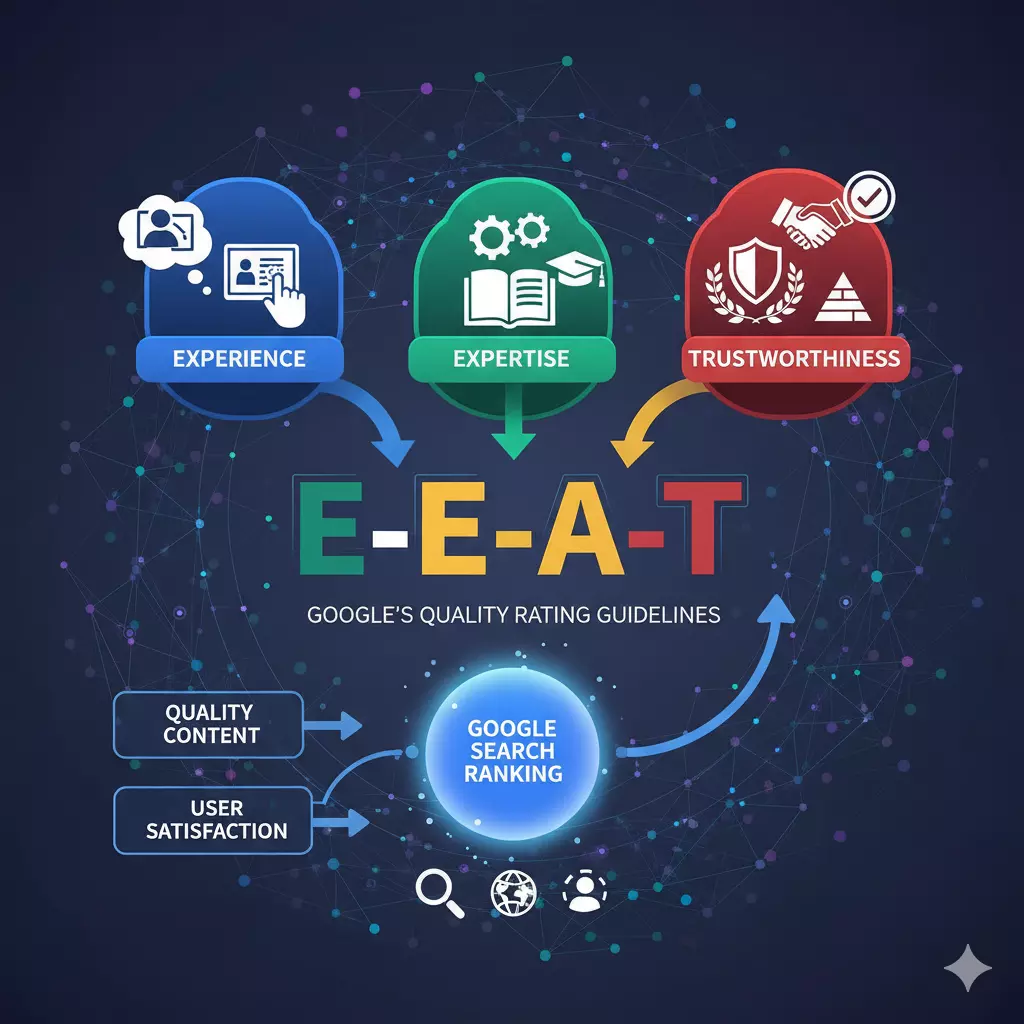
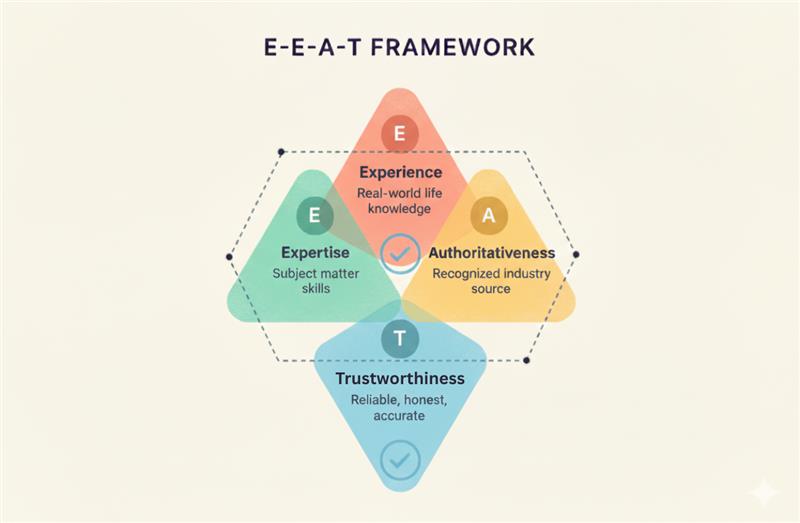
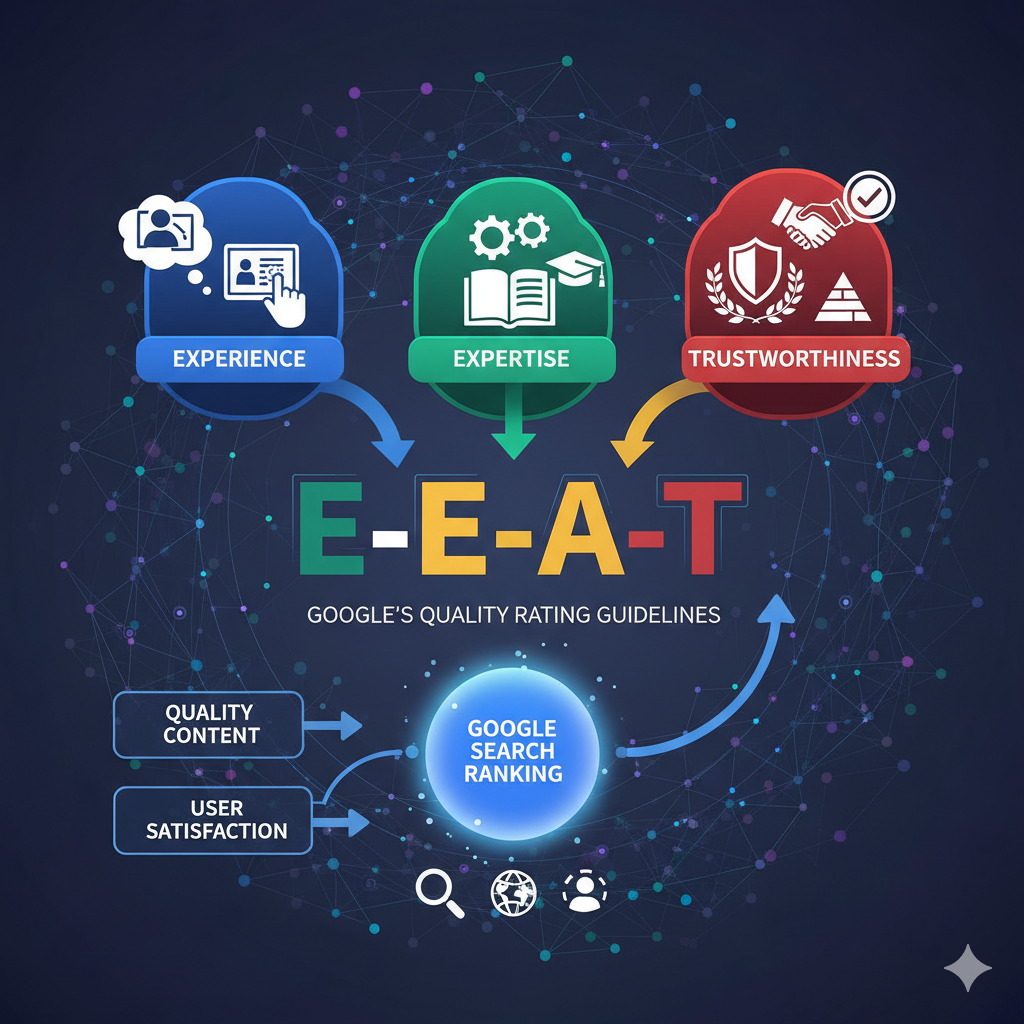
E-E-A-T stands for Experience, Expertise, Authoritativeness, and Trustworthiness. Here’s what each component means:
Experience
Experience is about proving that the content creator has first-hand knowledge of the subject. Claiming expertise isn’t enough; you need to show you’ve actually done what you’re writing about.
- Example 1: A restaurant can showcase a trusted food blogger’s review on its website by featuring excerpts, photos, and a link to the full article to show authentic customer experience and reinforce credibility through an independent third-party validation.
- Example 2: An e-commerce site can showcase user-generated videos of customers unboxing and using products on its website to highlight genuine user experience and reinforce trust through authentic, peer-based validation.
Expertise
Expertise refers to the depth of knowledge the creator has on a subject. It’s about demonstrating that the information is accurate, insightful, and valuable.
- Example 1: A lawyer can publish an in-depth guide on recent changes in tax law, drawing from years of legal experience to demonstrate expertise and build trust through authoritative insight.
- Example 2: An educational platform can feature certified experts who design course materials and develop content to demonstrate subject-matter expertise and build credibility through verified professional experience.
Need authoritative content that converts? Elevate your brand with data-driven Content Writing from
SEOTonic.
Authoritativeness
This pillar is about your reputation. It measures how others in your industry view you, based on your content’s quality and recognition from credible sources.
- Example 1: An engineering company can highlight its white papers that are frequently cited by respected industry publications to demonstrate technical authority and strengthen credibility through peer recognition.
- Example 2: A brand can showcase its features in top-tier media outlets to position itself as a thought leader and build trust through verified third-party endorsement.
Don’t just publish—be recognized. Build your industry reputation with a strategic Content Marketing plan by SEOTonic.
Trustworthiness
Trustworthiness is the core of E-E-A-T. If your content doesn’t feel credible, no amount of experience or expertise will save it. Trust is built through transparency, accuracy, and consistency.
- Example 1: A medical clinic can display clear privacy policies and contact information on its website to signal a safe, secure environment and build trust through transparency.
- Example 2: A beauty brand can showcase ingredient lists and third-party safety certifications to reinforce the authenticity of its claims and demonstrate reliability through verified standards.
Google’s Search Quality Rater Guidelines
(The Guidelines are Google’s signal for the future direction of content quality.)
- For truly valuable content, you must now prove first-hand Experience, moving beyond mere research to share unique, practical insights.
- Trust is the most important component of E-E-A-T, making transparency, security, and the disclosure of conflicts of interest non-negotiable.
- Google is hyper-focused on the individual creator’s reputation; content must be backed by a clear, credible, and topic-relevant author identity.
- The new measure of content quality is not time spent, but the effort, originality, and skill invested in creating unique, non-replicable value.
How to Apply E-E-A-T to Your Website Content?
Building and demonstrating E-E-A-T varies across businesses and niches, as users in different industries have distinct expectations for what constitutes helpful, trustworthy, and credible content. Let’s break down how different businesses can apply E-E-A-T with more practical examples:
E-E-A-T Component
Business Example
Actionable Content Strategy
Google’s Signal
Experience
Paint Company
Create a time-lapse video showing an employee painting a house with your new product, sharing real-world insights.
First-hand product usage with visual proof.
Expertise
Healthcare Clinic
Have all medical blog posts reviewed by an MD, linking to their credentials on the article page.
Proven expertise in a high-stakes industry.
Authoritativeness
Ed-Tech Company
Feature testimonials and logos from well-known companies that use your educational materials.
Recognized authority in the educational sector.
Trustworthiness
E-Commerce Store
Provide clear return policies, unfiltered reviews, and secure checkout pages to build trust.
Transparency and reliability in transactions.
Authoritativeness
Industrial Machinery
Publish white papers that are referenced by leading industry news outlets and engineering organizations.
Credible, cited industry knowledge.
The E-E-A-T Framework: Definition, Proof, and Benefits
COMPONENT
DEFINITION
HOW TO DEMONSTRATE
Experience
The first-hand knowledge and practical insights gained from directly working with or using a product, service, or topic.
Case studies, Projects, Real-world results, Anecdotes, Product Photos, Customer Experience Stories, Behind-the-Scenes content
Expertise
The proven skill, education, or professional training an author or creator has in a specific subject area.
Degrees, Certifications, Training, In-depth analysis, Independent Studies, Data, Facts
Authoritativeness
How widely recognized, cited, or trusted a creator or brand is by experts, industry leaders, or authoritative sources.
Mentions, Backlinks, Awards, Endorsements, Citations, Third-party Reviews, Customer Reviews
Trustworthiness
The assurance that a website or content is safe, accurate, transparent, and reliable for users.
Policies (Privacy, Terms), Security (HTTPS), Sourcing, Corrections, Data Protection Disclosures
E-E-A-T: The Statistical Shift in Search Marketing
E-E-A-T is now a core framework for high-quality content and a critical factor in SEO. Google’s algorithms assess content based on Experience, Expertise, Authoritativeness, and Trustworthiness to determine its value.
E-E-A-T is all about providing genuine, practical, and helpful information about your business, products, and the things that truly matter to your customers.
The focus should be on creating content that is valuable, credible, and directly addresses user needs, rather than simply aiming to meet word count or rank for keywords.
Content that aligns with these principles establishes trust, which Google increasingly prioritizes in its rankings.
Ready to future-proof your rankings? Master the new era of search and start your EEAT Optimization journey with SEOTonic today.
Key Insights Shaping Your SEO Strategy:
- AI Citation Priority: Google’s AI-driven features, like AI Overviews, prioritize content with verified Authoritativeness and Trustworthiness for citations and summaries. Without these credentials, your content may be overlooked by AI systems.
- Thought leadership SEO campaigns, which naturally integrate E-E-A-T through expert-driven content and strategic planning, achieve a very higher ROI with a break-even point in just few months.
- Spam Penalties: Google’s Helpful Content System (HCS) penalizes content created solely for ranking manipulation. “Search engine-first” strategies risk reduced visibility across your domain.
- User Expectation Shift: 60% of marketers using generative AI content in 2025, believe E-E-A-T content is essential to maintain the brand credibility and SEO visibility Source: Synthesia’s 2025 AI statistics
“As Google evolves, prioritizing E-E-A-T is becoming the ultimate differentiator for websites aiming for top rankings and sustainable traffic, especially in 2025.”- SEOTonic
Why E-E-A-T Matters for SEO?
E-E-A-T is a core component of Google’s ranking algorithms. Its focus is to ensure high-quality, reliable content rises to the top.
This framework is especially crucial for YMYL (Your Money or Your Life) topics, such as health, finance, and legal advice etc, where misinformation can have serious consequences.
“E-E-A-T isn’t a checklist—it’s the difference between content that performs and content that fades away. Today’s audiences want to see experience and expertise, not just generic advice.” — GO-Globe Content
Strategy Team, GO-Globe Podcast & Blog
Interesting Facts That Clearly Show the Increasing Importance of E-E-A-T Content –
- In 2024, 91% of marketers believe that focusing on E-E-A-T has enhanced their website’s performance. Source: SearchAtlas
- Sites with author bios, original data, expert reviews, and freshness signals are twice as likely to keep top rankings after Google updates. Source: Top 10 SEO Trends 2025
- Generative AI, Google’s E-E-A-T guidelines, and zero-click searches are predicted to drive the top 3 disruptions in SEO for 2025.
To see how E-E-A-T Strategies can be used to build Trust and Authority – Read the SEOTonic Article Here.
Why E-E-A-T is Critical for Long-Term Online Growth?
- Trust is the Ultimate Currency: E-E-A-T builds deep, lasting customer trust, which ensures repeat business that temporary tricks can’t buy.
- SEO Resilience: Authority signals are future-proof against algorithm updates, securing top visibility long-term.
- Premium Positioning: Proven quality lets you command premium pricing because you’re seen as the definitive, safest choice.
- Organic Conversion Engine: High Experience and Expertise lead to better-qualified traffic that converts more reliably.
- Brand Equity Over Hype: It shifts your brand value from relying on paid promotion to being an indisputable industry leader.
Quality Over Quantity: Why E-E-A-T Wins Every Time
Low-quality content might give you a quick SEO boost, but it’s unsustainable. Google’s Helpful Content update specifically targets websites with content that doesn’t serve user intent. You can’t fake authority or trust, and you certainly can’t cut corners on quality.
Brands now compete for AI-curated search real estate, meaning content authority and structured expertise play a bigger role than keywords alone. – Google I/O 2025
Non-EEAT Content
EEAT Content
Content is generic or AI-generated without human input.
Content is reviewed by experts and written with human insight.
Website lacks transparency (no author bio, contact info, policies).
Clear author bylines, visible policies, and secure contact information.
Content simply repeats what’s already been said.
Content provides original research or personal experience.
High bounce rates indicate poor user experience.
Pages engage users and prompt deeper interaction.
Backlinks from low-quality sites.
Backlinks from credible, high-authority sources.
Practical Tips to Implement E-E-A-T Today
You don’t need to wait for a big overhaul. Here are a few actionable steps to start improving your E-E-A-T signals right now:
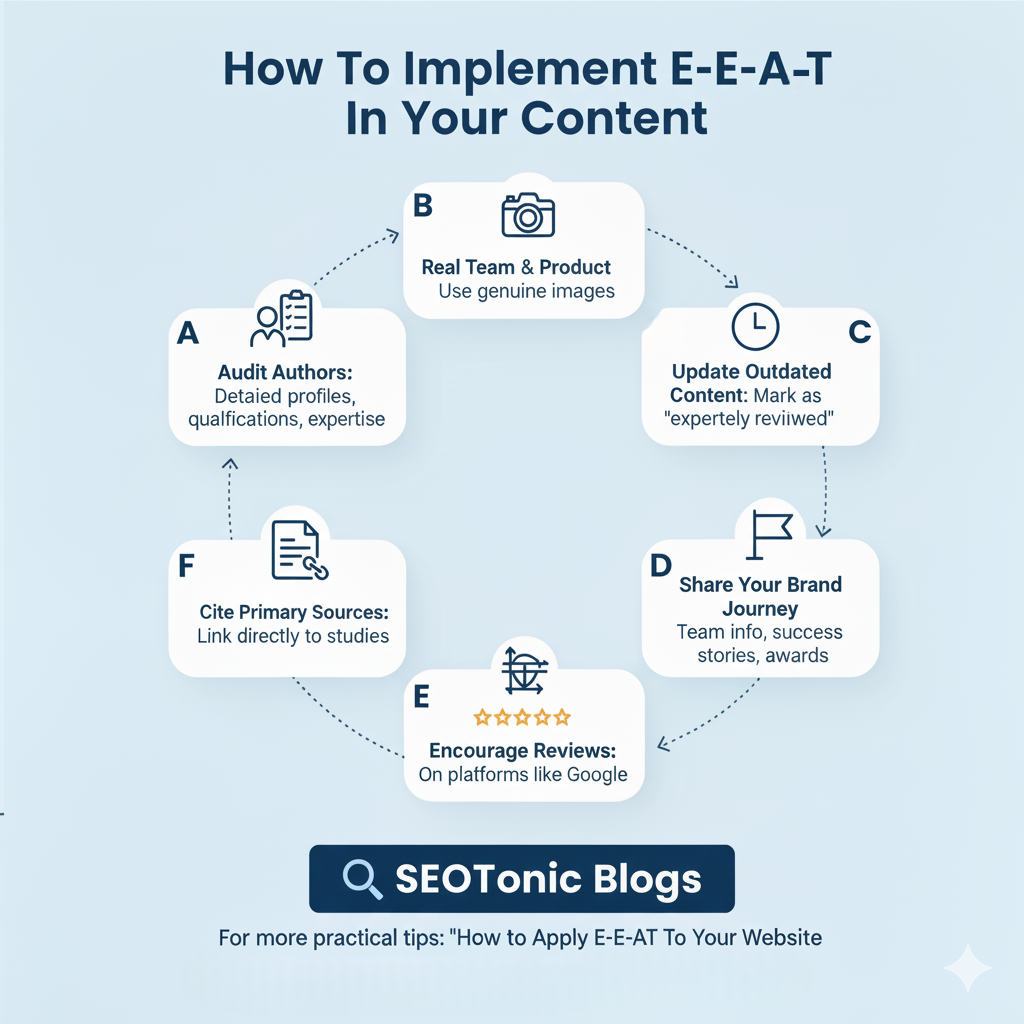
Step 1: Audit your authors: Create detailed profiles for every content creator. Showcase their experience, qualifications, and expertise.
Step 2: Replace stock photos: Use real images of your team, products, or process. It’s a simple but powerful way to signal authenticity.
Step 3: Cite primary sources: Link directly to studies, not secondary summaries. This shows your content is based on solid research.
Step 4: Update outdated content: Regularly refresh your top-performing pages, ensuring they’re up-to-date and clearly marked as “expertly reviewed.”
Step 5: Encourage third-party reviews: Ask satisfied customers to leave reviews on platforms like Google or Trustpilot and feature these reviews on your site.
Step 6: Share Your Brand Journey: Highlight information about your team members, success stories, achievements, awards, brand ethics and values.
For more practical tips on ‘How to Apply E-E-A-T To Your Website’ – check out the SEOTonic Blogs on the topic.
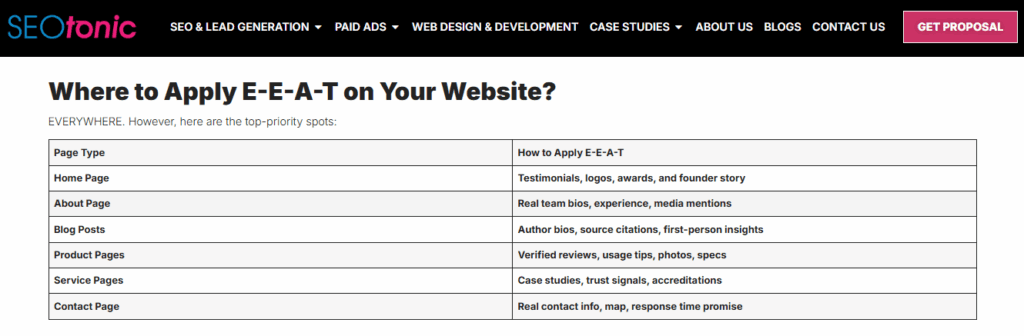
Visualizing Your E-E-A-T Strategy
Sometimes, visuals can make your E-E-A-T strategy clearer:
- Screenshot of a trust signal: Show a secure checkout page or a detailed “About Us” section with contact info and privacy policies.
- Expert by-line graphic: Display the author’s headshot with a brief list of their qualifications.
- Experience proof: Include a photo of your product in use with a caption that highlights its real-world application.
- Customer feedback or testimonial images: Display photos of satisfied customers using your product or service, along with their positive reviews. This visual proof builds trust and demonstrates real-world satisfaction.
Stop gambling on generics. Invest in guaranteed authority and visibility. Partner with SEOTonic, the most trusted SEO Agency in India and benefit from our EEAT Oriented SEO Services.
Conclusion
Adopting E-E-A-T as the foundation of your content strategy is essential for long-term success. By focusing on Experience, Expertise, Authoritativeness, and Trustworthiness, you’ll create content that ranks and builds a lasting, trusted brand.