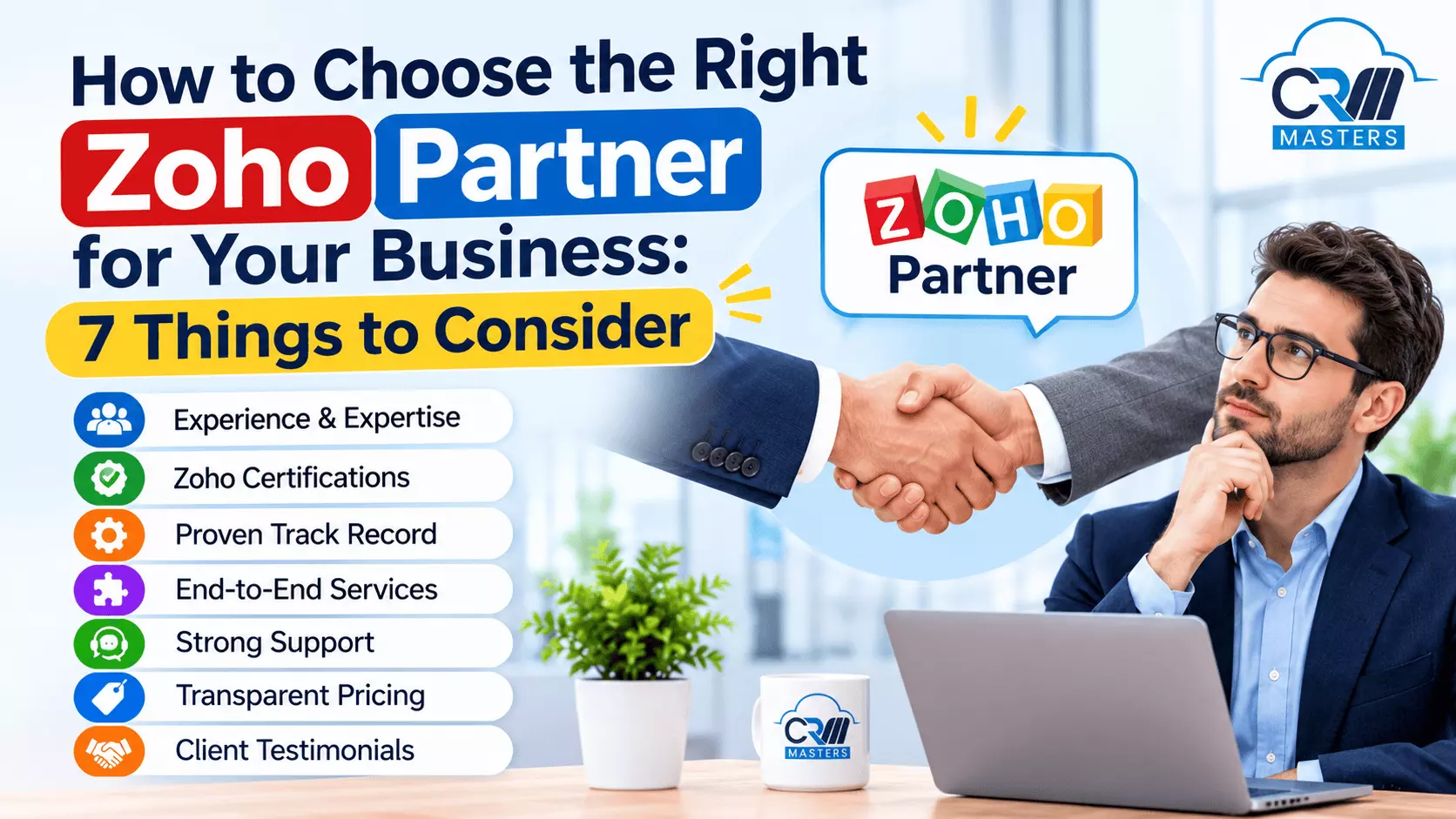
How to Choose the Right Zoho Partner for Your Business: 7 Things to Consider
Choosing business software is an important decision, but getting it to work properly for your team can be just as challenging.
Many businesses adopt Zoho to manage customer relationships, automate routine tasks, organize finances, or bring different departments onto a connected platform. However, the results often depend on how well the software is configured to match the way the business operates.
This is where a Zoho Partner can make a difference. The right partner can help a business select suitable applications, configure workflows, connect existing systems, and avoid common implementation problems.
But with different service providers offering different levels of expertise, how do you know which one is right for your business?
Before making a decision, there are seven important factors worth considering.
1. Understand Your Business Requirements First
Before searching for a Zoho Partner, take some time to identify what your business actually needs.
Are you looking to improve lead management in Zoho CRM? Do you want to automate employee processes, connect accounting software, or bring several business functions together through Zoho One? Each requirement calls for a different approach.
A clear understanding of your goals helps you evaluate potential partners more effectively. It also prevents you from investing in applications or customizations that your team may not need.
Start by listing the main challenges you want to solve. These could include repetitive data entry, disconnected applications, inconsistent reporting, or difficulty tracking customer interactions.
Once you understand these problems, you can look for a partner with relevant experience rather than choosing one based only on price or the number of services it offers.
2. Check Their Experience with Relevant Zoho Products
Zoho offers a wide range of applications for sales, marketing, finance, customer support, human resources, analytics, and business operations. A service provider may have strong experience with one product but limited knowledge of another.
For this reason, check whether the partner has worked with the specific applications your business plans to use.
If your main goal is improving sales operations, experience with Zoho CRM, lead management, sales automation, and reporting may be particularly important. If you need a broader business solution, you may also require knowledge of Zoho Books, Zoho People, Zoho Analytics, or Zoho Creator.
It is also worth asking about experience with Deluge scripting, APIs, third-party integrations, and custom functions if your project involves more advanced requirements.
The aim is to find a partner whose skills match the complexity of your project, not simply one that claims to support every Zoho product.
3. Verify Their Partnership Status and Credentials
Partnership credentials can provide useful information when comparing service providers. However, they should be considered alongside practical experience and the quality of their work.
If a company describes itself as an authorized or certified Zoho Partner, check its current status and relevant credentials through official Zoho channels where possible.
You should also ask whether the team members working on your project have experience with the applications involved. A company's overall partnership status does not automatically tell you which individuals will handle implementation, customization, or technical support.
Look for clear answers about the team's responsibilities, relevant training, and experience with projects similar to yours.
A credible provider should be willing to explain its capabilities without relying entirely on marketing claims.
Read: Expert Zoho CRM Implementation & Development Solutions
4. Evaluate Their Implementation and Customization Approach
Successful implementation involves more than activating applications and importing data. The software must fit your business processes, and your processes may need to be reviewed before automation begins.
A reliable Zoho implementation partner should understand your existing workflows, identify unnecessary steps, and recommend a practical configuration.
For example, a business might need leads to move through specific qualification stages before becoming sales opportunities. Another business may require approval rules, custom fields, automated notifications, or integrations with an accounting system.
The partner should explain how these requirements will be handled and which features can be configured using standard Zoho functionality.
Customization may be necessary in some situations, but adding too many custom functions can make a system harder to maintain. A good provider will explain the trade-offs and recommend the simplest approach that meets your requirements.
5. Ask About Integration and Data Migration
Businesses rarely operate with just one software application. They may already use accounting tools, marketing platforms, spreadsheets, ERP systems, or customer support software.
If these applications need to exchange information with Zoho, integration experience becomes an important selection criterion.
Ask the partner which integration methods are appropriate for your existing systems. Depending on the requirements, the solution may involve a native connector, an API, middleware, or custom development.
Data migration deserves similar attention. Moving records from an old CRM or spreadsheet into Zoho requires more than copying information. Duplicate records, inconsistent field formats, missing values, and outdated contacts can create problems after launch.
Before the project begins, clarify how the provider will clean, map, transfer, and validate your data.
A well-planned migration and integration process helps protect the accuracy of your business information and reduces disruption during the transition.
6. Look Beyond the Initial Implementation Cost
Cost is an important consideration, especially for small and growing businesses. However, the cheapest proposal may not always offer the best long-term value.
When comparing quotes, look at what each proposal includes. Does it cover requirements analysis, configuration, customization, data migration, testing, training, and post-launch support? Are third-party integration costs or additional development charges explained clearly?
It is also important to distinguish Zoho subscription fees from professional service fees. These are separate costs, and the total investment depends on the applications, user requirements, and complexity of the implementation.
Ask potential partners to explain their pricing structure and identify any assumptions that could affect the final cost.
A transparent proposal makes it easier to compare providers and understand what you are paying for.
7. Confirm Training, Support, and Long-Term Maintenance
An implementation is only successful when employees can use the system effectively in their daily work.
Without proper training, teams may continue relying on spreadsheets or manual processes even after the new system has been introduced. This can limit the benefits of the investment.
Before selecting a Zoho Partner, ask how training will be delivered and whether it will be tailored to different user roles. Sales representatives, administrators, finance staff, and managers may need different types of guidance.
You should also understand what happens after the system goes live. Will the provider help resolve issues, adjust workflows, review automation failures, or support future changes?
Business requirements rarely remain the same forever. As your team grows, you may need additional applications, new reports, or more advanced automation.
A partner that understands ongoing support and system maintenance can help you plan for these changes instead of treating implementation as a one-time activity.
Questions to Ask Before Selecting a Zoho Partner
Before making your final decision, consider asking each shortlisted provider a few practical questions:
- Have you handled projects with requirements similar to ours?
- Which Zoho applications and integration methods would you recommend, and why?
- How will you manage data migration and testing?
- What is included in your implementation proposal?
- How will you train our employees?
- What support is available after launch?
- How will you measure whether the implementation has achieved its objectives?
The answers can reveal how well a provider understands your requirements and communicates technical decisions.
It is also useful to request relevant references or examples of previous work, where available. Focus on the provider's role, the challenges addressed, and the approach taken rather than relying on impressive claims alone.
Final Thoughts
Choosing the right Zoho Partner is about finding a team that understands your business, has the appropriate technical skills, and can explain how its recommendations will solve your problems.
Start with clear objectives, check relevant experience, evaluate implementation and integration capabilities, and review the full cost of the project. Just as importantly, make sure the provider offers a realistic plan for training and ongoing support.
You do not necessarily need the most complicated Zoho setup to improve your business operations. You need one that fits your requirements, works reliably, and can adapt as your business changes.
Taking the time to evaluate these seven factors can help you choose a suitable partner and build a stronger foundation for getting value from your Zoho investment.