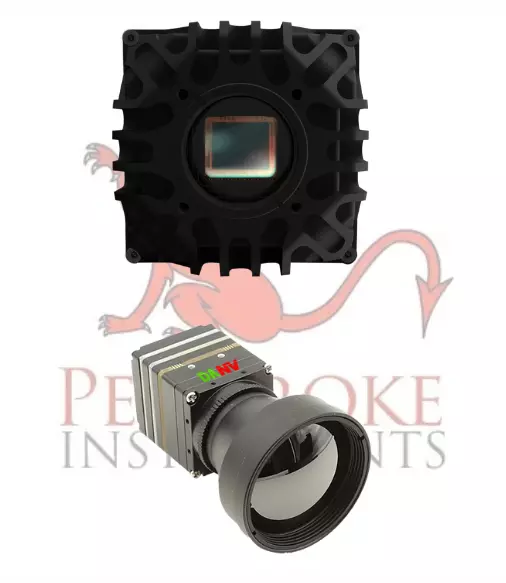
How to Choose the Right SWIR Camera Sensor: InGaAs vs. MCT
Short-wave infrared (SWIR) imaging plays a very important role in modern scientific, industrial, and defence applications. Detecting moisture in agricultural fields or inspecting semiconductor wafers or providing night vision, the SWIR camera provides capabilities that traditional visible-light systems cannot offer.
However, not all SWIR cameras are equal. At the heart of any SWIR imaging systems are the sensors-Most commonly InGaAs (Indium Gallium Arsenide) and MCT (Mercury Cadmium Telluride). Knowing the difference between these two technologies is key to determining which camera best fits your needs and thereby traversing the extensive range of prices for SWIR cameras.
Understanding the Basics of SWIR Sensors
SWIR cameras can detect light in a wavelength range of about 0.9 to 2.5 μm, beyond even the thermal infrared spectrum. Since objects reflect SWIR light differently from everyday visible or thermal infrared light, SWIR imaging is used for penetrative vision through haze, identity differentiation, and detection of imperfections invisible to the naked eye.
Among the most popular sensor materials used for SWIR imaging are InGaAs and MCT, which differ in their spectral range, sensitivity, cooling requirements, and, of course, price.
InGaAs Sensors: Tried-and-True, Practically Useful, and Popular
InGaAs sensors occupy the most significant part of the market for many mainstream SWIR applications. Their sensitivity peaks between 0.9 µm and 1.7 µm, the vast majority of which falls under typical SWIR imaging requirements.
Major InGaAs Sensors Features:
- Development: With the development of over twenty years, InGaAs sensors are now proven reliable and find great support.
- Cooling Requirements: They can be operated without the need for sophisticated refrigeration. They are, therefore, compact and energy-conserving.
- Price: In general, their cameras cost much less than MCT-based systems.
- High Frame Rates: Perfect for high-speed inspection, robotics, and laser beam profiling.
Typical Applications:
- Semiconductor Inspection
- Laser Alignment and Profiling
- Inspection of Moisture and Food Quality
- Low-Light Surveillance
Due to their price and stability, InGaAs sensors are the sensors of choice for the vast majority of commercial and industrial SWIR imaging applications.
MCT sensors: High Matrix with a High Cost
MCT sensors furnish high performance, being characterised by broad wavelength detection (often up to 2.5 μm) and even extending into the mid-wave infrared (MWIR) region, depending on the specific composition of the detector.
MCT Sensors' Key Features:
- Extended Wavelength Range: MCT sensors cover a wider band (up to 2.5 µm), allowing deeper material inspection and advanced analytics.
- Superior Sensitivity: MCT proves much more sensitive than InGaAs in low-light or passive detection scenarios.
- Cryogenic Cooling Required: These sensors require cooling (often with liquid nitrogen or Stirling engines), which makes the whole system more complex and costly.
- Higher SWIR Cameras Price: These cameras can be very expensive due to the challenges in fabrication and the cooling system.
Ideal Use Cases:
- Scientific Research
- Advanced Spectroscopy
- Missile Tracking and Aerospace Applications
- Hyperspectral Imaging
Whenever high sensitive and extended wavelength detections are mission-critical, MCT cameras are sunk down, but it comes with a great cost.
What Drives The SWIR Cameras Price?
The price of SWIR cameras encompasses several levels: basic InGaAs cameras cost several thousand dollars, while cooled cameras of MCT systems,, featuring advanced optics and electronics,, may exceed $100,000.
Factors Returning Costing:
- Sensor Material: To manufacture and integrate, InGaAs is inexpensive compared to its counterpart.
- Cooling Mechanism: First, thermoelectric, and then cryogenic: each influences size, power requirements, and costs, respectively.
- Resolution & Frame Rate: The higher the performance features, the higher the price.
- Spectral Range: The broader the spectral range covered by cameras, the more costly they are (mostly MCT).
- Application-Specific Enhancements: Additional costs are incurred when reinforced housing, special software, and connection options are considered.
If your application is within the normal SWIR range of 0.9 to 1.7 μm, the SWIR InGaAs camera is usually the best option in terms of balancing performance and price. On the other side, if your work requires higher sensitivity and wider spectral coverage, such a justification is worth the MCT's extra cost.
Conclusion: Matching Sensor to Mission
Your choice of the InGaAs or the MCT sensor for your SWIR camera will ultimately depend on the specifications governing each application. InGaAs sensors are worth it with their price, practicality and performance in everyday working-class settings. MCT sensors offer superior coverage of wavelength and superior sensitivity, but add to the complexity and cost.
Awareness of these basic differences will allow you to make good technical and financial decisions, especially while comparing prices of SWIR cameras across vendors and technologies. Ultimately, the sensor you choose should fit with your long-term objectives and operational limitations, sharing time with your imaging objectives.