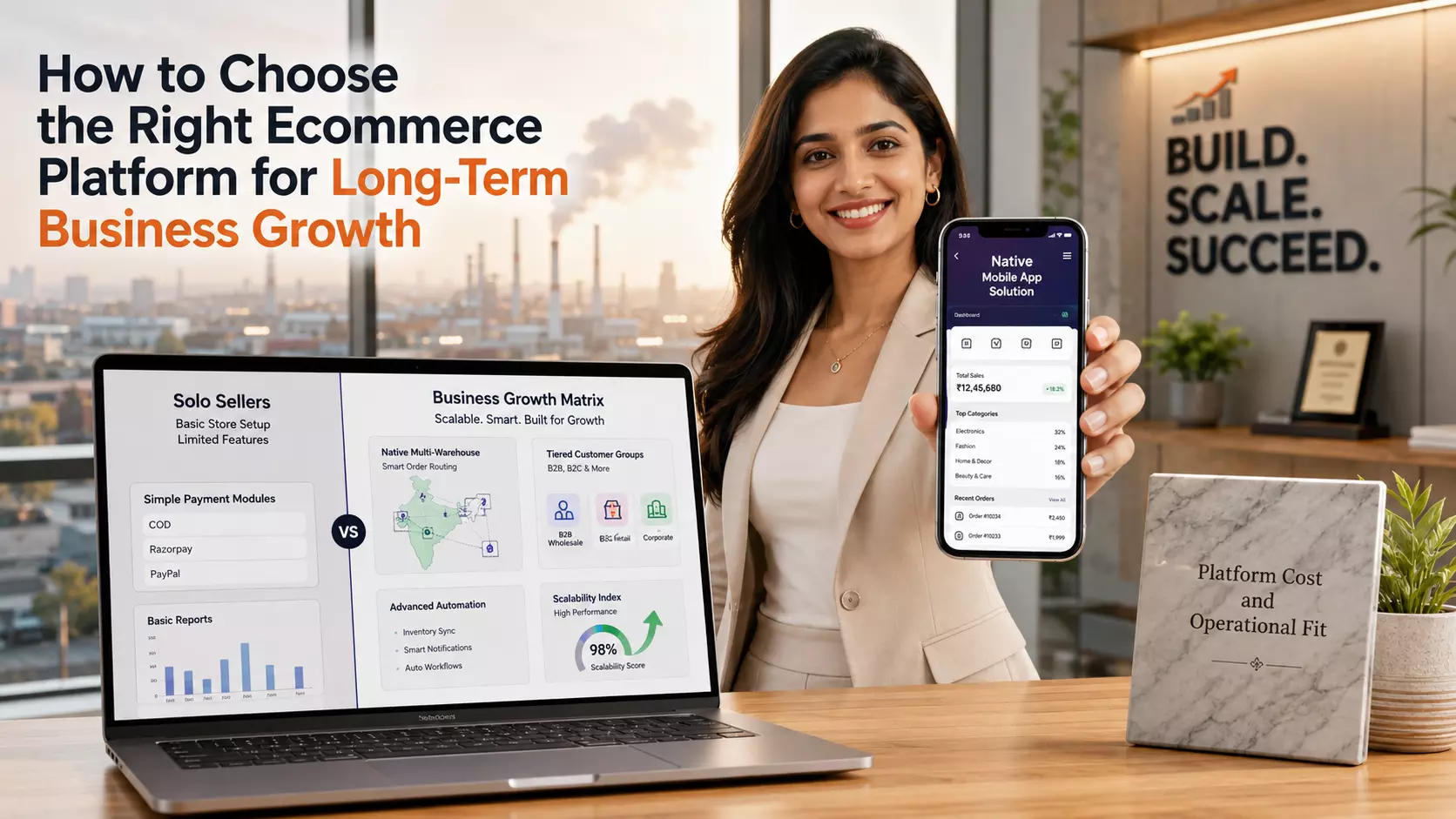
How to Choose the Right Ecommerce Platform: A Guide for Manufacturers, Distributors, and D2C Brands
You spent years building a supply chain, a customer base, and a product that actually sells. Now you want to take it online. You open a browser, search "best ecommerce platform," and immediately hit a wall of comparison articles written for someone selling handmade candles from a garage.
That is the real problem. Most ecommerce content is written for solo entrepreneurs starting from zero. If you are a manufacturer with 10,000 SKUs, a distributor managing five warehouses, or a D2C brand that needs a branded app alongside a website, the standard advice simply does not apply to you.
This guide is built for businesses that already exist. You have inventory, customers, and operational complexity. What you need is a platform that fits around your business, not one that forces your business to fit around it.
We evaluated eight of the most widely used ecommerce platforms through that lens and ranked them on what matters most to established businesses: scalability, B2B capability, automation, inventory management, and total cost of ownership.
What Makes an Ecommerce Platform Right for Your Business Model?
Before comparing platforms, you need a framework. Every platform on this list can technically host products and take payments. The difference is in depth, and depth is where most businesses get caught off guard.
Here are the dimensions that actually matter for manufacturers, distributors, and D2C brands:
1. Inventory Architecture
If you run a single warehouse with 50 products, almost any platform works. If you run three warehouses across different geographies with thousands of variants, you need a platform built for real inventory management, including multi-warehouse routing, stock allocation, and real-time sync.
2. B2B vs. B2C Capability
Distributors and manufacturers often sell to both wholesale buyers and end consumers. Running two separate stores doubles your overhead. Look for platforms that let you manage B2B and B2C from one dashboard with role-based pricing, custom catalogs, and separate buyer portals.
3. Mobile Commerce
A branded mobile app is not a luxury for D2C brands. It is a retention tool. Push notifications, in-app exclusive offers, and seamless checkout on mobile drive repeat purchases. Know whether a platform offers native apps or relies entirely on mobile-responsive web.
4. Transaction Fees
This one is often buried in the fine print. Some platforms charge a platform transaction fee on top of payment gateway fees. On $500,000 in annual revenue, even a 0.5% platform fee costs $2,500 a year on top of your subscription. That is real money.
5. Automation and Operational Fit
Can the platform automate order routing to the right warehouse? Can it generate GST-compliant invoices automatically? Can it trigger replenishment alerts? For businesses with real operational complexity, automation is not a bonus feature. It is a requirement.
The 8 Ecommerce Platforms Compared: Full Breakdown
1. Shopify
Best for: D2C brands and direct-to-consumer retailers looking for speed to market.
Shopify is the most recognized name in ecommerce, and for good reason. It is fast to set up, has an enormous app marketplace, and the user experience for both merchants and customers is genuinely polished.
The platform has invested heavily in its D2C ecosystem. Shopify Markets allows merchants to sell in multiple currencies and languages. Shopify Flow provides basic automation. And Shopify Plus, its enterprise tier, unlocks features like B2B wholesale channels, custom checkout scripts, and dedicated account management.
Where Shopify struggles for established businesses is cost structure and customization depth. Transaction fees apply if you do not use Shopify Payments, which is not available in all markets.
The app-first architecture means operational features like advanced inventory management, B2B pricing, or multi-warehouse order routing require third-party apps, and those costs add up quickly.
A manufacturer managing 5,000 SKUs across three warehouses will spend significantly more on apps and development than the base subscription suggests.
That is not a criticism of Shopify. It is built to serve a different primary use case. For a D2C brand launching with a focused catalog and scaling fast, Shopify remains a strong choice. For complex operational businesses, the total cost of ownership climbs steeply.
Key Strengths: Massive app ecosystem, polished UI, strong D2C tooling, Shopify Markets for multi-currency.
Key Weaknesses: Transaction fees outside Shopify Payments, high cost for enterprise features, B2B depth requires Shopify Plus ($2,300+/month) or costly apps.
Pricing: From $39/month (Basic) to $399/month (Advanced); Shopify Plus from $2,300/month.
2. Shopaccino
Best for: Manufacturers, exporters, distributors, and D2C brands that need a branded website + native mobile app with B2B and B2C capability from one system.
Shopaccino occupies a category that most platforms only partially serve: ecommerce built specifically for established businesses with operational complexity.
The platform was not built by adding enterprise features on top of a consumer storefront. It was designed by identifying the actual pain points of exporters, manufacturers, distributors, and D2C brands, and building solutions around those pain points from day one.
That distinction matters more than it sounds. When a platform is architecturally built for operational businesses, features like multi-warehouse management, B2B wholesale portals, and end-to-end order automation are native capabilities, not bolt-ons.
What Shopaccino Includes Natively
- Branded website + native Android and iOS apps (available on Growth plans, no third-party app builder required)
- B2B + B2C from one dashboard with role-based pricing, customer group management, and separate buyer experiences
- Multi-warehouse inventory management with automated order routing to the nearest or most appropriate fulfillment center
- Multi-currency support for businesses selling globally, exporters included
- Zero platform transaction fees on all plans, meaning you keep every rupee (or dollar) of your revenue
- End-to-end operational automation covering order processing, invoice generation, logistics integration, and fulfillment updates
- On-the-go business management so founders and operations teams can manage orders, inventory, and customer queries from anywhere
For a manufacturer that sells both to distributors (B2B) and directly to end consumers (B2C), Shopaccino removes the need to maintain two separate stores. Both buyer types log into the same storefront, but see different pricing, catalogs, and checkout flows based on their account type. That kind of B2B and B2C unification is rare at this price point.
The mobile app inclusion is a meaningful differentiator. Most platforms charge separately for app development or require integration with a third-party app builder.
On Shopaccino Growth plans, a branded Android and iOS app is part of the package. For D2C brands, this means a push-notification channel, in-app loyalty programs, and a mobile-first purchase experience without additional development cost.
Exporters benefit from built-in multi-currency pricing, international shipping integrations, and a storefront architecture designed to handle cross-border sales. For businesses where global reach is a growth priority, Shopaccino is built for that from the start.
Zero transaction fees across all plans is not a marketing claim. It means that on $1,000,000 in annual sales, you pay nothing extra to Shopaccino on top of your subscription. Compared to platforms that charge 0.5% to 2% per transaction, the savings over time are significant.
Key Strengths: Native B2B + B2C, multi-warehouse inventory, branded mobile apps on Growth plans, zero transaction fees, global/multi-currency, end-to-end automation, industry-specific design.
Key Weaknesses: Smaller third-party app marketplace compared to Shopify; best suited for businesses with real operational needs (not the simplest option for solo hobbyist sellers).
Pricing: Competitive with Shopify's mid-tier plans; zero platform transaction fees on all plans. Visit shopaccino.com for current pricing.
3. WooCommerce
Best for: Businesses already running on WordPress that want full code-level control.
WooCommerce is the world's most widely installed ecommerce plugin, powering a significant share of all online stores. It runs on WordPress, which means if you already use WordPress and have development resources, WooCommerce gives you unmatched flexibility.
The true cost of WooCommerce is hosting, maintenance, security, and developer time. You own the infrastructure, which is powerful in theory but expensive in practice. A manufacturer running WooCommerce at scale will need reliable managed hosting, regular plugin updates, security audits, and a developer on call for the inevitable conflicts between plugins.
For complex scenarios like multi-warehouse routing or B2B wholesale pricing, WooCommerce requires premium extensions. Those extensions range from $50 to $300+ per year each, and you often need several working together. Performance at scale also requires optimization work that a hosted SaaS platform handles automatically.
WooCommerce is genuinely excellent for businesses with development resources, a strong WordPress preference, and a need for deep customization. For businesses without a dedicated developer, the hidden costs and complexity can outweigh the perceived savings.
Key Strengths: Full open-source flexibility, massive plugin library, zero platform license cost, ideal for WordPress-native teams.
Key Weaknesses: Self-managed hosting and security, plugin conflicts at scale, developer dependency, B2B and multi-warehouse require premium extensions.
Pricing: Plugin is free; real costs are hosting ($20-$300+/month), premium extensions ($200-$1,500+/year), and developer time.
4. BigCommerce
Best for: Growing mid-market brands that want SaaS reliability with more built-in features than Shopify.
BigCommerce has positioned itself as the enterprise-friendly alternative to Shopify, and it earns that positioning in a few important ways. There are no transaction fees on any plan. Built-in features cover more ground than Shopify natively, including more robust product variant options, shipping calculators, and multi-currency checkout.
BigCommerce B2B Edition (available on Enterprise plans) includes quote management, custom price lists, and company account management. For distributors with a significant wholesale customer base, this is meaningful functionality.
The platform's biggest constraint is its Annual Sales Thresholds. Each plan tier has a revenue cap; once you exceed it, you are automatically moved to the next plan at a higher price. This creates unpredictable cost increases during growth periods, which is a real concern for fast-scaling manufacturers or D2C brands.
BigCommerce also lacks native mobile app functionality. If a branded app matters to your customer experience strategy, you will need a third-party integration, which adds cost and complexity.
Key Strengths: No transaction fees, strong built-in features, B2B Edition for wholesale, headless commerce architecture support.
Key Weaknesses: Revenue-based plan escalation, no native mobile app, Enterprise pricing required for full B2B capability.
Pricing: Standard from $39/month; Plus from $105/month; Pro from $399/month; Enterprise custom pricing.
5. Magento (Adobe Commerce)
Best for: Large enterprises with dedicated development teams and complex multi-store requirements.
Magento, now Adobe Commerce, is the gold standard of enterprise ecommerce customization. If you need granular control over every aspect of your store, from custom checkout flows to deeply integrated ERP systems, Magento can handle it.
The platform has native B2B modules including company account management, requisition lists, quick order forms, and approval workflows. For large distributors managing enterprise accounts, these are capabilities that justify the platform's complexity.
That complexity is the catch. A full Magento implementation typically costs between $50,000 and $250,000 in development, followed by significant ongoing maintenance. Adobe Commerce (the cloud-hosted version) adds a licensing fee that starts in the tens of thousands per year.
For manufacturers and distributors at enterprise scale with six-figure IT budgets, Magento is worth serious evaluation. For businesses under $10M in annual revenue, the cost-to-capability ratio rarely makes sense. There are better options at a fraction of the investment.
Key Strengths: Unmatched customization depth, native enterprise B2B modules, strong ERP and PIM integration ecosystem, multi-store management.
Key Weaknesses: Very high implementation and maintenance cost, requires dedicated Magento developers, not practical for businesses without large IT budgets.
Pricing: Open Source is free to download; Adobe Commerce licensing typically starts at $22,000+/year plus hosting and development costs.
6. Wix eCommerce
Best for: Small businesses and creatives wanting an all-in-one website builder with basic selling capability.
Wix is exceptional at what it does: letting anyone build a visually appealing website quickly, with ecommerce tacked on as a capable secondary feature. For a small artisan brand or a boutique retailer with a limited catalog, Wix eCommerce works well.
For manufacturers, distributors, or growing D2C brands, Wix hits a ceiling quickly. There is no native B2B wholesale functionality. Inventory management is basic. Multi-warehouse support does not exist. And the platform was not built to scale operationally.
Wix does offer a reasonably good mobile-responsive experience, and its drag-and-drop editor is genuinely intuitive. But operational automation, multi-currency, and B2B capability are either absent or require workarounds that introduce friction.
Wix belongs in the conversation for small businesses starting out. It does not belong in the evaluation for an established manufacturer or distributor moving their operations online.
Key Strengths: Easiest website builder experience, affordable pricing, good for small product catalogs and creative businesses.
Key Weaknesses: No B2B features, limited inventory management, no multi-warehouse, not built for operational scale.
Pricing: Business plans from $27/month; no transaction fees on higher plans.
7. Squarespace Commerce
Best for: Brands where design and visual storytelling are the primary priority.
Squarespace is the most beautiful website builder in the market. The templates are genuinely award-worthy, and the content management experience for editorial-heavy brands is excellent. If you are a luxury D2C brand where brand aesthetics are central to your positioning, Squarespace deserves a look.
For operational ecommerce, Squarespace has clear limitations. B2B functionality is essentially non-existent. Inventory management is basic. Integration options, while improved, are still limited compared to Shopify or WooCommerce.
The platform shines for a lifestyle brand selling a curated collection of high-margin products where the brand story is as important as the product itself. It is not the right tool for businesses with complex fulfillment, wholesale customers, or large product catalogs.
Key Strengths: Best-in-class design templates, strong content management, excellent for lifestyle and luxury brands, no transaction fees on Commerce plans.
Key Weaknesses: No B2B functionality, limited integrations, basic inventory management, not built for operational complexity.
Pricing: Basic Commerce at $36/month; Advanced Commerce at $65/month.
8. PrestaShop
Best for: European businesses that want open-source flexibility with lower development overhead than Magento.
PrestaShop is a free, open-source ecommerce platform with a strong following in Europe and Latin America. Like WooCommerce, it gives you full code-level control and avoids platform licensing fees. Unlike WooCommerce, it was built specifically for ecommerce rather than adapted from a blogging platform.
PrestaShop supports multi-language and multi-currency out of the box, which matters for exporters and businesses with international customer bases. The core platform handles product management, order workflows, and shipping configurations reasonably well.
The drawback is the same as any open-source solution: you own the infrastructure. Hosting, security updates, performance optimization, and plugin compatibility are your responsibility. For businesses without technical resources, this translates into real cost and real risk.
PrestaShop also has a smaller global module marketplace compared to WooCommerce and Shopify. For advanced B2B features or complex inventory scenarios, you may find fewer ready-made solutions and more need for custom development.
Key Strengths: Free open-source license, built for ecommerce (not blog-first), strong multi-language and multi-currency support, active European community.
Key Weaknesses: Self-hosted infrastructure management, smaller global app marketplace, B2B capability requires custom development or expensive modules.
Pricing: Free to download; hosting costs $20-$150+/month; modules and development add $500-$5,000+ depending on needs.
Side-by-Side Comparison: All 8 Platforms at a Glance
Platform
B2B Support
Mobile App
Multi-Warehouse
Transaction Fees
Best For
Shopify
Via Shopify Plus
Via 3rd party
Via apps
Yes (non-SP)
D2C, fast-launch brands
Shopaccino
Native (all plans)
Native (Growth)
Native
Zero
Mfrs, Distributors, D2C
WooCommerce
Via extensions
Via plugins
Via plugins
None (gateway only)
Dev-resource teams
BigCommerce
B2B Edition (Ent.)
Via 3rd party
Via apps
None
Mid-market B2B/B2C
Magento
Native (robust)
Via 3rd party
Native
None
Enterprise, large teams
Wix
None
Responsive only
None
None (higher plans)
Small/creative brands
Squarespace
None
Responsive only
None
None (Commerce)
Lifestyle/luxury brands
PrestaShop
Via modules
Via modules
Via modules
None
EU open-source users
How Should a Manufacturer Choose an Ecommerce Platform?
Manufacturers face a unique challenge: their operational complexity is real, and most ecommerce platforms were not designed with manufacturing workflows in mind. Here is a practical framework for manufacturers evaluating platforms.
Start With Inventory Reality
Count your SKUs. Count your warehouses. Map your replenishment triggers. If any of those numbers are large, you need a platform with native inventory depth, not a plugin-dependent workaround. Inventory mismatches during peak demand are the most common reason manufacturers face chargebacks and customer loss in their first year online.
Map Your Buyer Types
Do you sell only to consumers, or also to retailers and distributors? If you sell to both, you need B2B and B2C capability from one platform. Maintaining two stores doubles your operational workload and creates inventory split issues. Shopaccino and BigCommerce B2B Edition are the clearest options here, with Shopaccino offering this natively at a lower price point.
Calculate Total Cost of Ownership
Subscription cost is the visible iceberg tip. Add up: platform fees, app/plugin costs, transaction fees, development costs, and migration costs if you switch later. A platform at $99/month with $400/month in required apps is a $499/month platform. Run the real numbers before committing.
Verify Logistics Integrations
Can the platform connect to your existing shipping carriers and 3PL partners? Can it generate shipping labels, track packages, and trigger customer notifications automatically? For manufacturers shipping at volume, these integrations are operational necessities, not nice-to-haves.
Read: Top Features Every E-commerce Website Should Have to Attract
How Should a Distributor Choose an Ecommerce Platform?
Distributors have a specific set of requirements that differ from manufacturers and retailers. Customer account management, tiered pricing, and order history access are baseline needs. Here is how to evaluate platforms from a distribution standpoint.
Customer Account Structure
Wholesale buyers need account-based ordering. They need to see their specific negotiated pricing, access order history, reorder from past orders, and manage their own account details. Platforms with company account management and role-based access control save significant manual work for distributors.
Tiered and Custom Pricing
Can you set different price lists for different buyer groups? A national distributor might have 20 customer segments with different margins. A platform that only offers flat catalog pricing creates a manual pricing management nightmare.
Minimum Order Quantities and Bulk Rules
Distribution often involves MOQs (minimum order quantities), bundle requirements, and weight or volume-based pricing. Verify that the platform handles these natively before committing. Many platforms treat ecommerce as a consumer-first experience and only address bulk ordering through third-party workarounds.
Integration With ERP and Accounting Systems
Distributors typically run ERP systems for inventory and accounting software for financials. The ecommerce platform must integrate cleanly with both, or you will create a data reconciliation problem that costs more in staff time than the platform saves.
How Should a D2C Brand Choose an Ecommerce Platform?
D2C brands have different priorities. Speed, brand experience, mobile, and customer retention tools matter more than B2B capability. But as D2C brands scale, they often discover they need more operational depth than their initial platform can provide.
Brand Experience Across Every Touchpoint
Your website is not your only brand touchpoint. Email, mobile app, push notifications, and post-purchase experience all communicate your brand. A platform that gives you a branded mobile app natively keeps your brand consistent on mobile without requiring you to hire a separate app development team.
Customer Retention Infrastructure
What tools does the platform offer for loyalty programs, abandoned cart recovery, and post-purchase sequences? For D2C brands, customer acquisition is expensive. The economics only work if you retain customers and increase lifetime value. The platform you choose shapes what retention tools you can deploy.
Scalability Without Platform Switching
Many D2C brands start on a beginner-friendly platform and hit a wall as they scale. Migrating platforms is a significant project: data migration, SEO equity at risk, developer costs, and downtime risk. Choose a platform that can grow with you rather than one optimized for the launch phase.
Performance and Page Speed
Google's Core Web Vitals are a ranking factor. A slow storefront costs you both SEO rank and conversion rate. According to a Google/Deloitte study, a 0.1 second improvement in mobile site speed can increase conversion rates by 8% for retail sites. Platform infrastructure matters directly to your bottom line.
Which Platform Should You Choose? A Decision Map
Decision Framework: Matching Your Business Model to the Right Platform
Step 1: Do you need B2B capability (wholesale, tiered pricing, company accounts)?
YES --> Do you also need B2C (consumer) selling from the same platform?
YES --> Shopaccino (native) | BigCommerce B2B Edition | Magento (enterprise)
NO --> Shopaccino | BigCommerce | Magento | WooCommerce + B2B plugin
NO --> Do you need a branded mobile app?
YES --> Shopaccino (native app on Growth) | Shopify + app builder
NO --> Shopify | BigCommerce | Squarespace | Wix
Step 2: Do you manage multiple warehouses?
YES --> Shopaccino (native) | Magento (enterprise) | Shopify + apps | WooCommerce + plugins
Step 3: Are you selling globally or across currencies?
YES --> Shopaccino (multi-currency native) | Shopify Markets | BigCommerce | PrestaShop
Why Do Transaction Fees Matter More Than Most Businesses Realize?
Transaction fees are the most underestimated cost factor in platform selection. A platform transaction fee is charged by the ecommerce platform itself, separate from what your payment gateway charges. Not all platforms charge them, but the ones that do can meaningfully impact your margins.
Annual Revenue
0.5% Txn Fee Cost
1% Txn Fee Cost
2% Txn Fee Cost
$100,000
$500
$1,000
$2,000
$500,000
$2,500
$5,000
$10,000
$1,000,000
$5,000
$10,000
$20,000
$5,000,000
$25,000
$50,000
$100,000
Shopaccino charges zero platform transaction fees on all plans. Shopify charges 0.5% to 2% if you use a third-party payment gateway instead of Shopify Payments. For businesses in markets where Shopify Payments is unavailable, that fee is unavoidable. At $1M in revenue, the difference between zero and 1% is $10,000 per year. That is a meaningful cost difference.
What Is the Right Time to Move From an Existing Platform to a Better One?
Platform migration is a significant decision, but staying on the wrong platform as your business scales has real costs: lost orders from poor mobile experience, manual work from weak automation, and capped growth from inadequate B2B tools. Here are signals that you have outgrown your current platform.
- Inventory management is manual or error-prone. If you are reconciling inventory in spreadsheets because your platform cannot handle multi-location stock, you have an infrastructure problem.
- Your B2B buyers use the same experience as retail customers. Wholesale buyers who cannot see their negotiated pricing or access account-specific catalogs create manual customer service overhead.
- Transaction fees are a significant line item. If you can calculate the annual transaction fee cost and it exceeds the migration cost, the ROI on switching is immediate.
- You are running three or more separate apps for core functions. Multi-warehouse, B2B pricing, mobile app, and inventory sync should be platform-native, not a fragile chain of third-party integrations.
- Mobile conversion rate is significantly lower than desktop. If your gap is larger than 10-15 percentage points, your mobile experience needs a structural fix, which may mean a platform change.
Key Takeaways
Summary: What to Remember
- There is no single best ecommerce platform. There is the right platform for your specific business model and operational requirements.
- Manufacturers and distributors need native B2B, multi-warehouse support, and automation. Most consumer-first platforms deliver these as expensive add-ons, not built-in features.
- D2C brands should prioritize branded mobile experience, retention tools, and scalability. A platform that cannot grow with you creates migration risk down the road.
- Calculate total cost of ownership: subscription + apps + transaction fees + development. The cheapest headline price rarely stays cheapest at scale.
- Shopaccino is purpose-built for manufacturers, exporters, distributors, and D2C brands. B2B + B2C, multi-warehouse, mobile app, and zero transaction fees are native features, not upgrades.