How to Choose the Right Custom Stickers for Product Packaging: Material, Shape & Use Guide
Custom stickers can turn a plain box, bottle, jar or pouch into branded packaging without requiring the entire package to be custom printed. But choosing the right sticker involves more than selecting an attractive design.
The packaging surface, sticker material, shape, size, artwork and intended use all affect how the finished sticker will look and perform.
This guide explains how businesses can choose the right custom stickers for product packaging, compare common sticker materials and shapes, and avoid mistakes before placing an order.
Which Custom Sticker Should You Choose?
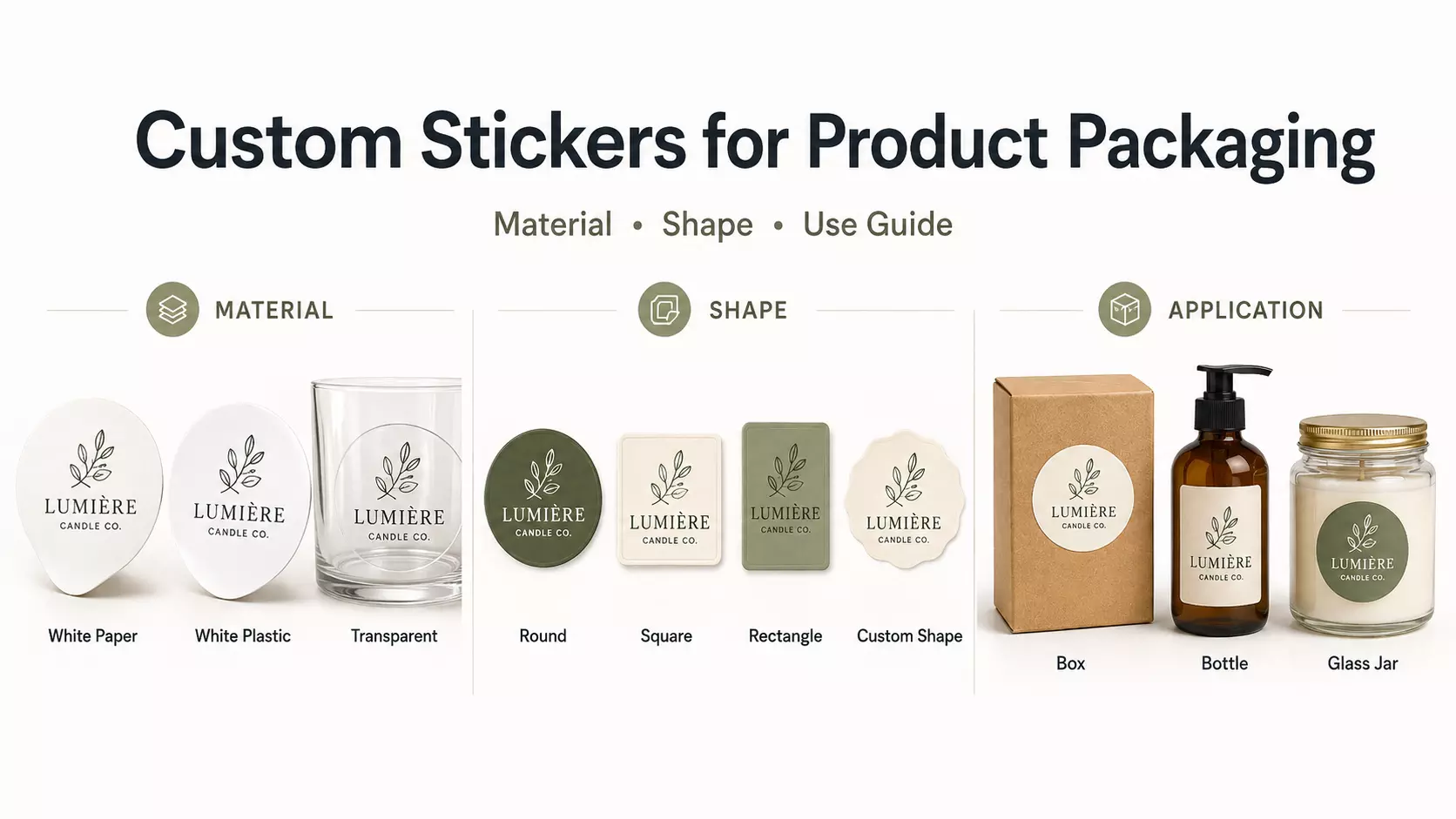
For boxes, envelopes and many indoor packaging applications, White Paper stickers are often a practical starting option. For bottles, containers or applications where a smoother sticker material is preferred, White Plastic can be considered.
For glass jars and clear packaging where you want the underlying surface to remain visible, Transparent stickers can create a minimal appearance.
The best option ultimately depends on the packaging surface, handling conditions, design and intended application.
What Are Custom Stickers for Product Packaging?
Custom stickers are adhesive printed labels personalised with a business logo, product name, text, graphics, QR code or custom artwork.
They can be used on:
- Product boxes
- Bottles
- Glass jars
- Pouches
- Envelopes
- Shipping boxes
- Gift packaging
- Retail packaging
- Takeaway packaging
Businesses commonly use them as custom logo stickers, product labels, packaging seals, QR code labels, promotional stickers and thank-you stickers.
One advantage of stickers is flexibility. A business can use standard packaging and change the sticker according to the product, flavour, collection, campaign or season instead of changing the entire packaging format.
Which Sticker Material Is Best for Product Packaging?
There is no single sticker material that is best for every product.
Start by asking:
What surface will the sticker be applied to, and under what conditions will the product be stored or handled?
Quick Sticker Material Comparison
Material
Good Starting Use
Main Characteristic
White Paper
Boxes, envelopes, kraft packaging and many indoor applications
Clean printed background
White Plastic
Bottles, containers and product packaging
Smooth material appearance
Transparent
Glass jars, clear bottles and transparent packaging
Allows the surface beneath to remain visible
Sticker performance can also depend on factors such as the adhesive, surface texture, moisture, temperature, storage and handling conditions. When possible, test the selected sticker on the actual packaging before placing a large order.
1. White Paper Stickers
White Paper stickers can be a practical option for businesses using cartons, kraft boxes, envelopes, paper pouches and other indoor packaging.
The white printing surface helps logos, text and colours remain visible against the packaging underneath.
Common uses include:
- E-commerce boxes
- Bakery packaging
- Gift boxes
- Retail cartons
- Paper pouches
- Thank-you labels
- Promotional packaging
For example, a white circular logo sticker can create strong visual contrast when applied to a brown kraft box.
If your packaging will regularly face moisture or demanding handling conditions, confirm the exact material specification before ordering.
2. White Plastic Stickers
White Plastic stickers can be considered when a business wants a smoother sticker material for bottles, containers, pouches or branded products.
They may be suitable for applications such as:
- Cosmetic containers
- Product bottles
- Retail packaging
- Food or beverage containers
- Product pouches
- Branded jars
The exact suitability will depend on the product surface and usage conditions, so avoid selecting a material based only on appearance.
3. Transparent Stickers
Transparent stickers are useful when you want your branding to appear on the product without covering the underlying packaging with a solid white background.
They can create a minimal, integrated look on:
- Glass jars
- Clear bottles
- Transparent containers
- Cosmetic packaging
- Premium product packaging
For example, a transparent sticker on a clear jar allows the glass to remain visible while displaying the logo and product information.
This can be particularly useful for brands with clean or minimalist packaging styles.
Read: DiscoverCreative Perch: Trending Stickers, Printables &
Quick Sticker Selection Guide
Use this as a starting point when comparing materials.
Packaging Type
Material to Consider First
Why
Kraft Box
White Paper
Creates visible contrast against brown packaging
Glass Jar
Transparent
Keeps the glass surface visible
Bottle
White Plastic or Transparent
Depends on desired appearance and application
Product Pouch
White Paper or White Plastic
Depends on pouch surface and handling
Shipping Box
White Paper
Suitable for logo, seal and branding applications
Clear Container
Transparent
Creates a minimal label appearance
This is a general selection guide rather than a universal rule. Always consider the actual product surface before finalising the sticker.
What Sticker Shape Is Best for Boxes, Bottles and Jars?
The sticker shape should complement the logo or artwork while fitting comfortably within the available packaging area.
Round Stickers
Round stickers are especially useful when the logo is already circular or when you need a compact branding element.
They can work well on:
- Jars
- Bottles
- Boxes
- Coffee packaging
- Bakery packaging
- Thank-you labels
Square Stickers
Square stickers provide balanced space for a logo, product name and short supporting information.
They work well for:
- Product boxes
- Pouches
- Retail packaging
- Branded containers
Rectangle Stickers
Rectangle stickers provide more horizontal or vertical space and can be useful when additional information needs to be displayed.
Typical applications include:
- Product names
- QR codes
- Instructions
- Variants
- Contact details
- Packaging labels
Custom Shape Stickers
Custom-shape stickers follow the outline of the artwork or logo instead of using a standard geometric shape.
They are useful for:
- Brand logos
- Promotional stickers
- Creative packaging
- Event branding
- Distinctive artwork
A custom shape can make the sticker itself part of the visual identity rather than simply functioning as a label.
How Should Stickers Be Matched With Different Packaging Surfaces?
A sticker should feel integrated with the packaging rather than added as an afterthought.
Kraft Boxes
A solid white sticker can provide useful contrast against a brown kraft surface.
Round logo stickers work well for simple branding, while rectangular labels provide more room for product information.
Glass Jars
Transparent labels can help maintain the appearance of the glass. Round or custom-shape designs can also work well depending on the available space.
Bottles
White Plastic or Transparent materials may be considered depending on the bottle surface and desired finish.
Before ordering in bulk, it is useful to check whether the selected sticker sits smoothly on any curved areas.
Product Pouches
Square or rectangular stickers usually provide sufficient space for a product name, logo and other essential information.
Shipping Boxes
Logo stickers, branded seals or thank-you stickers can help turn a standard shipping box into more personalised packaging.
How Can Businesses Use Custom Stickers?
Custom stickers can serve several purposes beyond simply displaying a logo.
Product Branding
A logo sticker can transform plain packaging into branded packaging without requiring the whole box, jar or pouch to be custom printed.
This can be useful for small businesses, D2C brands and businesses managing multiple product variants.
Product Identification
Sticker labels can carry information such as:
- Brand name
- Product name
- Variant
- QR code
- Instructions
- Contact information
Any information legally required for a particular product should follow the regulations that apply to that product category.
Packaging Seals
Stickers can be applied to envelopes, boxes, tissue paper or pouches as branded seals.
Thank-You Stickers
A small thank-you sticker can add a branded element to e-commerce and gift packaging.
Promotional Stickers
Businesses can also create custom printed stickers for:
- Events
- Product launches
- Seasonal campaigns
- Promotional giveaways
- Special collections
Practical Sticker Examples for Different Businesses
D2C Skincare Brand
A skincare business may use a transparent sticker on a clear jar, a white sticker on a bottle and a logo sticker on its shipping box.
Using the same fonts, colours and brand elements across these different stickers can help maintain visual consistency.
Bakery or Food Business
A bakery might use:
- Round logo stickers on cookie jars
- Branded stickers on takeaway boxes
- Rectangle product labels on food pouches
The material should be selected according to the actual packaging surface and environment.
Gourmet Food Brand
For products such as olive oil, sauces or speciality foods, a bottle label can display the brand name, product name and supporting information while strengthening shelf presentation.
Keep essential text readable rather than filling a small sticker with excessive information.
E-commerce Brand
An online seller can use standard shipping materials with:
- Logo stickers
- Thank-you stickers
- Packaging seals
- Promotional labels
This provides flexibility when packaging or campaigns change frequently.
How to Order Custom Stickers Online
A clear process helps reduce artwork and sizing mistakes.
Step 1: Identify the Packaging Surface
Determine whether the sticker will be applied to:
- Paper
- Cardboard
- Glass
- Plastic
- A curved container
- Another surface
Step 2: Select the Material
Compare White Paper, White Plastic and Transparent options according to the packaging surface and intended use.
Step 3: Measure the Available Space
Measure the exact area where the sticker will be applied before choosing the final size.
Do not assume a sticker will fit based only on how it appears on-screen.
Step 4: Select the Shape
Choose Round, Square, Rectangle or Custom Shape based on your artwork and available packaging area.
Step 5: Prepare Your Artwork
Use clear, high-resolution artwork.
Keep important logos and text away from cutting edges and make sure small text remains readable at the final printed size.
Step 6: Select the Quantity
Choose a quantity based on your current packaging requirements and how likely the design is to change.
Step 7: Review Before Ordering
Double-check:
- Spelling
- Size
- Shape
- Material
- Quantity
- Artwork placement
Businesses comparing available materials, shapes and sizes can review Tagsen's custom sticker printing options before choosing specifications for their packaging requirements.
7 Common Mistakes to Avoid When Ordering Custom Stickers
1. Choosing Material Only by Appearance
A sticker that looks good may not suit the actual packaging surface or handling conditions.
2. Ordering Before Measuring the Packaging
Measure the usable area first, especially on bottles, jars and small boxes.
3. Uploading Low-Resolution Artwork
Low-quality logos and images may affect the clarity of the final print.
4. Placing Important Content Near the Cut Edge
Leave enough space between important design elements and the sticker edge.
5. Adding Too Much Information
Small stickers become difficult to read when too much text is included.
Prioritise the most important information.
6. Ignoring the Application Surface
Curved, textured or unusual packaging can affect how a sticker sits on the product.
7. Ordering a Large Quantity Before Finalising the Design
If the logo, packaging or product information is still changing, finalise the design before committing to a larger quantity.
Custom Stickers vs Fully Printed Packaging
Both approaches can be useful, but they solve different business needs.
Factor
Custom Stickers
Fully Printed Packaging
Design Changes
Easier to update sticker artwork
Packaging may need to be reprinted
Product Variants
Different stickers can be applied to similar packaging
Separate printed packaging may be required
Branding
Applied to existing packaging
Branding is integrated directly into packaging
Flexibility
Useful when requirements change
Better suited to stable packaging designs
Small Requirements
Can be practical for smaller or changing needs
Depends on printing method and supplier MOQ
Presentation
Adds a separate branding layer
Creates a more integrated printed appearance
For brands that frequently introduce flavours, variants or campaigns, stickers can provide greater design flexibility.
Frequently Asked Questions
Which sticker material is best for product packaging?
It depends on the packaging surface and use. White Paper can suit many indoor applications, while White Plastic and Transparent options may suit different surfaces and visual requirements.
Can custom stickers be used on bottles and jars?
Yes. Choose the sticker material according to the bottle or jar surface and test it on the actual packaging when possible.
What sticker shape is best for a logo?
Round and custom-shape stickers work well for many logos, but the best choice depends on the logo design and available packaging space.
Should I test a sticker before ordering in bulk?
Testing can be useful for curved, textured, frequently handled or unusual surfaces before committing to a larger quantity.
What should I include on a product sticker?
Include information that helps identify or understand the product, such as the brand name, product name, variant, QR code or other required details.
How do I choose the right sticker size?
Measure the available packaging area first and choose a size that keeps the logo and text readable without covering unnecessary parts of the product.
Final Takeaway
Choosing the right custom sticker becomes easier when you make decisions in the right order:
Packaging Surface → Material → Shape → Size → Artwork → Quantity
Start by identifying where the sticker will be applied. Then compare material options, measure the packaging carefully and select a shape that suits the artwork.
White Paper, White Plastic and Transparent stickers each serve different packaging needs, while Round, Square, Rectangle and Custom Shape options provide different design possibilities.
The goal is not simply to create an attractive sticker. The sticker should fit the packaging, remain easy to read, support the brand identity and serve the intended application.
When those factors are considered together, custom stickers can become a practical and flexible part of a business's overall packaging strategy.