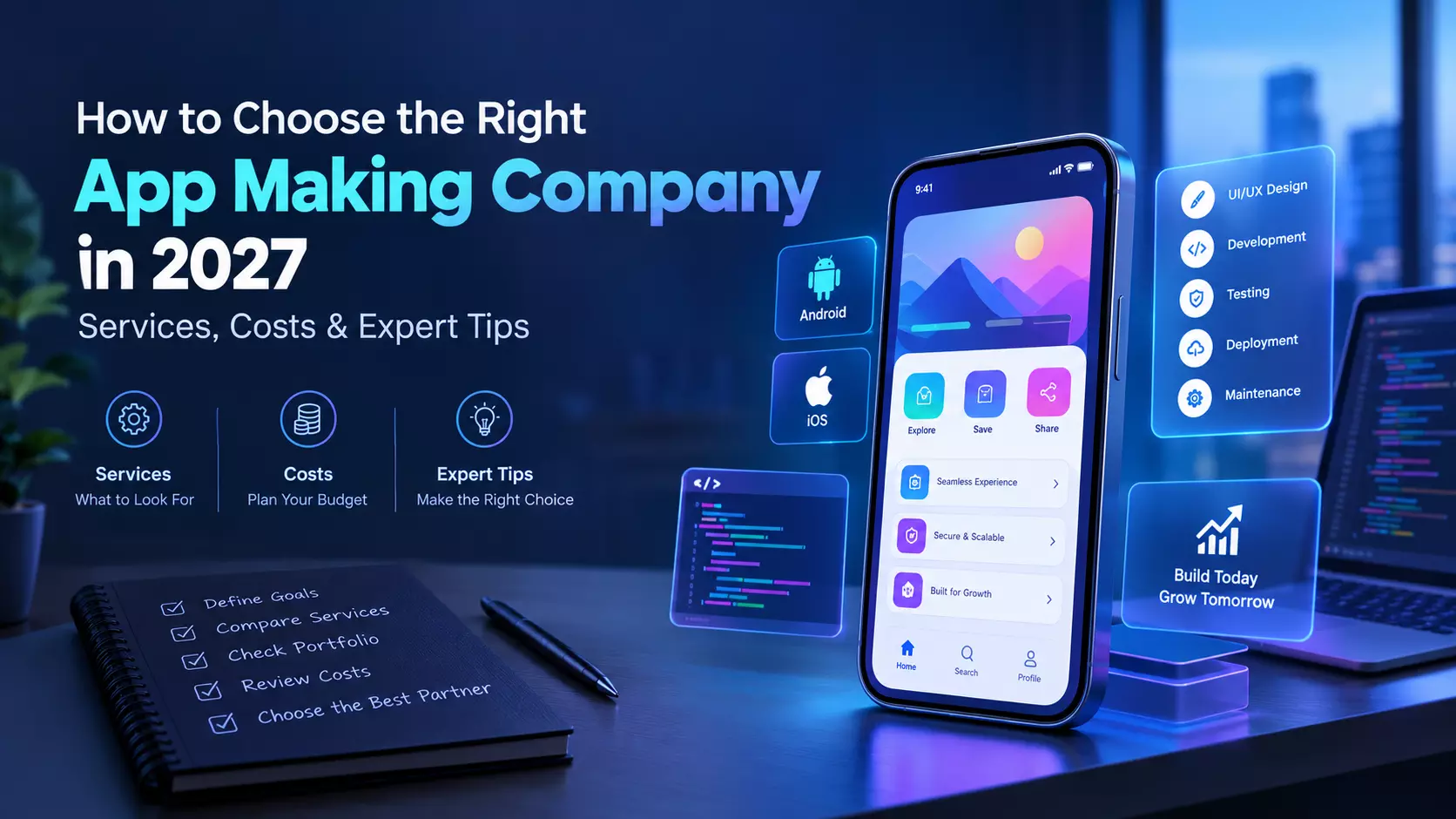
How to Choose the Right App Making Company in 2027: Services, Costs & Expert Tips
Choosing the right app development partner in 2027 is about more than finding developers who can build an application.
Businesses need a reliable technology partner who understands their goals, delivers a smooth user experience, protects sensitive data, and builds software that can scale as the business grows.
With AI-powered mobile apps features, cloud-native architecture, and cross-platform development becoming increasingly important, selecting the right development team can directly influence your product's success.
Whether you are launching a startup MVP, modernizing an existing application, or building an enterprise solution, the right partner can help you control costs and reduce development risks.
This guide explains how to evaluate an app development partner, compare services, understand development costs, and make a confident business decision.
1. Define Your App Requirements and Business Goals
Before approaching development companies, identify the problem your application will solve and the users it will serve. Clear requirements help you evaluate proposals accurately and avoid unnecessary development expenses.
Start by answering these questions:
- Who is your target audience?
- What business problem will the application solve?
- Do you need a customer-facing app, an internal business tool, or a marketplace?
- Which features are essential for the first release?
- Will the application require AI integration, payment gateways, APIs, or third-party systems?
- What are your budget, timeline, and long-term growth expectations?
For example, a startup validating a new product may need a minimum viable product (MVP) with essential features. An established business might require advanced analytics, enterprise integrations, stronger security, and support for thousands of users.
Defining these priorities helps you find a development partner that fits your actual needs rather than one that simply offers the lowest price.
2. Evaluate the Company's Technical Expertise and Services
Not every development company has the same capabilities. Look for a team with experience in your industry, target platforms, and application type.
A reliable app building company should offer more than coding. Ideally, its capabilities should cover the entire product lifecycle, including discovery, UI/UX design, development, testing, deployment, and ongoing maintenance.
Evaluate whether the company provides:
- Product discovery and consulting: Converts business requirements into a practical development roadmap.
- UI/UX design: Creates intuitive interfaces that improve usability and user retention.
- Mobile application development: Builds applications for Android, iOS, or both.
- Backend and API development: Connects the app with databases, business systems, and external services.
- AI and cloud integration: Adds intelligent features and supports scalable infrastructure when needed.
- Quality assurance: Tests functionality, performance, security, and compatibility.
- Maintenance and optimization: Addresses bugs, updates dependencies, and improves performance after launch.
Also, ask how the team evaluates new technologies. AI-powered features can create business value, but they should solve a genuine user problem rather than increase complexity without a measurable benefit.
3. Review the Portfolio, Case Studies, and Client Experience
A company's portfolio offers practical evidence of its development capabilities. However, reviewing screenshots alone is not enough.
Examine completed projects to understand how the team approaches real business challenges. Look for applications with similar functionality, user expectations, integrations, or technical complexity to your proposed product.
Ask potential partners:
- Have you developed an application similar to our idea?
- What challenges did you encounter, and how did you solve them?
- Can you demonstrate measurable business outcomes?
- How do you handle changing requirements and project delays?
- Can we speak with previous clients?
Look for evidence of improved operational efficiency, customer engagement, conversion rates, or product adoption. Where possible, verify these results through client references or documented case studies.
Client reviews and technical discussions can also reveal whether the company communicates clearly, manages expectations, and takes responsibility for project outcomes.
Read: Best Mobile App Development Companies in India to Watch
4. Understand the Cost to Develop a Mobile App in 2027
The cost to develop a mobile app depends on its features, design complexity, technology stack, integrations, security requirements, and development team's location and experience.
The following figures are illustrative planning estimates, not verified 2027 market averages.
App type
Estimated cost (USD)
Typical timeline
Basic app or MVP
15,000–40,000
2–4 months
Mid-complexity business app
40,000–100,000
3–6 months
Advanced app with integrations
100,000–200,000+
5–9 months
Enterprise-grade application
200,000–500,000+
8–15+ months
Actual costs can fall outside these ranges, particularly for regulated products, complex AI capabilities, or large-scale enterprise systems.
When comparing quotations, check what each proposal includes. A low initial price may exclude QA, deployment, documentation, infrastructure, or post-launch support.
Request an itemized estimate covering design, development, testing, third-party services, maintenance, and potential infrastructure costs. This gives you a more realistic picture of the total cost of ownership.
5. Choose the Right Platform: Android, iOS, or Both
Your target audience and business objectives should determine which platforms you prioritize.
Android app development may be the right starting point when your target users primarily use Android devices or your business needs to reach a broad range of device types and price segments.
iOS app development may be a priority if your audience primarily uses Apple devices or your product strategy depends on iOS-specific capabilities.
If you need to launch on both platforms, compare native development with cross-platform frameworks such as Flutter or React Native. Cross-platform development can reduce duplicated effort, although platform-specific features and performance requirements may still require additional work.
Ask your prospective partner to explain the trade-offs in cost, performance, maintenance, user experience, and future scalability before making a decision.
6. Check Communication, Project Management, and Scalability
Strong technical skills cannot compensate for poor project management. Your development partner should provide a clear process for tracking progress, resolving issues, and making decisions.
Before signing a contract, confirm:
- Who will manage the project and communicate with your team?
- How frequently will you receive updates and working builds?
- Which tools will be used for project tracking and collaboration?
- How will changes in scope affect costs and delivery dates?
- Who owns the source code, designs, documentation, and intellectual property?
- What security practices and confidentiality agreements are in place?
Also, assess whether the proposed architecture can accommodate future users, new features, and business integrations.
A scalable solution does not necessarily require complex enterprise architecture from day one. It requires sensible technical decisions that support the product's expected growth.
For startups, an experienced team that can validate an idea quickly and expand the product in stages may offer greater value than a large team building unnecessary features upfront.
7. Compare Engagement Models and Post-Launch Support
Different projects require different working arrangements. Common engagement models include fixed-price contracts, time-and-materials arrangements, and dedicated development teams.
- Fixed-price: Suitable when requirements, deliverables, and acceptance criteria are clearly defined.
- Time and materials: Useful when features and priorities may evolve during development.
- Dedicated team: Appropriate for long-term product development that requires ongoing collaboration and flexible capacity.
Businesses looking for app developers for startups should consider flexibility, transparent billing, and the ability to build an MVP before committing to a larger investment.
Post-launch support is equally important. Confirm whether the contract covers bug fixes, operating system updates, security patches, performance monitoring, and feature enhancements. Ask about response times and whether maintenance is included or charged separately.
The right engagement model should match your product's maturity, budget, and expected development workload.
Expert Tips for Choosing the Best App Development Partner
Use this checklist to make your final decision:
- Prioritize business understanding: Choose a team that asks about your customers, revenue model, and success metrics.
- Compare value, not just price: Evaluate technical quality, communication, security, and long-term maintenance alongside cost.
- Start with a clear scope: Define essential features, milestones, deliverables, and acceptance criteria.
- Verify ownership: Ensure your contract clearly defines intellectual property, source code access, and account ownership.
- Plan for growth: Select an architecture that supports realistic future requirements without unnecessary complexity.
- Validate before scaling: Launch a focused MVP, gather user feedback, and prioritize improvements using real usage data.
A structured evaluation process helps you avoid common mistakes, such as selecting a vendor solely because of a low quote or committing to a lengthy contract before validating the team's capabilities.
Final Thoughts
Choosing the right app development partner in 2027 requires a balance of technical expertise, business understanding, transparent pricing, and long-term support.
The best partner will help you validate your idea, prioritize features, manage risks, and build an application that delivers measurable value.
Look beyond the initial development quote. Consider the quality of the team's work, its communication process, its approach to security, and its ability to support your product after launch.
At Albiorix Technology, businesses can explore tailored mobile and software development solutions aligned with their product goals, user needs, and growth plans.
Start with a clear understanding of your requirements, compare qualified teams, and choose a partner that can turn your application idea into a sustainable digital product.