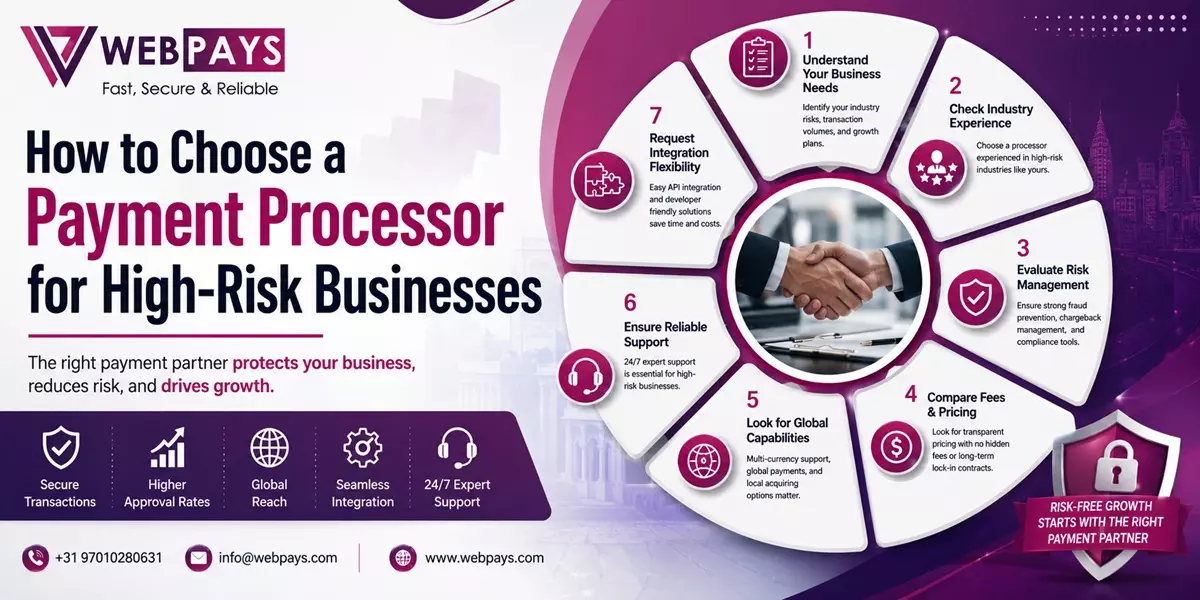
How to Choose a Payment Processor for High-Risk Businesses
Choosing a payment processor based solely on a shiny website and a “Get Started” button is a little like choosing a car because you like the cup holders.
The details matter.
For high-risk businesses, the payment processor can directly influence revenue, cash flow, customer experience, compliance, and operational continuity.
Whether you operate gaming, casino, betting, gambling, forex trading, crypto, CBD, peptides, adult services, or another specialized business, selecting payment infrastructure requires careful evaluation.
Start With the Merchant Account
Before comparing gateway features, understand the merchant account structure.
Ask:
- Who is the acquiring bank?
- Which country is the acquiring relationship based in?
- What industries are supported?
- What transaction volume is permitted?
- Is a reserve required?
- How often are funds settled?
A beautiful gateway cannot compensate for an unsuitable acquiring relationship.
Evaluate the Payment Gateway
The gateway should match your technical and commercial requirements.
Look for:
- API support
- Hosted checkout
- Payment links
- Tokenization
- 3DS
- Recurring billing
- Fraud controls
- Refunds
- Reporting
- Webhooks
- Alternative payment methods
The right technology depends on how your customers actually pay.
Understand Pricing
Payment costs may include:
- Transaction fees
- Gateway fees
- Monthly fees
- Chargeback fees
- Refund fees
- Currency-conversion costs
- Cross-border fees
- Reserve requirements
- Setup or onboarding charges
Do not compare providers using only the percentage shown in a sales email.
Calculate the complete cost.
Authorization Rate Matters
- Suppose Processor A charges 2.9% but approves 80% of legitimate transactions.
- Processor B charges 3.5% but approves 94%.
- Which is cheaper?
- It depends on the economics of your business.
- A slightly higher processing rate can sometimes produce better overall revenue if the system successfully processes more legitimate customers.
- That is why merchants should monitor:
- Net revenue after payment costs and failed transactions.
Read:What Makes a Payment Processor the Best? Key Factors to
Chargeback Management
Ask how the provider handles disputes.
Questions include:
- Are chargeback alerts available?
- Is evidence management supported?
- Are fraud tools included?
- What thresholds trigger reviews?
- What happens after a dispute spike?
A provider should explain these policies before onboarding.
Not after your account has a problem.
Settlement and Reserves
Cash flow is crucial.
Understand:
- Settlement frequency
- Settlement currency
- Reserve percentage
- Reserve duration
- Release terms
- Refund treatment
- Chargeback deductions
For high-volume businesses, a settlement delay can have a major operational impact.
International Payment Gateway Capabilities
If your business serves global customers, evaluate:
- Country coverage
- Local acquiring
- Currency support
- Local payment methods
- Cross-border fees
- Geographic restrictions
International processing should be designed around actual customer markets.
Industry Experience
A provider may say it supports high-risk merchants.
Ask what that means.
Does it support:
- Gaming?
- Casino?
- Betting?
- Gambling?
- Forex?
- Crypto?
- CBD?
- Peptides?
- Adult?
- Subscription businesses?
The distinction matters.
High-risk is not one single industry.
Each vertical has different risk characteristics.
Brand Snapshot
WebPays positions itself as a high-risk and international payment provider with publicly listed coverage spanning forex, gaming, casino, gambling, crypto, adult businesses, and other high-risk sectors.
PAYCLY presents international payment infrastructure with merchant accounts, high-risk payment processing, multi-currency capabilities, credit cards, alternative payment methods, and reporting tools.
Inquid focuses on high-risk merchant accounts and global payment infrastructure, publishing solutions for forex, gaming, crypto, nutraceuticals, e-commerce, subscriptions, and other specialized sectors.
BoxChrge describes itself as global payment infrastructure covering merchant services, cross-border payments, payment orchestration, intelligent routing, alternative payment methods, tokenization, 3DS, and fraud prevention.
Amald offers merchant accounts, high-risk payment gateways, international payment processing, credit-card processing, multi-currency solutions, alternative payment methods, and chargeback-related services, with published coverage across several high-risk industries.
These descriptions are based on the providers' publicly available materials. Merchants should independently verify current pricing, licensing, acquiring relationships, supported industries, and contractual terms before making a decision.
Red Flags to Watch
Be cautious when a provider:
- Guarantees approval without reviewing the business
- Promises zero chargebacks
- Refuses to explain reserves
- Avoids discussing acquiring partners
- Provides vague pricing
- Cannot explain settlement
- Asks merchants to misrepresent their business
- Cannot explain compliance requirements
- Offers terms that seem dramatically different from market conditions without explanation
High-risk processing is inherently more complex.
If someone makes it sound suspiciously effortless, ask more questions.
Create a Payment Backup Plan
High-risk businesses should consider contingency planning.
That can involve:
- Secondary acquiring relationships
- Alternative payment methods
- Backup gateway infrastructure
- Multiple settlement channels where appropriate
- Internal monitoring
- Chargeback alerts
A backup plan is not pessimism.
It is business continuity.
Build a Payment KPI Dashboard
Monitor:
Approval rate
Percentage of transactions successfully authorized.
Decline rate
Percentage of transactions rejected.
Chargeback rate
Percentage of transactions disputed.
Refund rate
Percentage of transactions returned.
Average ticket
Average transaction value.
Settlement time
Time between transaction and available funds.
Fraud rate
Percentage of transactions identified as suspicious or fraudulent.
These metrics provide a clearer picture than revenue alone.
Final Thoughts
The best payment processor for one business may be completely unsuitable for another.
A forex broker, online casino, CBD store, crypto company, and adult subscription platform can all have dramatically different payment requirements.
Instead of searching for a generic “best payment processor,” evaluate:
- Merchant-account compatibility
- Gateway technology
- Industry support
- International coverage
- Payment methods
- Fraud controls
- Chargeback management
- Pricing
- Settlement
- Reserves
- Compliance
- Support
- Scalability
That approach creates a payment strategy based on business reality rather than marketing slogans.
And in high-risk payments, reality tends to send the invoice eventually.
FAQs
1. What is the best payment processor for a high-risk business?
There is no universal answer. The right provider depends on industry, jurisdiction, transaction profile, payment methods, compliance requirements, pricing, and settlement terms.
2. What should I compare besides processing rates?
Compare approval rates, chargebacks, reserves, settlement timing, gateway features, international coverage, fraud controls, and support.
3. Why is a high-risk merchant account important?
It provides the acquiring structure needed by businesses whose risk profile may not fit conventional processing programs.
4. Should international businesses consider multiple processors?
Depending on their scale and risk profile, multiple acquiring or payment relationships can provide additional resilience.
5. How do I avoid payment-account problems after approval?
Keep business information accurate, maintain compliance documentation, monitor chargebacks, control fraud, communicate major business changes, and follow the processor's agreed transaction parameters.