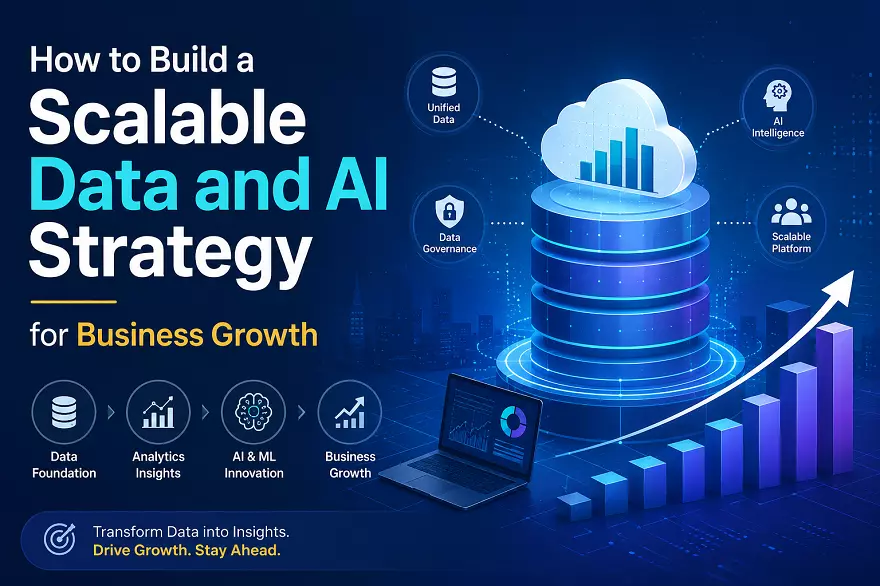
How to Build a Scalable Data and AI Strategy for Business Growth
In today’s digital-first economy, data has become one of the most valuable business assets. Organizations across the United States are investing heavily in analytics, artificial intelligence (AI), and cloud technologies to gain a competitive advantage.
However, many businesses struggle to turn their growing volumes of data into actionable insights because they lack a clear and scalable strategy.
A successful data and AI strategy is not just about implementing the latest technologies. It requires the right infrastructure, governance framework, skilled resources, and a long-term vision that aligns with business objectives. By building a scalable foundation, companies can unlock innovation, improve operational efficiency, and drive sustainable growth.
Why a Scalable Data and AI Strategy Matters
As organizations grow, the amount of data they generate increases exponentially. Customer interactions, sales transactions, marketing campaigns, IoT devices, and business applications continuously produce valuable information. Without a scalable approach, businesses often face challenges such as:
- Data silos across departments
- Slow decision-making processes
- Inconsistent reporting
- Limited visibility into business performance
- Difficulty deploying AI and machine learning initiatives
A well-designed strategy helps organizations centralize data, improve accessibility, and create an environment where analytics and AI can thrive. This enables leaders to make informed decisions based on real-time insights rather than assumptions.
Start with Clear Business Objectives
The most successful data initiatives begin with business goals rather than technology.
Before investing in platforms or AI tools, organizations should identify key objectives such as:
- Increasing revenue growth
- Improving customer experiences
- Optimizing operational efficiency
- Reducing costs
- Enhancing forecasting accuracy
- Accelerating product innovation
When business objectives drive technology decisions, organizations can prioritize high-impact use cases and maximize return on investment.
For example, a retail company may focus on customer personalization, while a healthcare provider may prioritize predictive analytics for patient outcomes.
Build a Modern Data Foundation
A scalable strategy requires a strong and flexible data infrastructure.
Traditional data warehouses often struggle to handle the volume, variety, and velocity of modern business data. Organizations are increasingly adopting cloud-based data platforms that support analytics, machine learning, and data engineering from a single environment.
Modern platforms provide:
- Centralized data storage
- Real-time data processing
- Improved scalability
- Enhanced security and governance
- Support for AI and machine learning workloads
This foundation enables teams across the organization to access reliable data and collaborate more effectively.
Break Down Data Silos
One of the biggest obstacles to business growth is fragmented data.
When departments operate independently, valuable insights remain trapped in separate systems. Sales, marketing, finance, customer service, and operations often maintain their own databases, creating inconsistencies and limiting visibility.
A scalable strategy should focus on creating a unified data ecosystem where information flows seamlessly across the organization.
Benefits of eliminating data silos include:
- Better cross-functional collaboration
- Improved reporting accuracy
- Faster decision-making
- Enhanced customer experiences
- Greater operational transparency
Organizations that create a single source of truth are better positioned to leverage analytics and AI effectively.
Establish Strong Data Governance
Data quality directly impacts the success of analytics and AI initiatives.
Poor-quality data can lead to inaccurate insights, flawed predictions, and compliance risks. That's why governance should be a core component of every data strategy.
Effective data governance includes:
- Data quality management
- Access controls and security policies
- Compliance monitoring
- Metadata management
- Data ownership and accountability
By implementing governance frameworks early, organizations can ensure their data remains accurate, secure, and trustworthy as they scale.
Leverage AI for Business Value
Artificial intelligence offers significant opportunities for organizations looking to improve performance and drive innovation.
However, many companies rush into AI projects without establishing the necessary data foundation. Successful AI adoption requires clean, accessible, and well-governed data.
Businesses can leverage AI for:
- Predictive analytics
- Customer segmentation
- Fraud detection
- Demand forecasting
- Process automation
- Intelligent recommendations
- Risk management
Instead of pursuing AI for the sake of innovation, organizations should focus on use cases that solve real business challenges and deliver measurable outcomes.
Invest in Data Engineering and Analytics
Data is only valuable when it can be transformed into meaningful insights.
Modern organizations require robust data engineering processes to collect, clean, integrate, and prepare information for analytics and AI applications.
Data engineering teams help organizations:
- Automate data pipelines
- Improve data reliability
- Enable real-time reporting
- Support machine learning initiatives
- Reduce manual processing
Combined with advanced analytics capabilities, businesses can gain deeper visibility into customer behavior, operational performance, and market trends.
Read: Top Ai Automation Company in 2026
Choose the Right Technology Partner
Building a scalable data and AI ecosystem requires specialized expertise.
Many organizations partner with experienced providers offering Databricks Consulting Services to accelerate implementation, optimize architecture, and reduce project risks. These experts help businesses design modern data platforms, implement cloud-native solutions, and develop AI strategies aligned with business goals.
Professional Databricks Consulting Services can support:
- Data platform modernization
- Lakehouse architecture implementation
- Data engineering optimization
- Machine learning deployment
- Advanced analytics initiatives
- Data governance and security
- Performance optimization
Working with experienced consultants enables organizations to avoid common pitfalls and achieve faster time-to-value from their data investments.
Foster a Data-Driven Culture
Technology alone cannot create business transformation.
Organizations must empower employees to use data in their daily decision-making processes. A data-driven culture encourages teams to rely on insights rather than intuition when evaluating opportunities and solving problems.
Key steps include:
- Providing analytics training
- Promoting data literacy
- Encouraging collaboration across departments
- Making insights easily accessible
- Aligning performance metrics with data-driven goals
When employees understand how to leverage data effectively, organizations can unlock greater innovation and business value.
Measure and Continuously Improve
A scalable strategy should evolve alongside business needs.
Organizations should establish key performance indicators (KPIs) to measure the success of their data and AI initiatives. These metrics may include:
- Revenue growth
- Customer retention rates
- Operational efficiency improvements
- Cost reductions
- AI adoption rates
- Data quality scores
Regular reviews help identify opportunities for optimization and ensure technology investments continue delivering measurable results.
Conclusion
Building a scalable data and AI strategy is essential for organizations seeking long-term growth in an increasingly competitive marketplace.
By aligning technology investments with business objectives, modernizing data infrastructure, implementing strong governance practices, and fostering a data-driven culture, companies can unlock the full potential of their data assets.
As businesses continue to embrace analytics, machine learning, and cloud technologies, partnering with experts in Databricks Consulting Services can help accelerate transformation and maximize return on investment. With the right strategy in place, organizations can turn data into a powerful engine for innovation, efficiency, and sustainable business growth.