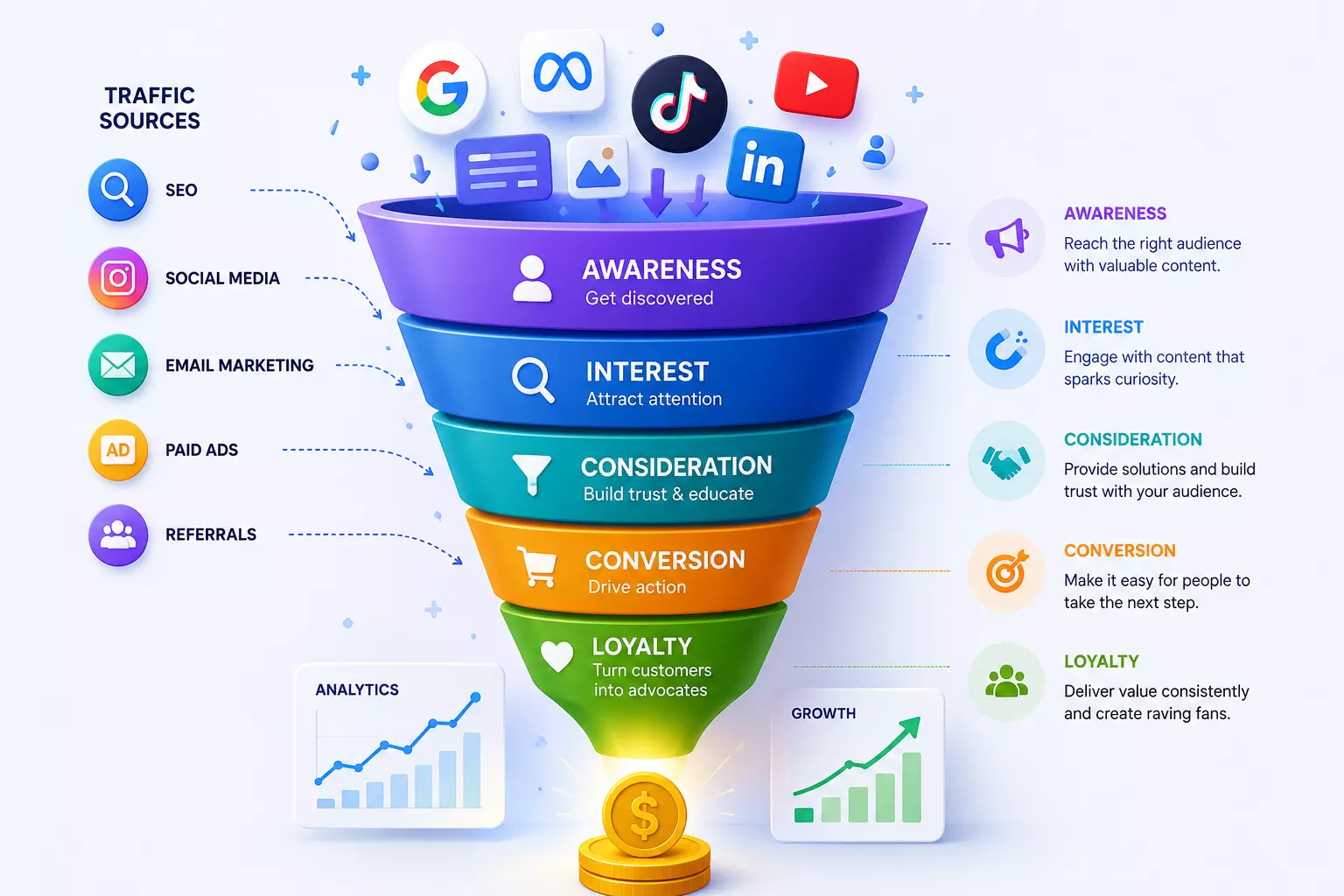
How to Build a Digital Marketing Funnel That Converts in 2026
A marketing funnel that converts in 2026 looks less like a straight line and more like a loop, because buyers research across search, social, and AI assistants before they ever fill in a form.
This article breaks down how to move a stranger to a paying customer without wasting budget on the wrong stage. It is written for business owners and marketers who run their own campaigns or manage an agency and want to know where their money actually works.
The sections below cover each funnel stage, the channels that fit it, and the mistake that quietly drains most marketing budgets.
What a marketing funnel actually is
A marketing funnel is the path a person takes from first hearing about a business to becoming a customer, usually split into awareness, consideration, and decision stages. The word “funnel” is slightly misleading, because real buyer journeys loop back on themselves.
Someone discovers you on social media, forgets about you, searches your name three weeks later, then converts. The point of mapping a funnel is not to force people through a rigid sequence; it is to make sure you have the right message ready at each stage they might be in.
Top of funnel: earning attention without buying all of it
The top of the funnel is about being found by people who do not yet know they need you, and the cheapest version of that is organic. SEO content, short-form video, and helpful social posts reach people who are researching a problem rather than a brand.
Paid ads work here too, but relying only on paid attention means your pipeline stops the moment you stop spending. A healthy top of funnel mixes a few owned channels so that one platform’s algorithm change does not erase your reach overnight.
Read: Top 10 Digital Marketing Agencies in India (2026)
Middle of funnel: the stage most businesses skip
The middle of the funnel is where you turn awareness into trust, and it is the stage most businesses ignore entirely. Someone who found your blog post is not ready to buy, but they are ready to be convinced.
Case studies, comparison pages, email sequences, and retargeting all live here, doing the slow work of moving a curious visitor toward a decision. Skip this stage and you are asking strangers to buy on first contact, which is why so many campaigns post strong traffic numbers and weak sales.
Bottom of funnel: turning intent into revenue
The bottom of the funnel is for people who have already decided to act and just need a reason to choose you. Pricing pages, free audits, demos, clear calls to action, and reviews carry the most weight here.
The first organic result on Google earns roughly 27% of clicks according to Backlinko’s click-through research, so ranking for high-intent terms like “best [service] near me” puts you in front of buyers at the exact moment they are ready. Retargeting and reputation signals then close the gap between intent and purchase.
How the channels work together
No single channel runs a funnel on its own, which is the real argument for an integrated approach. SEO fills the top with people who are searching, social keeps you visible through the long middle, email and retargeting carry the consideration stage, and paid search captures the bottom when intent is highest.
Agencies that provide data-driven digital marketing services earn their fee by connecting these channels so the data from one improves the others, rather than running each as a separate campaign. When the channels share data and goals, the same budget produces noticeably more revenue.
Build the funnel around your buyer’s real behaviour, not a textbook diagram. Map where your customers actually spend time, make sure you have something useful waiting at each stage, and measure the journey end to end instead of judging channels in isolation.
The businesses that grow are rarely the ones with the biggest ad budgets. They are the ones whose funnel has no obvious gap for a ready buyer to fall through.