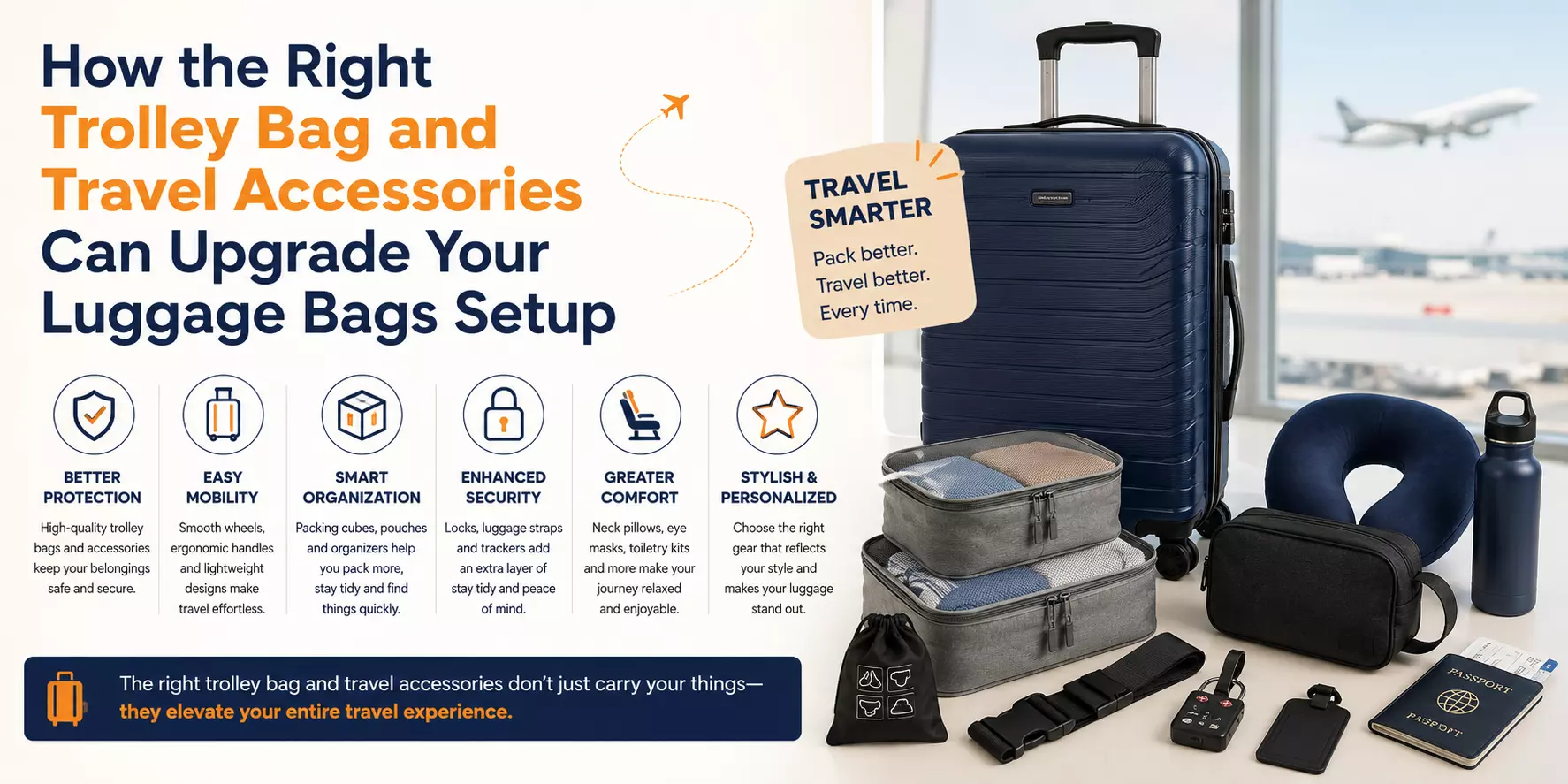
How the Right Trolley Bag and Travel Accessories Can Upgrade Your Luggage Bags Setup
Most people don't think about their luggage until something goes wrong. A zipper breaks mid-trip. A bag gets too heavy to lift into the overhead bin. A boarding pass disappears somewhere inside a chaotic carry-on. It's only then that you realise your setup needs a proper rethink.
Good luggage bags aren't about owning the most expensive things. They're about having the right combination — a trolley bag that actually suits how you travel, paired with a few practical travel accessories that keep everything working the way it should.
The Trolley Bag Is the Anchor of Everything
If you're a frequent traveller, your trolley bag is probably the one piece of gear you rely on more than anything else. It carries the most, it's with you the longest, and it takes the most abuse — being tossed onto luggage belts, dragged across cobblestones, and shoved into tight storage spaces.
What people often don't pay enough attention to is wheel quality. Four spinner wheels feel smooth in an airport, but if you're doing uneven terrain — an old railway station, a bumpy pavement in a hill town — they can wobble and wear out faster than you'd expect.
Two-wheel inline trolleys are less convenient in smooth spaces but hold up better over time in mixed conditions. It's worth asking which kind of travel you actually do before choosing.
The other thing that gets overlooked is interior structure. A lot of trolley bags look fine from the outside but are completely flat inside — no pockets, no dividers, no way to organise anything.
In practice, this means your clothes, chargers, and toiletries end up in one giant pile that you dig through at every stop. A bag with even basic interior organisation — a flat divider, a few mesh pockets — saves a surprising amount of time and frustration.
Hard-shell versus soft-shell is a question people argue about forever. Hard-shell bags offer better crush protection and are easier to wipe clean. Soft-shell ones flex a bit, which helps when you've slightly overpacked, and often have external pockets for things you need to access quickly. Neither is wrong. It depends on your priorities.
The Stuff Inside the Bag Matters Too
Once you've sorted the trolley bag itself, the next layer is what goes inside it — and this is where travel accessories quietly do a lot of work.
Packing cubes are probably the most genuinely useful thing most travellers skip. They're not glamorous, but they turn a disorganised bag into one where you actually know where things are. A separate cube for tops, one for bottoms, one for cables and chargers. You pull out exactly what you need without unpacking everything else. People who start using them rarely go back.
Compression bags are different — they're for when you're genuinely trying to reduce bulk. They work well for bulkier items like jackets or knitwear. The trade-off is that you have to repack them each time, and that's not always convenient on a short trip.
A small toiletry bag that can hang — the kind with a hook that opens up flat — is genuinely useful if you're moving between hotels. You don't need to unpack it or lay it on a wet counter. It just hangs on the back of a door. Simple, but it makes a real difference.
Read: Top 10 Suppliers of Custom Duffle Bags Wholesale in 2025
The Document Side of Travel Is Underrated
Here's something that doesn't get mentioned often enough: how you handle your travel documents affects how calm or stressed you feel at every checkpoint.
A good passport holder does more than just hold a passport. The better ones have slots for a boarding pass, a few cards, a SIM card, a hotel booking printout. You keep everything together in one place and hand it over at security without hunting through your bag.
What surprises many first-time international travellers is how disorganised this part of their setup is until something goes wrong — a missed boarding pass at the gate, a lost hotel address, a SIM card that went through the wash. A proper passport holder solves a lot of that.
Slim ones that fit into a jacket pocket or the front pocket of your trolley bag are ideal. You don't want something bulky. You want something that's always in the same place so you don't have to think about it.
A Luggage Tag That's Actually Readable
This sounds minor. It isn't. Airlines lose bags regularly, and when they do, the first thing they check is the tag. If yours has faded, has no contact information, or fell off somewhere between check-in and the carousel, you're relying entirely on the bag's internal label — which most people never bother filling out.
A sturdy luggage tag, attached properly, with current contact information, is a five-minute job that can save you days of hassle. Leather ones tend to last longer and stay readable. The plastic sleeves on cheap tags crack, the paper inside fades, and suddenly your ₹15,000 trolley bag is anonymous on a conveyor belt in some other city.
Building a Setup That Actually Works for You
The best luggage bags setup isn't the one from a travel influencer's flat-lay. It's the one that's dialled in for how you specifically travel — how often, how long, and for what kind of trip.
Someone doing back-to-back business trips needs a different configuration than someone going on a two-week family holiday.
A cabin bag that fits into the overhead bin every time is worth more than a large trolley bag you always have to check. A compact set of packing cubes beats a jumble of carrier bags stuffed inside a suitcase.
The goal is a setup where you're not thinking about your bags mid-trip. You just travel.