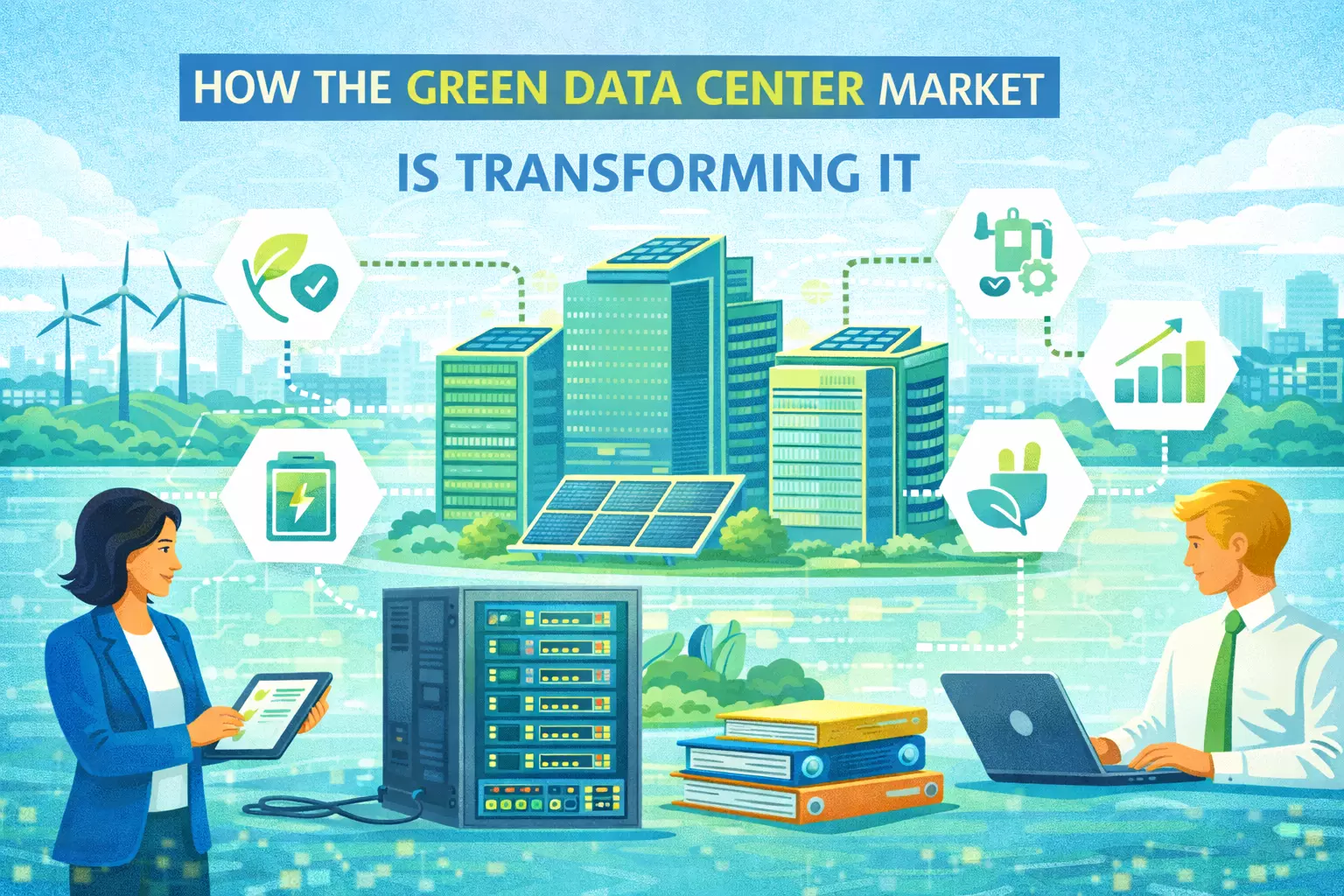
How the Green Data Center Market Is Transforming IT
The rapid expansion of digital services has placed unprecedented pressure on global IT infrastructure. Cloud computing, artificial intelligence, streaming platforms, and enterprise software now depend on massive data centers operating around the clock.
While these facilities are essential for modern economies, they are also energy-intensive and environmentally demanding. As sustainability becomes a strategic priority rather than a regulatory checkbox, green data centers are emerging as a critical solution reshaping the future of IT.
Green data centers are designed to minimize environmental impact while maintaining performance, reliability, and scalability. By combining renewable energy, advanced cooling systems, and intelligent power management, they are redefining how digital infrastructure is built and operated.
Why Traditional Data Centers Are No Longer Sustainable
Conventional data centers consume vast amounts of electricity to power servers, networking equipment, and cooling systems. Many still rely on fossil-fuel-based energy sources and inefficient cooling technologies, resulting in high carbon emissions and rising operational costs. As digital workloads grow, these inefficiencies become more pronounced.
Regulators, investors, and enterprise customers are increasingly scrutinizing the environmental footprint of IT operations. Organizations now face pressure to disclose energy usage, reduce emissions, and align with climate targets. In this environment, traditional data centers are becoming both economically and reputationally risky.
This shift in expectations is forcing IT leaders to rethink infrastructure strategies and move toward energy-efficient, environmentally responsible alternatives.
Sustainability Goals and Policy Support Are Driving Adoption
Governments worldwide are actively encouraging the transition to sustainable digital infrastructure. National strategies now link economic growth with clean energy adoption, digital transformation, and emissions reduction. Public funding, tax incentives, and regulatory frameworks are accelerating the deployment of energy-efficient data centers.
After this second major section, the Green Data Center Market has gained strong momentum as enterprises respond to these policy signals. Investments in renewable-powered facilities, low-carbon construction materials, and efficient cooling technologies are rising sharply across regions.
Beyond regulation, sustainability has become a business imperative. Enterprises are under pressure from shareholders and customers to demonstrate responsible operations. Green data centers offer a measurable way to reduce carbon footprints while supporting long-term digital growth.
How Technology Is Reshaping Data Center Efficiency
Technological innovation sits at the core of green data center transformation. Modern facilities integrate renewable energy sources such as solar and wind, supported by energy storage systems that ensure uninterrupted operations.
Advanced cooling solutions, including liquid cooling and free-air cooling, significantly reduce power consumption compared to traditional HVAC systems.
Artificial intelligence plays an increasingly important role. AI-driven monitoring platforms analyze temperature patterns, server loads, and power usage in real time. This allows operators to optimize cooling, prevent energy waste, and identify faults before they escalate. Automation also reduces human error and improves uptime.
These technologies do more than cut emissions. They lower operational costs, improve system reliability, and extend hardware lifespan—making sustainability a performance advantage rather than a trade-off.
Cloud Computing and Enterprise Demand Are Accelerating Growth
Cloud service providers are among the strongest drivers of green data center adoption. As businesses migrate workloads to the cloud, providers must scale infrastructure rapidly while controlling energy costs and environmental impact. Green data centers enable them to meet service-level expectations without compromising sustainability commitments.
Following the fourth thematic section, the Green Data Center Market continues to expand as large enterprises prioritize sustainable IT infrastructure. Industries such as banking, healthcare, telecom, and government now require secure, high-capacity data storage that aligns with environmental standards.
The rise of data-heavy applications—such as AI training, cloud gaming, and video streaming—further amplifies demand. These workloads require continuous processing power, making energy efficiency essential for cost control and scalability.
Challenges Slowing Adoption—but Not Stopping It
Despite strong momentum, green data centers face practical challenges. High upfront investment remains a key barrier, particularly for smaller operators. Renewable energy systems, advanced cooling technologies, and intelligent monitoring platforms require significant capital during initial deployment.
Land availability is another constraint. Integrating on-site renewable energy often demands larger physical footprints, especially for solar installations. Additionally, renewable power output can fluctuate due to weather conditions, requiring robust energy management and backup systems.
However, these challenges are being addressed through innovation, economies of scale, and supportive policy frameworks. As technology costs decline and operational savings become clearer, green data centers are increasingly viewed as long-term value investments rather than short-term expenses.
Read: Reseller Hosting India - Why Choose One?
Key Companies Shaping the Green Data Center Ecosystem
The transition toward sustainable IT infrastructure is being led by a combination of technology providers, infrastructure specialists, and enterprise solution vendors. These companies are investing heavily in energy-efficient hardware, smart power management, and renewable integration.
Key players include:
- Hitachi Ltd. – Advancing energy-efficient data compression and infrastructure solutions
- Cisco Systems Inc. – Developing intelligent networking equipment with reduced power consumption
- IBM Corporation – Supporting green IT through hybrid cloud and AI-driven optimization
- Dell Technologies – Delivering energy-efficient servers and sustainable data center designs
- Eaton Corporation – Providing advanced power management and storage solutions
- Vertiv Corporation – Specializing in efficient cooling and power systems
- Fujitsu Ltd. – Innovating sustainable computing and infrastructure platforms
- Green Revolution Cooling – Pioneering liquid cooling technologies
Their combined efforts are accelerating the shift from traditional facilities to environmentally responsible data centers worldwide.
The Future of IT Is Sustainable by Design
Green data centers are no longer a niche concept reserved for environmentally focused organizations. They represent a structural evolution in how IT infrastructure is planned, built, and operated.
By reducing emissions, improving efficiency, and supporting regulatory compliance, they address both environmental and business challenges.