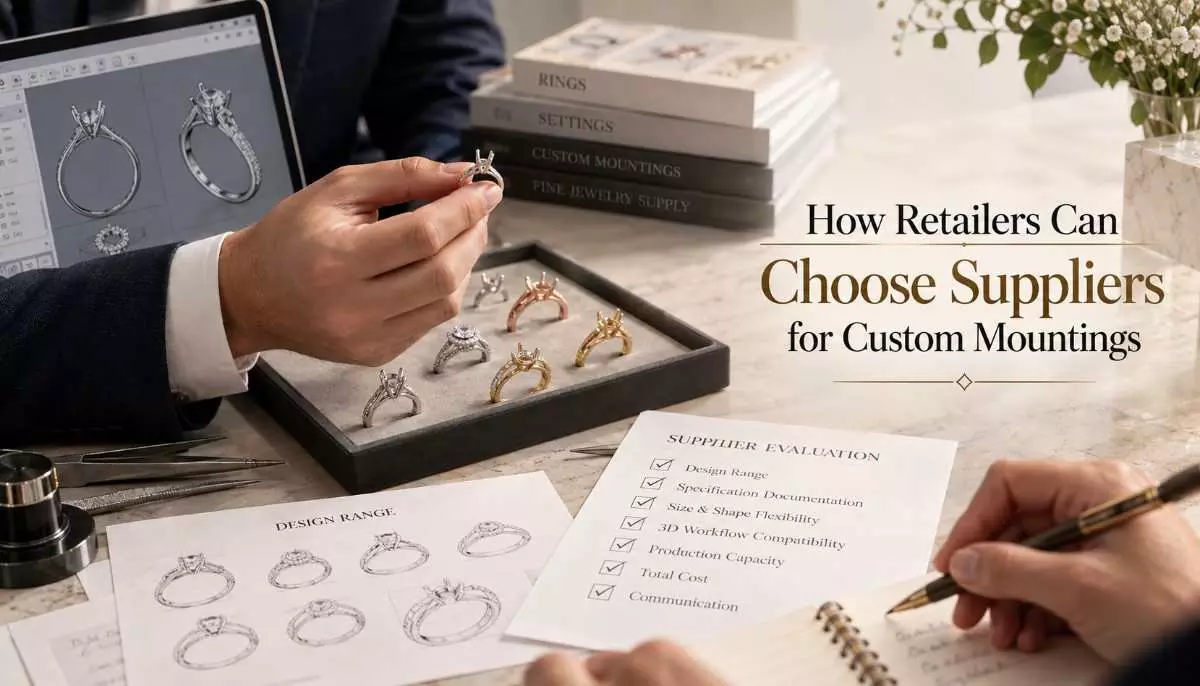
How Retailers Can Choose Suppliers for Custom Mountings
Choosing a mounting supplier is a decision that quietly shapes nearly every other part of a custom jewellery business, production timelines, customer approval experience, inventory flexibility, and ultimately profit margin on every custom order that moves through the relationship.
Yet a lot of retailers still choose suppliers primarily on price or a single sample piece, without evaluating the broader factors that actually determine whether a partnership will hold up across hundreds of real orders over time.
This guide walks through the practical criteria that actually matter when selecting a mounting supplier, beyond simply comparing catalogs and price lists side by side.
Start With Design Range, Not Just Design Quality
Individual piece quality matters, but it's only part of the picture. A supplier's overall design range determines how well they can serve the actual variety of requests your customer base generates, across stone shapes, setting styles, and metal preferences.
Evaluate whether a potential supplier offers genuine coverage across the shapes and styles your customers request most often, rather than a narrow specialization that leaves you sourcing separately from multiple suppliers to fill gaps.
A supplier with a strong range in the specific categories your business needs most is generally more valuable than one with excellent but narrow specialization outside your core demand.
Assess Specification Documentation and Consistency
A supplier's willingness and ability to provide clear, consistent specifications, prong tolerances, metal weight ranges, stone accommodation sizing, directly affects how smoothly their mountings integrate into your broader production process, particularly if you're coordinating stone setting separately.
Request detailed specification documentation before committing to a supplier relationship and evaluate whether that documentation is genuinely precise enough for your production team to work from reliably,
or whether it leaves meaningful gaps that will require back-and-forth clarification on every order.
Suppliers who treat documentation as a core part of their offering, not an afterthought, tend to create considerably fewer downstream production issues.
Evaluate Flexibility for Stone Size and Shape Variation
Since custom orders inherently involve variation, a supplier's ability to accommodate a reasonable range of stone sizes and, where structurally appropriate,
multiple compatible shapes within a given mounting design meaningfully affect your inventory efficiency and your ability to serve diverse customer requests without constant custom redesign.
MeruliyaJewels builds this kind of flexibility directly into its mounting catalog, offering designs engineered to accommodate genuine size and shape variation rather than narrow, single-specification pieces.
When evaluating any supplier, ask directly how much size tolerance a given mounting design supports, and whether that flexibility is documented clearly or simply assumed.
Read: Best Anti Tarnish Jewellery Gift Ideas Under Budget (Complete
Confirm Support for Modern Design and Approval Workflows
A supplier whose systems and specifications integrate smoothly with 3D modelling and digital approval processes saves considerable time and reduces miscommunication compared to one requiring manual translation between their specifications and your customer-facing design tools.
Ask potential suppliers directly whether their mounting specifications are available in formats compatible with your 3D rendering and approval workflow,
since a mismatch here creates exactly the kind of reconciliation friction that undermines the efficiency modern design tools are meant to provide in the first place.
Assess Production Capacity and Realistic Lead Times
A supplier's stated capacity and lead times matter less than their actual, consistent track record of meeting them, particularly during higher-demand periods when many retailers are placing orders simultaneously.
Ask for realistic, honest lead time expectations, including how those timelines shift during seasonal demand spikes, rather than accepting only best-case figures.
It's worth requesting references or reviewing a supplier's track record with businesses of a similar size and order volume to your own, since a supplier well-suited to very small custom operations may not scale reliably to a higher-volume business, and the reverse is true as well.
Weigh Price Against Total Cost, Not Just Unit Cost
The lowest per-unit mounting price doesn't necessarily represent the lowest total cost once downstream factors, rework from unclear specifications, delays from inconsistent lead times, or limited flexibility driving excess inventory, are factored in honestly.
Calculate total cost of a supplier relationship holistically: unit price, plus estimated rework and delay costs based on the supplier's documentation and track record, plus inventory efficiency gained or lost through their design flexibility.
A modestly higher unit price from a supplier offering strong documentation, flexibility, and reliable lead times frequently produces a better overall margin than the cheapest available option once these factors are accounted for honestly.
Evaluate Communication and Coordination Practices Directly
Beyond the product itself, assess how a potential supplier actually communicates during the evaluation process, since this is a reasonably reliable preview of how they'll communicate once you're a committed customer working through real production issues.
A supplier who provides clear, complete answers to specification questions during initial evaluation, without requiring repeated follow-up to get complete information, generally reflects the same coordination quality you'll experience in ongoing production.
A supplier who finds it difficult to get clear answers from during a sales conversation rarely improves once the relationship moves into regular order fulfillment.
A Practical Supplier Evaluation Checklist
- Review design range against your actual customer demand patterns, not just overall catalog size.
- Request and assess specification of documentation for clarity and completeness before committing an order.
- Confirm size and shape of flexibility within individual mounting designs, and how that flexibility is documented.
- Verify compatibility with your 3D modelling and approval workflow, avoiding suppliers who require manual reconciliation.
- Ask for realistic lead times, including performance during seasonal demand spikes, not just best-case figures.
- Calculate total cost, not just unit price, incorporating rework, delay, and inventory efficiency factors.
- Evaluate communication quality directly during the evaluation process as a preview of the ongoing relationship.
Why This Decision Deserves More Scrutiny Than It Typically Gets
Given how directly mounting supplier choice affects production timelines, customer approval experience, inventory efficiency, and ultimately margin,
treating this decision with the same rigor applied to other major business decisions, rather than defaulting to whichever supplier offers the lowest quoted price, tends to produce meaningfully better outcomes across every custom order that follows.
Businesses seeking a partner built around genuine flexibility, clear documentation, and modern workflow compatibility can explore mounting collections designed specifically around these evaluation priorities,
rather than treating them as separate considerations layered on top of a standard catalog.
The Bottom Line
Choosing a mounting supplier well means looking meaningfully beyond price and individual sample quality, toward design range relevant to actual demand,
clear specification documentation, genuine size and shape flexibility, compatibility with modern design workflows, realistic lead times, and total cost calculated honestly rather than narrowly.
Retailers who apply this level of scrutiny to supplier selection consistently build more efficient, more profitable custom mounting operations than those who default to the lowest quoted price without examining what that price includes, and excludes, over the life of the relationship.