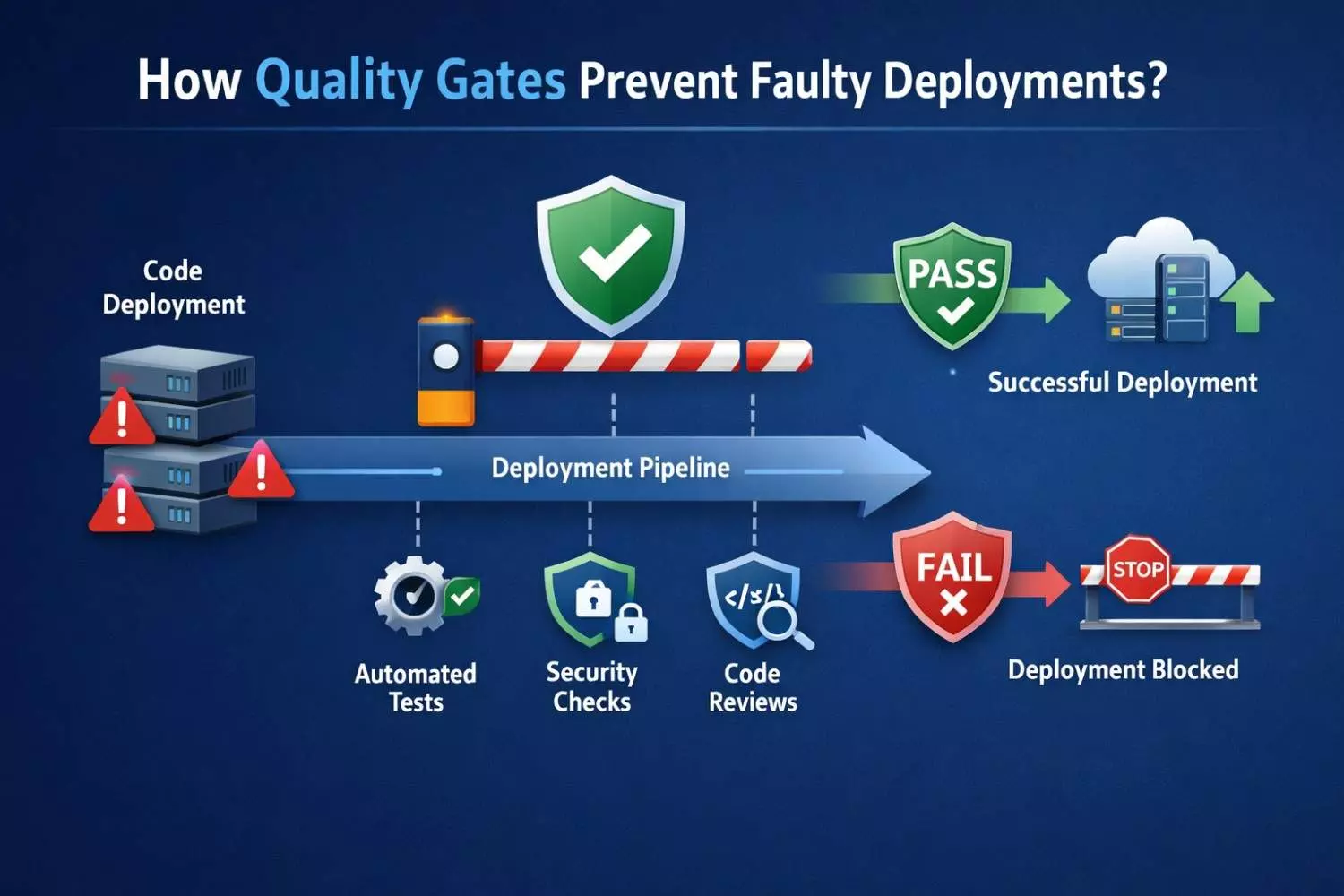
How Quality Gates Prevent Faulty Deployments?
Modern software teams release updates frequently using continuous integration and continuous delivery pipelines. While this rapid release cycle helps deliver features faster, it also increases the risk of deploying unstable or defective code.
Without proper validation mechanisms, even small changes can introduce serious issues into production systems.
This is where quality gates become essential. Quality gates act as automated checkpoints within CI/CD pipelines that ensure software meets predefined standards before it moves to the next stage of deployment.
By enforcing clear validation criteria, quality gates help prevent faulty builds from reaching production environments.
Understanding Quality Gates in Deployment Pipelines
Quality gates are automated rules that determine whether a build is ready to progress through a pipeline. These rules are based on measurable indicators such as test results, code quality metrics, security checks, and build success status.
If a build fails to meet the defined requirements, the pipeline stops automatically. Developers must address the issue before the code can move forward.
This structured validation process ensures that only stable and verified builds continue through the deployment pipeline.
Why Faulty Deployments Occur
Even well-designed applications can experience unexpected failures during releases. Several factors contribute to faulty deployments.
Common causes include:
- Incomplete or insufficient testing
- Integration issues between services
- Hidden bugs introduced by new features
- Configuration errors in deployment environments
- Poor visibility into system dependencies
When these issues are not detected early, they can lead to production failures that impact users and business operations.
Quality gates help identify these problems earlier in the development process.
How Quality Gates Stop Faulty Builds
Quality gates prevent faulty deployments by automatically validating software against defined quality standards. These checks occur at critical stages within the pipeline.
If a build fails any of these checks, the pipeline halts immediately. This prevents unstable code from progressing further in the release process.
Typical quality gate checks include:
- Automated test execution
- Code quality and maintainability analysis
- Security vulnerability scanning
- Performance threshold validation
- Build and dependency verification
These automated checks create a reliable safety net that protects production environments.
Integrating Testing into Quality Gates
Automated testing is one of the most important components of effective quality gates. Tests verify whether application functionality behaves as expected after code changes.
Different types of tests can be integrated into the pipeline, including:
- Unit tests for individual components
- Integration tests for service interactions
- API tests for backend functionality
- End-to-end tests for complete user workflows
When these tests fail, the quality gate prevents the build from moving forward. This ensures that defects are identified and resolved before deployment.
Improving Code Quality with Automated Validation
Quality gates also help maintain high code quality standards. Many pipelines include static code analysis tools that evaluate maintainability, complexity, and duplication.
These checks encourage developers to follow best practices when writing code. If code does not meet the defined quality standards, the build fails and must be corrected.
Over time, this process leads to cleaner codebases and more maintainable applications.
Reducing Deployment Risks
Deploying software always carries some level of risk. However, quality gates significantly reduce that risk by ensuring that every build passes through consistent validation checks.
By identifying problems early, teams avoid costly production incidents and emergency fixes. This proactive approach helps organizations maintain reliable systems even as release frequency increases.
Quality gates also provide confidence that new changes will not negatively affect existing features.
Supporting Faster and Safer Releases
Although quality gates introduce additional validation steps, they often help teams release software more efficiently.
When issues are detected earlier in the pipeline, they are typically easier and faster to fix. This reduces the likelihood of major failures that require extensive debugging later.
As a result, teams can maintain both speed and stability in their deployment processes.
Read: Code Coverage vs Code Quality: What the Numbers Don't .
Best Practices for Implementing Quality Gates
- To make quality gates effective, teams should design them around meaningful validation criteria.
- Some recommended practices include:
- Define clear quality thresholds that reflect the application’s reliability requirements.
- Integrate automated testing into CI/CD pipelines so validation runs consistently.
- Ensure developers receive immediate feedback when builds fail.
- Regularly review and update gate conditions as systems evolve.
- These practices help maintain a balance between strong quality control and efficient development workflows.
Conclusion
Frequent deployments are essential for modern software development, but they also increase the risk of releasing unstable code.
Without proper safeguards, even small changes can lead to serious production issues. Quality gates provide a structured way to prevent faulty deployments by enforcing automated validation throughout the CI/CD pipeline.
By verifying test results, code quality, and system stability, quality gates ensure that only reliable builds reach production. When implemented effectively, quality gates allow organizations to maintain rapid release cycles while protecting the stability and reliability of their software systems.