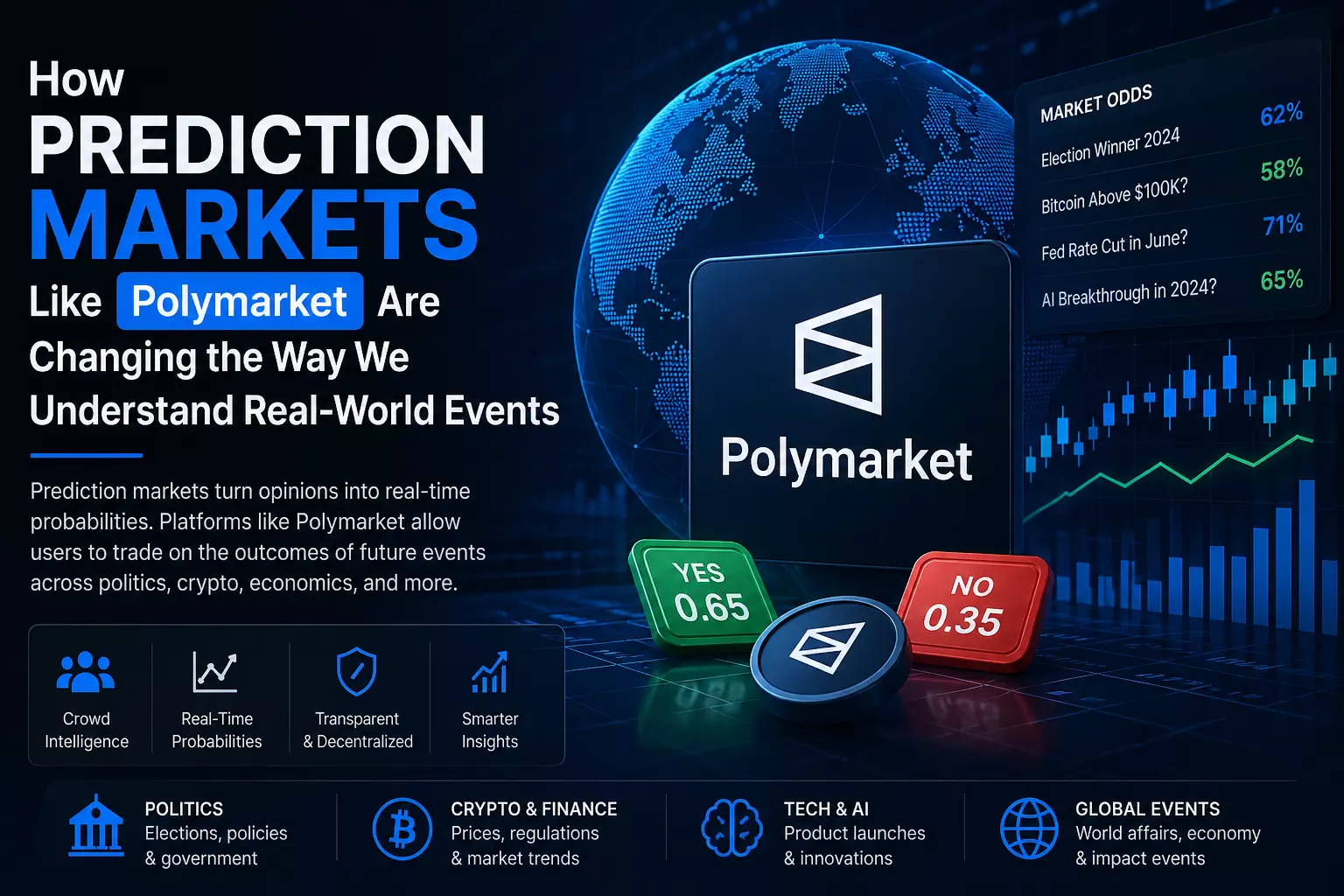
How Prediction Markets Like Polymarket Are Changing the Way We Understand Real-World Events
In recent years, prediction markets have emerged as a powerful tool for understanding real-world events.
Instead of relying only on polls or expert opinions, platforms like Polymarket allow users to trade on the outcomes of future events. This creates a unique system where market prices reflect collective expectations in real time.
Unlike traditional forecasting methods, prediction markets combine financial incentives with crowd intelligence, making them increasingly relevant in today’s fast-changing world.
What Are Prediction Markets?
Prediction markets are platforms where users can buy and sell shares based on the outcome of future events. Each market represents a question, such as:
- Will inflation drop below a certain level?
- Who will win an election?
- Will a major tech company release a product by a specific date?
If the event happens, the share pays out. If not, it becomes worthless.
This simple mechanism turns opinions into measurable probabilities.
How Polymarket Works?
Polymarket is one of the most well-known decentralized prediction market platforms. It operates using blockchain technology, allowing users to trade on real-world outcomes using crypto-based assets.
Key features include:
- Real-time pricing of probabilities
- Wide range of markets (politics, crypto, AI, economy)
- User-driven liquidity and sentiment
- Transparent blockchain settlement
The price of each market reflects what traders collectively believe is the probability of an event happening.
For example, if a market is trading at 0.65, it suggests a 65% chance of that outcome occurring.
Why Prediction Markets Are Becoming Popular
There are several reasons why prediction markets are gaining attention:
1. Faster Than Traditional Polls
Polling data often lags behind reality. Prediction markets update instantly based on new information.
2. Financial Incentives Improve Accuracy
Because users risk real money, they are more likely to make rational predictions instead of emotional guesses.
3. Aggregated Crowd Intelligence
Instead of relying on one expert, prediction markets combine thousands of opinions into a single probability.
4. Real-Time Sentiment Tracking
Markets react immediately to news, making them useful for tracking sentiment around global events.
Major Categories of Prediction Markets
Most prediction platforms cover several key areas:
1. Politics
Elections, government decisions, and policy outcomes are some of the most active markets.
2. Crypto and Finance
Traders predict Bitcoin prices, regulatory changes, and macroeconomic trends.
3. Technology & AI
Markets often focus on product launches, AI breakthroughs, and big tech announcements.
4. Global Events
From wars to economic shifts, prediction markets track high-impact global developments.
How Prediction Markets Are Used in Real Life
Prediction markets are no longer just experimental tools. They are being used for:
- News analysis and journalism
- Risk assessment in financial markets
- Research in behavioral economics
- Tracking public sentiment in real time
Many analysts now treat prediction market data as an additional signal alongside traditional data sources.
Read: How to Build a Kalshi Clone 10 Steps to Launch a Successful
Limitations of Prediction Markets
While powerful, prediction markets are not perfect:
- Liquidity can be low in niche markets
- Market manipulation is possible in small pools
- Regulatory uncertainty exists in some regions
- Outcomes depend on user participation
Despite these challenges, accuracy tends to improve as participation increases.
The Future of Prediction Markets
As blockchain adoption grows, prediction markets are likely to become more mainstream. Integration with news platforms, AI systems, and financial tools could turn them into a standard way of measuring expectations.
In the future, we may see prediction data used alongside traditional analytics in journalism, finance, and policy-making.
Conclusion
Prediction markets are changing how we interpret the world. By turning opinions into tradable probabilities, platforms like Polymarket offer a unique window into collective human expectations.
As adoption increases, these systems may become one of the most important tools for understanding uncertainty in global events.